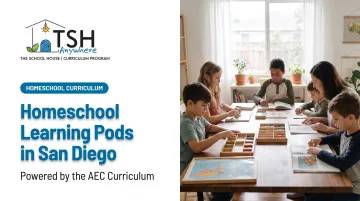
The appeal is obvious: small groups, personalized attention, and kids learning alongside peers instead of alone on a screen. The confusion is just as real. Parents keep asking the same questions: How much does this actually cost? Is it even legal in California? And is a pod realistic for a family earning a teacher's or nurse's salary, or are pods just for households with money to spare?
This guide covers what a learning pod actually is, the models San Diego families use, real cost ranges, hybrid alternatives, and the steps to start or join one.
Key Takeaways
- Expect small in-person groups of 3–10 same-grade students, led by a parent, tutor, or teacher
- Costs range from free parent-led swaps to $1,000+ per month per child for tutor- or teacher-led pods
- Equity is a genuine concern: pods can informally exclude working and essential-worker families
- Hybrid charter programs and affordable models like The School House offer structure without pod-level costs
What Is a Homeschool Learning Pod?
A homeschool learning pod is a small, consistent group of students (usually the same grade) who meet in person under one instructor. That instructor might be a rotating parent, a hired tutor, or a credentialed teacher. Pods can supplement an online or homeschool curriculum, or fully replace traditional schooling once a family meets California's home education requirements.
How Pods Started in San Diego
Pods trace back to spring 2020. Once San Diego Unified and other districts shut campuses and moved online, parents realized their kids needed structure a laptop alone couldn't provide. Local families started forming six-child pods, splitting the cost of a hired teacher or tutor to supervise coursework and add hands-on instruction.
The Legal Basics
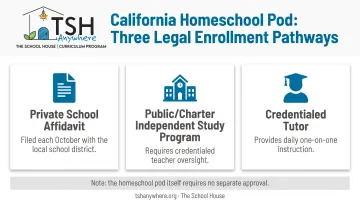
A pod itself isn't a distinct legal category in California. The instructional setting is separate from how each child is officially enrolled. Most families operate under one of these routes:
- Filing a private school affidavit (PSA), which lets a family run as a private homeschool with its own curriculum
- Enrolling in a public or charter independent study program supervised by a credentialed teacher
- Hiring a credentialed tutor to provide daily instruction
The California Department of Education's private school affidavit filing process runs each October 1-15, though the online system stays open year-round for late filers. The pod doesn't need separate approval. What matters legally is each child's individual enrollment status.
Pods Outlasted the Pandemic
What started as an emergency workaround stuck around. Families liked smaller groups, flexible schedules, and a built-in peer community enough to keep pods running long after campuses reopened.
Families comparing options usually stack pods against two related models:
- Pods: informal groups, often built around a single school year
- Microschools: more structured programs with dedicated staff and a set curriculum that continues year after year
- Co-ops: a middle ground, with regular classes parents may or may not teach
Types of Learning Pods in San Diego
Not all pods look the same. The model a family chooses usually comes down to budget, available time, and how much academic structure the kids need.
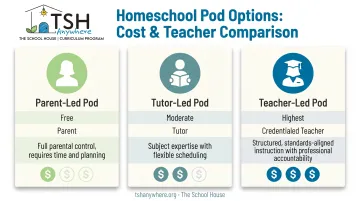
Parent-Led Pods
Parents split teaching duties by subject and rotate hosting. One handles math and science, another reading and writing, another art and PE. It's the most affordable structure since no one gets paid. Families trade time instead of money.
Setup tips that actually work:
- Notify your school or charter if your child remains enrolled elsewhere
- Keep the group small (3-6 kids) and grade-level appropriate
- Designate a consistent learning space, even if it rotates between homes
- Build a set weekly schedule so parents can plan around their teaching days
Tutor-Led Pods
Here, families pool funds to hire one tutor for the group. Before signing anyone on, vet for:
- Subject-specific training relevant to what the pod actually needs
- Familiarity with California's academic standards
- A track record addressing your child's specific learning gaps, not just general subject knowledge
For pods with kids in early elementary grades, prioritize a tutor with reading specialist training. Early literacy gaps compound fast, and a generalist may not catch them in time.
Teacher-Led Pods
Some San Diego families hire credentialed teachers for "specials" (art, music, PE, or enrichment) on top of core academics. It's the most polished model, and the one educators flag most often for cost and access problems.
A credentialed teacher commands a higher rate than a tutor or rotating parent. Splitting that cost across six families can still price out anyone without significant disposable income.
A real-world example: A typical teacher-led pod might meet four days a week, three hours a day. Mornings cover core academics; afternoons rotate between science projects, art, and outdoor time at a local park or a spot like Balboa Park's Fleet Science Center. Families split the teacher's pay, supplies, and any admission fees.
How Much Does a Learning Pod Cost in San Diego?
Pod costs span an enormous range, depending entirely on who's teaching and how many families split the bill.
Parent-led pods can cost nothing beyond shared supplies, since parents trade teaching time instead of paying a salary. Tutor- or teacher-led pods run well into four figures per child, per month.
The most commonly cited local benchmark dates to 2020, when the San Diego Union-Tribune reported that families forming six-child pods were paying more than $1,000 per month per child once teacher pay and supplies were included.
That figure is several years old, but it remains the clearest local number available. Current pricing likely sits at or above it.
What Drives the Cost
- Educator pay split across families — a credentialed teacher costs more than a tutor, who costs more than a rotating parent
- Pod size — smaller pods mean a higher per-child share of the same fixed cost
- Curriculum and supplies — workbooks, art materials, science kits
- Host-home logistics — utilities, cleaning, and wear on whichever home hosts most often
Easy-to-miss extras add up fast:
- Field trip admission for museums, parks, and science centers
- Replacement materials and consumable supplies
- Liability coverage if a child is hurt at a host family's home
How Pods Compare
| Option | Typical Cost |
|---|---|
| Parent-led pod | Free to low-cost (shared supplies only) |
| Tutor/teacher-led pod (6 children) | $1,000+/month per child (2020 benchmark) |
| Private tutor, hourly | Roughly $29/hour and up |
| San Diego private school tuition | Averages around $18,000+/year |
Against private school tuition, even a pricier pod can look reasonable—especially if it replaces both tuition and childcare. Stacked next to a free hybrid charter program, though, a tutor-led pod is still a significant added expense.
Cutting Pod Costs
- Rotate parent teaching instead of hiring a tutor for every subject
- Recruit more families to spread tutor or teacher pay across a larger group
- Ask about sliding-scale pricing for larger, longer-term commitments
Hybrid Homeschool Programs & Affordable Alternatives in San Diego
San Diego families don't have to choose between full-cost private school and a pricey tutor-led pod. Hybrid programs blend in-person class days with independent study at home, often at no cost through public charter funding.
Charter and Hybrid Options in San Diego County
| Provider | Structure |
|---|---|
| Coastal Academy (Oceanside) | Tuition-free TK-8 charter; K-6 students attend campus two days a week, home-study three days |
| Dimensions Collaborative | Tuition-free TK-12 charter; up to three days weekly at staffed learning centers, plus virtual options |
| The Learning Choice Academy | Public charter offering full home study or a three-days-on, two-days-off hybrid schedule |
| Many families pair a tuition-free charter enrollment with a private pod — using the charter's curriculum and funding for core academics, and the pod for social time, enrichment, and hands-on projects. |
A Lower-Cost Curriculum Option from The School House
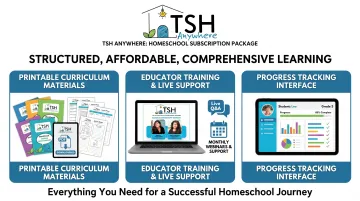
For families who want more structure than a pod but can't stomach premium tutor rates, The School House offers another path. Based on Long Island, NY, it built the American Emergent Curriculum (AEC) for families anywhere through its TSH Anywhere homeschool subscription. The subscription runs $125 a month or $1,200 a year per learner and includes:
- AEC curriculum
- 400+ educator training films
- Printable materials
- Live weekly educator support
- Progress tracking That pricing is a fraction of what a tutor-led San Diego pod typically costs per child. The curriculum draws on a decade of pedagogical research and six years of live classroom testing, and students using it have reportedly tested at least twice above the national average. Groups of San Diego families who want something more community-based can also explore TSH Anywhere's school-building partnership. A small group can stand up a pod-like microschool on the same curriculum for a shared support fee instead of an hourly tutor rate.
Other Alternatives to Compare
- Microschools: small, multi-family programs with dedicated staff; national data pegs average operating costs around $8,200 per student per year
- Forest schools: nature-based, learner-centered programs held mostly outdoors, with costs that vary by provider
- Homeschool co-ops: parent-organized groups offering regular classes, often at low or no cost since parents share teaching duties
Weighing the Pros, Cons & How to Start or Join a Pod
Benefits and Drawbacks to Consider
Pods offer real advantages, but they come with tradeoffs.
What works well:
- Personalized attention in a group small enough for every kid to be seen
- Meaningful small-group socialization instead of isolated screen time
- Scheduling flexibility around work and family life
- Hands-on learning using San Diego's parks, museums, and beaches as an extended classroom
What to watch for:
A nationwide CRPE study of pandemic-era pods found the average pod family paid $306 a week, putting pods out of reach for many working households.
The same research found participants skewed toward white, well-educated, economically advantaged families, and warned that pods can reinforce neighborhood and socioeconomic segregation.
Other common drawbacks:
- Inconsistent screening of pod leaders, since parent-organized groups have no formal vetting requirement
- Uneven quality, especially for kids with learning differences who need trained support
Cost and quality gaps are why some families pair a pod with a structured curriculum instead of a premium tutor. The School House's AEC model, for example, supplies sequenced materials and parent support at a fraction of tutor-led pod rates.
Steps to Start or Find a Pod in San Diego
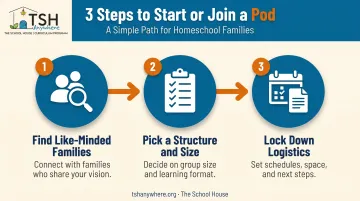
- Find like-minded families. Start with your child's school community, local parent groups on Facebook or Nextdoor, or an existing homeschool co-op network.
- Pick a structure and size. Decide between parent-, tutor-, or teacher-led, and aim for roughly 3-10 same-grade students — small enough to stay personal, big enough to split costs.
- Lock down logistics. Set a weekly schedule and rotating host homes, put cost-sharing in writing, and confirm each child's enrollment meets California filing rules if the pod replaces traditional school.
Frequently Asked Questions
How much does a learning pod cost in San Diego?
Costs range from free for parent-led rotation models to $1,000 or more per month per child for tutor- or teacher-led pods, based on a 2020 local benchmark. The exact price depends on group size and who's teaching.
Is there a hybrid homeschool program available in San Diego?
Yes. Options include tuition-free charters like Coastal Academy and Dimensions Collaborative, plus umbrella and hybrid academies. Many families pair one of these with a private pod for social time.
Are homeschool learning pods legal in California?
Pods aren't a separate legal category — what matters is each child's enrollment status. Most operate under a private school affidavit or alongside public/charter enrollment, so check current requirements with the state before starting one.
What age groups do learning pods typically serve?
Pods can serve any grade, but they're most common in elementary and middle school. Most group same-grade cohorts of 3 to 10 students together.
How do I find a learning pod near me in San Diego?
Start with your school's parent community, local Facebook or Nextdoor groups, and homeschool co-op directories. Word of mouth through other homeschooling families is often the fastest route.
What's the difference between a learning pod and a microschool?
Pods tend to be informal, short-term groups organized by a handful of families. Microschools are typically ongoing programs with dedicated staff and a set curriculum, run year after year.