The trouble is, most parents find hundreds of "Montessori activities" scattered across Pinterest and blogs, with no clear sense of how those pieces fit into an actual kindergarten-year curriculum. A sandpaper letter here, a pouring exercise there — but where's the structure?
This guide walks through the philosophy behind Montessori kindergarten, the core subject areas, how to build a workable daily rhythm at home, and how the whole approach stacks up against a traditional kindergarten classroom.
Key Takeaways
- Montessori kindergarten is the third and final year of the 3-6 primary cycle — a mastery year, not a year of new content.
- The curriculum centers on five to six core areas, from Practical Life to Math and Culture.
- A prepared environment with child-led choice matters more than any workbook.
- Progress is tracked through observation, not grades or standardized tests.
What Makes Montessori Kindergarten Different from Traditional Kindergarten?
Traditional kindergarten typically groups children by a single age, follows a teacher-led lesson plan, and moves the whole class through the same material on the same day. Montessori flips that model.
The American Montessori Society defines Early Childhood as a mixed-age span from 2.5 to 6 years old, structured as one continuous three-year sequence rather than isolated grade levels. A 5-year-old in a Montessori setting works alongside 3- and 4-year-olds, choosing hands-on materials at their own pace instead of following a single scripted lesson.
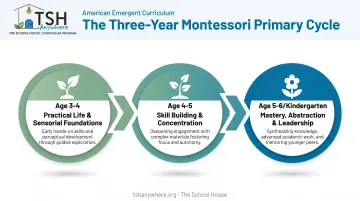
The Three-Year Cycle, Explained
In Montessori, kindergarten is the payoff year, not a fresh start. Children who spent their first two years in the primary cycle absorbing practical life skills and sensorial refinement spend their kindergarten year:
- Consolidating and deepening prior lessons
- Moving from concrete materials toward abstract understanding
- Mentoring younger siblings or peers when the setting is mixed-age, which reinforces their own learning
- Building the confidence that comes with being the "oldest" in the room
Does Montessori Actually Prepare Kids for Kindergarten?
Yes. This is where the model earns its reputation. Two years of practical life work (dressing frames, pouring, food prep) build the fine motor control and focus a child needs before ever touching a pencil. Sensorial materials train classification and order, skills that underpin both reading and math readiness.
By the time a child in a Montessori program reaches the kindergarten year, they've already built the attention span and independence that traditional kindergarten expects on day one. Homeschool families can follow the same continuum: keep practical life and sensorial work at the center for the early years, then use the kindergarten year to deepen abstraction, leadership, and confidence at the child's pace.
Core Montessori Principles That Guide the Kindergarten Year
Two ideas hold the whole approach together: freedom within limits, and the adult as guide rather than director.
Freedom within limits means a child chooses their own work, but that choice operates inside firm community expectations — care for materials, respect for others, and cleanup after use. It's not a free-for-all. A 5-year-old can pick sandpaper letters over math beads on a given morning, but they can't skip putting materials back where they belong.
The parent or teacher's role shifts with that structure. Rather than lecturing from the front, the adult:
- Observes what the child is ready for
- Prepares the environment with the right next material
- Presents new lessons individually or in small groups
- Steps back and lets the child work
What the Research Actually Shows
Skepticism about Montessori's academic rigor is common. A 2025 national randomized controlled trial followed 588 children across 24 public Montessori schools. At the end of kindergarten, researchers found meaningful advantages for Montessori students in letter-word identification, executive function, digit span, and theory of mind, with effect sizes between 0.22 and 0.30.
Not every measure showed a gap — vocabulary and social problem-solving came out roughly even. One caveat: only about 49% of the treatment group was still in a Montessori school by kindergarten, so the results likely undersell the model when families stick with it consistently.
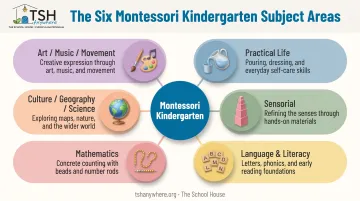
The Six Core Subject Areas of a Montessori Kindergarten Curriculum
Montessori doesn't separate "academics" from "life skills." All six areas below work together to build focus, coordination, and reasoning at once, not just to check subject boxes.
Practical Life
This is where independence gets built. Pouring water between pitchers, using dressing frames with buttons and zippers, food prep like slicing a banana with a child-safe knife: these aren't busywork. They train the fine motor control, sequencing, and concentration that everything else depends on.
At home, practical life can lean on real household objects: your own kitchen tools, real dishes instead of plastic, actual laundry to fold.
Sensorial
Materials like the Pink Tower (ten cubes ranging from 1 cm³ to 1,000 cm³), sound cylinders, and color tablets isolate one sensory quality at a time (size, sound, or color) so a child learns to classify and order the world. That training is the groundwork for later math (place value) and language (categorization).
Language & Early Literacy
The progression is deliberate:
- Sandpaper letters: tracing rough letter shapes builds the muscle memory for handwriting while linking sound to symbol
- Movable alphabet: children build words phonetically before they can write them by hand
- Independent reading and writing: by the end of kindergarten, most children read simple books and write short sentences
Mathematics
Concrete materials come before anything on paper. Golden beads represent units, tens, hundreds, and thousands physically, so a child can see place value rather than memorize it. Number rods link quantity to numeral. Only after this concrete stage does math move toward abstract, paper-based work.
Culture (Geography, Science & History)
Puzzle maps of the continents, land-and-water form trays, simple plant and animal studies, and basic experiments introduce children to the wider world. This area rotates the most. Seasonal and thematic units belong here.
Art, Music & Movement
Creative expression runs through cultural studies rather than sitting in its own silo. Daily outdoor or movement time is treated as essential, not extra. Metal insets (geometric stencils used for drawing) double as fine motor practice and early art work.
How to Structure a Montessori Kindergarten Curriculum at Home
Building this at home comes down to four things: environment, materials, rhythm, and tracking progress.
Set Up a Prepared Environment
Low, open shelving organized by the six subject areas above lets a child choose work independently, with no asking permission and no adult fetching materials. Keep it simple:
- One shelf section per subject area
- Materials displayed left-to-right, simple-to-complex
- Only a handful of activities out at once (rotate the rest)
Sourcing Materials Without Overspending
A full classroom material set from a specialty retailer can run from roughly $175 for a small homeschool bundle to well over $1,700–$25,000 for classroom-scale packages. Those numbers make sense for a school, not a household of one child.
You don't need any of that:
- DIY sensorial materials (color swatches, homemade sound cylinders) work just as well for a single learner
- Secondhand marketplaces and Montessori homeschool groups often carry gently used sets
- Household objects cover most practical life work for free
The Daily Work Cycle
Montessori guidance points to roughly a 2.5- to 3-hour uninterrupted block where the child selects and completes work at their own pace (this isn't a rigid rule). Some days it's shorter; some days longer. The point is no adult-imposed interruptions in the middle.
Rotate Themes, Keep Core Threads Constant
Keep practical life and math on the shelves every day so core skills stay warm. Refresh interest with monthly or seasonal culture units — a country, a season, or an animal group — so the environment doesn't go stale. Language, sensorial, and science materials can rotate with those units without disrupting the daily threads.
Tracking Progress Without Grades
Skip the worksheets and grade book. Instead:
- Keep a simple observation notebook: what a child chose, how long they focused, what they mastered
- Use a checklist per subject area to flag when a skill is "introduced," "practicing," or "mastered"
- Introduce a new lesson only once the current one shows consistent, confident repetition
Montessori Homeschool vs. Traditional Kindergarten at Home
Side by side, the differences between a Montessori homeschool approach and a traditional kindergarten curriculum at home stand out clearly.
| Factor | Montessori Homeschool | Traditional Kindergarten at Home |
|---|---|---|
| Grouping/pacing | Mixed-age model, self-paced | Fixed grade-level, set weekly benchmarks |
| Success measure | Narrative observation, mastery-based | Standardized checkpoints, workbook completion |
| Materials | Hands-on, self-correcting manipulatives | Worksheets, workbooks, digital lessons |
Neither model sits at one extreme. NAEYC's own kindergarten guidance supports observation-based assessment too, including running records, anecdotal notes, and portfolios, alongside any state-mandated testing.
The real difference is emphasis: Montessori treats observation as the primary tool, while conventional programs often layer it on top of formal tests.
Is Montessori Homeschool Kindergarten Right for Your Family?
Before committing, get honest about what this actually asks of you.
The Time Commitment
Running a Montessori-style kindergarten at home isn't a drop-off situation. You're the prepared environment's architect and the observer-in-chief. A sustainable rhythm usually means:
- Blocking the same 2-3 hour window daily, even if content varies
- Prepping materials the night before or on weekends
- Accepting that some days will look messier than the plan
Solving the Socialization Question
This is the most common hesitation, and it's a fair one. A single child at home doesn't get the built-in mixed-age peer group of a classroom. Practical fixes:
- Join a local Montessori-aligned homeschool co-op
- Add a weekly nature group or forest school session
- Enroll part-time in an enrichment program for social contact without full enrollment
When Full Homeschooling Isn't the Right Fit
Some families want the philosophy — mixed-age learning, hands-on materials, observation over testing — without carrying the entire daily teaching load themselves. That's a legitimate trade-off to consider.
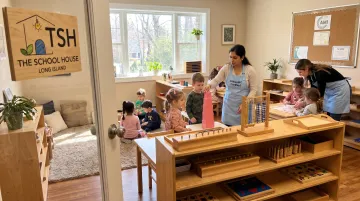
The School House applies this thinking at a brick-and-mortar level. Its flagship Long Island, NY location is staffed by AMI- and NAMC-certified Montessori educators, several with 14 to 20+ years of classroom experience.
The curriculum draws on roughly a decade of pedagogical research and more than six years of live classroom testing. New school-building partner locations are planned in Maine and Florida.
For a hybrid path, TSH Anywhere's homeschool curriculum subscription ($125/month or $1,200/year) delivers the same American Emergent Curriculum framework with printables and training films. Parents get structured support instead of building everything from scratch.
Frequently Asked Questions
How is Montessori different from kindergarten?
Montessori is self-paced, mixed-age (3-6), and built around hands-on materials a child chooses independently. Traditional kindergarten groups children by a single age and follows a teacher-led, standardized schedule.
Does Montessori prepare kids for kindergarten?
Yes. The practical life and sensorial work done in the first two years typically builds the focus, fine motor skills, and independence that meet or exceed standard kindergarten readiness expectations.
What is the best age to start a Montessori kindergarten curriculum at home?
Most children begin around age 5-6, but ideally they've already completed one to two years in the Montessori primary cycle. Starting fresh at kindergarten still works, just with a steeper initial adjustment.
Do I need official Montessori materials to homeschool the kindergarten curriculum?
No. DIY versions and secondhand sets can substitute effectively for costly branded materials, especially for sensorial and practical life work, which rely on real household objects anyway.
How many hours a day should Montessori kindergarten homeschooling take?
A focused work cycle of roughly 2-3 hours is typical, supplemented with outdoor time and creative or movement activities later in the day.
Can a Montessori homeschool kindergarten curriculum meet state education requirements?
It can, but requirements vary significantly by state. Check your local homeschool regulations directly and keep whatever attendance, instructional, or portfolio documentation your jurisdiction requires.