Introduction
Walk into any preschool open house today and you'll hear it within the first five minutes: "We're a play-based program." It sounds warm, modern, even a little progressive.
But ask three different schools what that actually means, and you'll likely get three different answers. Parents and community leaders often struggle to tell real play-based learning from marketing language.
Many assume play-based means no structure, no academics, just kids running around. That's a costly misunderstanding. Quality play-based learning is deliberately designed and academically rigorous. It is grounded in developmental research — it just looks different from a worksheet-heavy classroom.
This guide breaks down what play-based learning actually is, the five elements that separate real play from mere free time, the research on its benefits, and what to look for when evaluating a curriculum for your child or community.
Key Takeaways
- Quality play-based learning blends free play, guided play, and structured games, with teachers facilitating rather than directing
- True play meets five conditions: it is self-chosen, enjoyable, unstructured, process-oriented, and imaginative
- Research from the AAP and NAEYC links play to stronger cognitive, social-emotional, physical, and language outcomes
- The strongest curricula pair playful exploration with intentional, science-based structure, the model The School House was built around
What Is Play-Based Learning in Preschool?
According to NAEYC's framework, play-based learning spans a continuum of approaches. Children learn through:
- Self-directed free play with no adult agenda
- Guided play, where a teacher shapes the environment but the child leads
- Structured games with rules
- Playful instruction and, occasionally, direct instruction
The shift is in the teacher's role. Instead of standing at the front delivering information, the teacher moves alongside the child, asking questions, offering materials, and observing. The child becomes an active participant in their own learning.
Free Play vs. Guided Play: Finding the Balance
Free play is fully child-directed. There's no adult-set objective. A child picks up blocks and builds whatever comes to mind, for as long as interest holds.
Guided play is the middle ground. An adult sets up a learning-rich environment (for example, a shape-sorting station), but the child still chooses how to engage with it.
In a study published in Child Development, researchers followed 70 children ages 4–5 as they learned about geometric shapes through one of three methods: guided play, free play, or direct instruction. The guided-play group showed stronger shape knowledge than both other groups, and the advantage held up a full week later.
That's why most quality curricula don't pick one extreme. They blend both, using guided play to nudge specific skills while still protecting the child's sense of choice.
Common Types of Play Found in a Preschool Curriculum
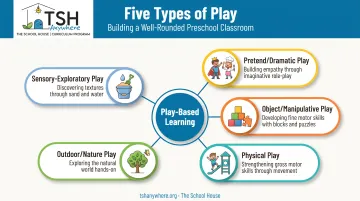
A well-rounded classroom rotates deliberately through several play categories, each targeting different developmental domains:
- Pretend/dramatic play — role-play, make-believe scenarios
- Object/manipulative play — blocks, puzzles, sorting materials
- Physical play — climbing, running, balance activities
- Outdoor/nature play — unstructured time outside in all seasons
- Sensory-exploratory play — sand, water, textured materials
None of this happens by accident in a strong program. Teachers intentionally cycle through these types across the week so no single developmental domain gets neglected.
The 5 Key Elements of Play-Based Learning
Not all unstructured time counts as real play. Researchers point to five specific characteristics that must be present for play to actually support development.
Self-Chosen and Self-Directed
The child controls what they engage in, how long, and under what self-made "rules." Teachers offer options (a shelf of activities, a set of stations) rather than mandates.
Enjoyable and Intrinsically Motivated
The activity has to be chosen because it's fun. The moment a sticker chart or grade enters the picture, it stops being play in the developmental sense and becomes a task.
Unstructured and Process-Oriented
There's no fixed end goal. A child building a tower that collapses ten times isn't failing. The exploration, including the mistakes, is where the learning actually happens.
Imaginative
Pretend and make-believe scenarios let children step outside the real world. A child "becoming" a doctor or a dragon is doing real cognitive work: building creativity, empathy, and social-emotional skill through the role itself.
Actively Engaging
Children are physically and mentally involved, not watching from the sidelines. Hands-on exploration (stacking, sorting, negotiating roles, testing ideas) is what turns play into lasting learning.
Together, these five traits separate true play-based learning from busywork dressed up as free time. When all five are present, preschoolers practice focus, problem-solving, and social skill without needing a worksheet to prove it.
Benefits of a Play-Based Preschool Curriculum
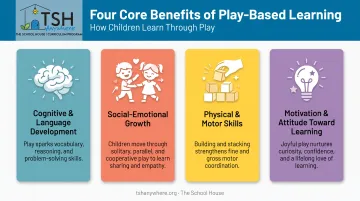
Cognitive and Language Development
Play builds executive functioning: attention, self-control, and flexible problem-solving. The American Academy of Pediatrics links play directly to working memory, inhibitory control, and cognitive flexibility.
Peer play also drives language growth. Negotiating rules with another child ("no, you have to be the customer first") pulls out more sophisticated language than passive listening.
Social-Emotional Growth
Through play, children practice turn-taking, empathy, and how to repair conflict. Mildred Parten's classic stages describe how that social play matures:
- Solitary play — playing alone, common in younger toddlers
- Parallel play — playing near peers without much interaction
- Cooperative play — actively playing together toward a shared goal
A quality classroom doesn't force a 3-year-old into cooperative play before they're ready. It scaffolds the transition.
Physical and Motor Skill Development
Blocks, painting, and outdoor games strengthen both fine and gross motor skills. Fine motor work (pouring, cutting, drawing) prepares children for later tasks like holding a pencil and writing legibly.
Motivation and Attitude Toward Learning
Self-chosen, low-stress play builds intrinsic motivation and confidence. When preschool years feel like genuine discovery rather than drills, children carry that curiosity into later schooling.
Play-Based vs. Traditional Preschool Curriculum: What's Best for Preschoolers?
Traditional academic preschool models lean teacher-led: worksheets, seat time, and direct instruction dominate the day. Play-based models flip that. Child-led exploration takes center stage, with the teacher setting up opportunities rather than delivering lectures.
So which wins? Neither, on its own. NAEYC and the AAP both point to a blended approach as what actually supports children best: playful learning intentionally designed around science-based developmental goals.
Pure unstructured free time with zero adult scaffolding leaves learning goals unmet. Pure worksheet-based instruction crowds out the choice and joy that make play effective in the first place.
Parents often worry this means their child will fall behind before kindergarten. In practice, the opposite tends to hold. Children coming out of strong play-based programs typically arrive with:
- Well-developed self-regulation
- Stronger problem-solving instincts
- More advanced social skills, from sharing to conflict resolution
These are exactly the skills kindergarten teachers say matter most in September, often more than knowing letters or numbers on day one.
What to Look for in a Quality Play-Based Preschool Curriculum
Not every program calling itself "play-based" delivers the real thing. Use this checklist when evaluating one:
- Grounded in child-development science. The curriculum should be built on current research, not unsupervised free time relabeled as "play-based."
- Teachers trained in open-ended questioning. Staff should guide through questions ("What do you think will happen if...?") rather than direct instruction.
- Protected, uninterrupted play blocks. The daily schedule should give play enough time to deepen, so activities aren't cut short right as they become meaningful.
- Observation-based assessment. Progress is tracked through real skill growth over time, not worksheets.
One school built around this model is The School House, founded in 2017 on Long Island, NY. Its American Emergent Curriculum blends structured work, project-based learning, and an Art, Nature & Design Studio in a classroom culture that is child-driven yet still structured.
Staff hold AMI or NAMC Montessori credentials, several with 14–20+ years of experience. The curriculum draws on a decade of research plus more than six years of live classroom validation.
The result: learners there consistently test at least twice the national average across subjects — without academic screening for admission. The broader aim is to make this kind of play-based education affordable and replicable so working families and communities nationwide can access it, not only families near the flagship campus.
Frequently Asked Questions
What is play-based learning in preschool?
It's a teaching approach using free play, guided play, and structured games to help children learn through exploration rather than direct instruction. NAEYC frames it as a continuum, not a single fixed method.
What are the 5 elements of play-based learning?
Genuine play is self-chosen, enjoyable, unstructured, process-oriented, and imaginative. Without all five, an activity stops functioning as developmentally meaningful play.
What type of curriculum is best for preschoolers?
Research consistently supports a blended model — playful exploration paired with intentional, science-based structure — over either pure free play or pure direct instruction alone.
Is my child still learning if they're just playing?
Yes, when the play is well-designed. Teachers build purposeful activities into play and use observation-based assessment, not worksheets, to track real skill growth.
What age is play-based learning appropriate for?
Play-based learning is most emphasized for ages 2–5, aligning with recognized developmental stages of play, though its underlying principles extend through early elementary years.
Will play-based learning prepare my child for kindergarten?
Children from strong play-based programs typically show solid self-regulation, curiosity, and problem-solving skills — the traits kindergarten teachers consistently point to as true readiness markers.