That gap leaves a lot of new homeschool parents second-guessing themselves. Without a state checklist, textbook mandate, or scope-and-sequence, it's easy to wonder if you're "doing it wrong."
You're not. This guide breaks down the legal basis for the good citizenship requirement, what it really covers, how to teach it at different ages, and how to document it so you can stop worrying and start teaching.
Key Takeaways
- Texas requires a "study of good citizenship" but leaves curriculum design entirely to parents
- Good citizenship covers three areas: civic knowledge, personal responsibility, and community engagement
- No grading, testing, or state reporting is required; an activity log is enough
- Community service, field trips, and current-events discussions all count as instruction
Understanding Texas's Legal Requirement for Good Citizenship
Texas homeschools operate as private schools, not as a separate legal category. This comes from Texas Education Agency v. Leeper, 893 S.W.2d 432 (Tex. 1994), a Texas Supreme Court decision that resolved a class-action dispute over compulsory attendance law.
The court held that children taught at home in a bona fide manner (good faith, not a sham) qualify for the same private-school exemption as any other private institution. The curriculum must cover five basic goals: reading, spelling, grammar, mathematics, and a study of good citizenship.
What "Bona Fide" Actually Requires
The court's own language on curriculum format is more flexible than most parents expect. Acceptable materials include:
- Books, workbooks, or printed materials
- Content displayed on a computer or video screen
- Any combination of the above, developed or purchased from any source
There's no approved vendor list. There's no required textbook. If you're using it in good faith to teach the five subjects, it counts.
The Statement of Assurance — When You'd Actually Need One
If a school district contacts your family asking where your child is enrolled, you can respond with a Texas Statement of Assurance: a letter confirming the child is homeschooled and that your curriculum covers the five Leeper subjects.
This isn't an annual filing. HSLDA's current guidance notes it's typically only used when a district makes an inquiry, not as routine paperwork. TEA has confirmed it doesn't register, monitor, or accredit homeschool programs at all. Outside of a rare district inquiry, this requirement stays dormant for most families.
What Does "Good Citizenship" Actually Mean in a Texas Homeschool?
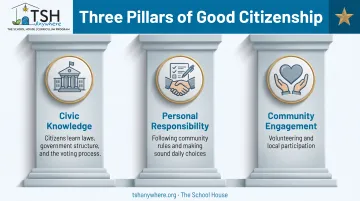
Since the law offers no definition, it helps to think of good citizenship as three overlapping pillars rather than one subject with a fixed syllabus.
Three Pillars of Good Citizenship
- Civic knowledge — how government works, basic laws, the electoral process, and the structure of local and state institutions
- Personal responsibility — following community rules, respecting others, caring for shared spaces, and understanding cause and effect in daily choices
- Community engagement — volunteering, service projects, and active participation in local life
Younger kids can absorb these ideas through everyday habits: recycling, returning library books on time, learning traffic and pedestrian safety rules. Older students move into heavier territory: how taxes work, how a bill becomes law, how to evaluate media bias, and eventually, registering to vote.
Families who lean toward unschooling in Texas often teach this subject almost entirely through lived experience: a trip to the county courthouse, a conversation about a local ballot measure, a season of volunteering at a food pantry. That counts. There's no rule saying citizenship has to come from a textbook chapter.
Why Intentional Citizenship Education Matters
This isn't just a homeschool paperwork exercise. National data suggests civic knowledge is slipping. The 2022 NAEP civics assessment showed the average eighth-grade score dropped 2 points from 2018 (the first documented decline for that test), with the share of students scoring below "Basic" rising 3 percentage points.
Traditional schools also tend to skip the practical stuff. CIRCLE's 2023 research found only 69% of politically interested teens had access to a government or institutions course, and just 52% of college-enrolled young adults said they'd actually learned how and where to register to vote.
That's a real gap, and one homeschool families are positioned to close by teaching these things on purpose instead of assuming a school covered them along the way.
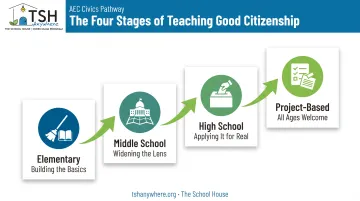
How to Teach Good Citizenship: Age-Tiered Activities and Ideas
Good citizenship doesn't need a separate hour on the schedule. It layers naturally into history, reading, and daily life once you know what to look for.
Elementary: Building the Basics
- Organize a neighborhood or park clean-up project
- Practice library etiquette and the return process
- Learn local traffic signs and pedestrian safety rules
- Read picture books about community helpers and local government
Middle School: Widening the Lens
- Map out local and state government structure: who does what, and where the power sits
- Discuss current events weekly, including how the same story gets covered differently across outlets
- Visit a historical site or state park tied to Texas history
High School: Applying It for Real
- Register to vote as soon as eligible (17 years and 10 months to apply, 18 by Election Day)
- Attend a city council or school board meeting in person
- Run through a basic tax-filing simulation
- Study how a bill becomes law using an actual current bill from the Texas Legislature
Project-Based Options Across Ages
- Hold a mock election at home, complete with campaign posters and a ballot
- Keep a volunteer service log tracking hours and organizations
- Write a letter to a state representative about a real issue
Tucking these into history and reading time keeps the schedule sane. A unit on the Texas Revolution pairs naturally with a discussion on civic duty. A current-events article doubles as a media literacy lesson.
Choosing Curriculum and Resources for Good Citizenship
Most Texas families cover good citizenship through one of a few standard resource types:
- Civics-focused workbooks or unit studies
- Community service trackers or volunteer logs
- Online curriculum providers that build citizenship into broader lesson plans
If you'd rather not bolt citizenship onto your existing curriculum as an extra task, look for a program that already treats it as part of the core design.
The School House's American Emergent Curriculum, delivered through TSH Anywhere, names civics as one of six foundational values woven across every subject. It shows up inside reading, history, and even math lessons instead of sitting in its own workbook.
Key details on AEC and TSH Anywhere:
- Runs Pre-K through 8th grade at $125/month or $1,200/year per learner
- Secular design that works for families of any background
- Includes 400+ training films, printables, and a free samples page to preview lessons
- Civics work supported by a $2.3 million U.S. Department of Education grant with Long Island University
Because AEC ends at 8th grade, high schoolers still need outside resources for procedural topics such as taxes, voting, and the legislative process. Texas-specific tools fill that gap well:
- VoteTexas.gov for registration and eligibility rules
- Texas Parks & Wildlife historical site listings for field trips that double as living history
Compliance Tips and Common Mistakes to Avoid
The biggest compliance mistake is assuming good citizenship must look like a public school class. Texas does not require that format.
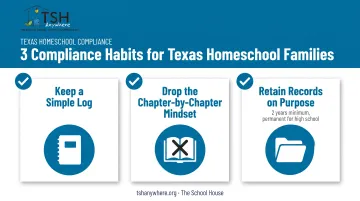
Practical habits that keep you covered:
- Keep a simple log. Note dates, activities, readings, and field trips in your homeschool portfolio. You won't submit it to the state, but it helps if a truancy or enrollment question ever comes up.
- Drop the chapter-by-chapter mindset. No scope or sequence is required. Volunteering, local government visits, and current-events discussions satisfy the requirement as well as a formal textbook.
- Retain records on purpose. HSLDA advises keeping work samples, attendance, and curriculum notes for at least two years—and permanently for high school. That file is how you show the program was bona fide if anyone asks.
Frequently Asked Questions
What curriculum is best for Texas homeschoolers?
There's no single required curriculum. Families can choose any written program — textbook, online, or unit study — as long as it covers the five Leeper subjects, including good citizenship.
What is good citizenship in homeschool in Texas?
It's an undefined but legally required subject generally covering civic knowledge, personal responsibility, and community engagement. Texas leaves the specific content entirely to parental discretion.
Is good citizenship a graded subject in a Texas homeschool?
No. Texas doesn't mandate grading or testing for homeschoolers, so families can assess this subject informally through discussion, projects, or portfolio review.
Do I need to report my good citizenship curriculum to the state?
No. Texas homeschools aren't required to register or report curriculum to any state agency. Keeping your own records is still a smart precaution.
At what age should I start teaching good citizenship?
You can start as early as preschool, with simple habits like sharing and following community rules. The concepts grow more complex as your child gets older.
Can community service count toward the good citizenship requirement?
Yes. Volunteering and service projects are widely accepted as a meaningful, valid way to teach good citizenship in a Texas homeschool.