Introduction
Homeschooling isn't just a school-age phenomenon anymore. Households across the country have been rethinking home education for years, and many of those families have preschoolers who've never set foot in a traditional kindergarten classroom.
During the pandemic, the U.S. Census Bureau found that homeschooling rates rose sharply across American households, a shift that hasn't fully reversed. If you're setting up a learning space for a 3- or 4-year-old, you're part of a much bigger movement than you might think.
Here's the problem: most parents compare their spare bedroom corner to Pinterest photos of color-coded shelving and matching baskets, then feel like they're failing before they even start. You don't need any of that.
This guide covers what actually matters: space planning, essential supplies, curriculum options, daily learning zones, and budget-friendly shortcuts. You'll build something functional instead of chasing perfection.
Key Takeaways
- A well-organized corner beats an elaborate room every time
- Low, open shelving turns toddlers into independent decision-makers
- Three zones matter more than square footage: reading, hands-on work, and movement
- Curriculum choice should fit your family's rhythm, not a trend you saw online
- Secondhand furniture and library books build a functional setup for very little money
Why a Well-Planned Preschool Homeschool Setup Matters
Young children absorb everything around them, whether or not anyone is actively teaching them. Montessori educators call this the "absorbent mind": the idea that a child under six learns spontaneously just by taking in their surroundings.
The American Montessori Society describes this as the foundation of what's called a prepared environment: a space intentionally arranged so materials and furniture match what a child is developmentally ready for.
That's the whole point of thoughtful setup. A room designed for adults (tall shelves, closed cabinets, everything out of reach) forces a child to ask for help constantly. A room designed for a 3-year-old lets them:
- Choose an activity on their own
- Use it without an adult hovering
- Put it away when they're done
This isn't just Montessori philosophy anymore. It's part of a broader shift toward evidence-based early education design. Organizations like The School House build entire curricula around current child development research, starting from the same premise: environment shapes learning as much as the lesson plan does.
None of this requires a dedicated playroom. A single well-organized corner, set up with the child's height and reach in mind, does more for independence than an entire beautifully decorated room that's really designed for how it photographs.
How to Choose and Organize Your Preschool Homeschool Space
Decide Between a Dedicated Room and a Multi-Functional Space
A dedicated room has real advantages. It stays "ready" between sessions, and there's less visual clutter competing for attention. But it's not realistic for every family.
- Dedicated room: Fewer distractions, materials stay set up, easier to maintain a consistent routine
- Shared space (dining table, playroom corner, bedroom wall): Better for renters, small homes, or families who move often; no wasted square footage
When picking your spot, prioritize:
- Natural light: brightens the space and makes it feel inviting, not clinical
- Low foot traffic: away from the kitchen or front door where interruptions happen
- Proximity to your work area: close enough that you can supervise toddlers or siblings without leaving what you're doing
Apply Montessori-Inspired Accessibility Principles
Low, open shelving at your child's eye level is the single biggest upgrade you can make. When materials are visible and reachable, kids select activities on their own instead of asking you to get things down constantly.
Keep anything requiring supervision (scissors for younger toddlers, small parts, seasonal items) on higher shelves or in closed storage. Rotate what's displayed so only one to two weeks' worth of activities sits on the open shelf at any time.
A 2018 study published in Infant Behavior and Development tested toddlers with four toys versus sixteen toys available during free play. Children with fewer toys played longer with each one and showed more varied play behavior.
Create Distinct Functional Zones Within the Space
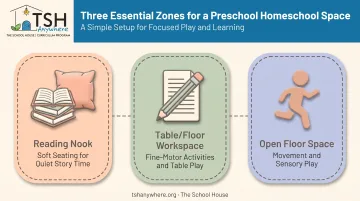
Even in a small footprint, aim for three zones:
- A reading nook with soft seating
- A table or floor workspace for fine-motor and art activities
- An open floor space for movement or sensory play
Rugs, floor mats, or even painter's tape lines can define these areas without walls, a trick that works especially well in apartments or a shared bedroom.
Must-Have Supplies, Furniture, and Storage Solutions
Essential Furniture for a Preschool Learning Space
You need less furniture than you'd expect:
- A child-sized table and chairs sized so feet reach the floor
- A low bookshelf with covers face-out so kids can find books on their own
- A cozy floor cushion or rug for circle time or read-alouds
Facebook Marketplace, thrift stores, and local homeschool swap groups are reliable sources for gently used furniture at a fraction of retail price.
Storage and Organization Systems
Labeled bins by category — art, sensory, manipulatives, current unit — make grab-and-go setup and cleanup faster for both of you.
A few habits that keep clutter down:
- Rotate a small "theme shelf" every one to two weeks to maintain novelty without adding more stuff
- Use trays to contain messy activities like playdough, paint, or sensory bins
- Set aside a dedicated spot for in-progress projects so half-finished art doesn't end up in the trash
Core Supplies Checklist for Preschoolers
Art and fine-motor supplies:
- Washable markers and crayons
- Glue sticks
- Safety scissors
- Playdough
- Lacing cards
Early literacy and numeracy materials:
- Alphabet cards
- Counting objects (buttons, blocks, small figures)
- Picture books
Routine tools:
- Wall calendar
- Daily rhythm cards
- Small whiteboard or chalkboard
These support circle-time-style routines and help the space feel complete without much extra gear.
Choosing the Best Preschool Homeschool Curriculum
There's no single "best" curriculum for every preschooler. The right pick depends on your child's learning style, your budget, and how much daily structure you want.
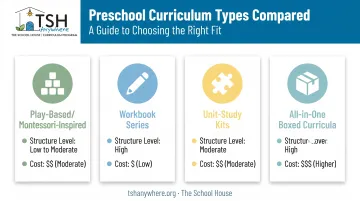
Most preschool homeschool families choose from a handful of broad categories:
- Play-based or Montessori-inspired programs built around child-led exploration
- Simple workbook series for parents who want structured, printable practice
- Unit-study kits organized around themes (seasons, animals, community helpers)
- All-in-one boxed curricula that bundle materials, lesson plans, and assessments
Many successful preschool homeschoolers skip an expensive full package entirely. Instead, they combine free or low-cost resources (library books, printables, open-ended toys) with a single structured "spine" curriculum that anchors the week.
For families who want research-backed structure without building lessons from scratch, The School House's American Emergent Curriculum offers a ready framework. Its Pre-K–K tier, TSH Primary, is built around three core areas:
- Reading, math, and science through hands-on, sensory-based activities (not worksheets or screens)
- Civics, creativity, and critical thinking woven in rather than taught in isolation
- About $125 a month per learner for the full structured option
You don't need to adopt a program like this wholesale. Even borrowing the underlying structure (short, integrated, hands-on lessons instead of siloed workbook pages) can shape how you plan your own week.
Setting Up Learning Zones Like a Pre-K Classroom
Circle-Time and Independent Work Areas
Licensed pre-K classrooms open the day with routine, and you can replicate that at home with a small rug, wall calendar, weather chart, and visual daily schedule.
For independent work, store materials in trays or baskets your child can carry to a table or floor mat, the same choice-time setup Montessori and pre-K classrooms rely on. A reading corner with soft seating and a face-out book display rounds out the essentials, encouraging kids to select books on their own instead of always asking you to pick.
Sensory Play and Realistic Timing
A sensory or messy-play zone needs an easy-to-clean surface (a vinyl mat or tray works fine) for playdough, water play, or sensory bins.
Here's the piece that trips up a lot of new homeschool parents: you don't need a rigid, hour-long schedule. The American Academy of Pediatrics notes that a child entering kindergarten should be able to concentrate for at least 15 minutes. Younger preschoolers have even shorter focus windows.
NAEYC's developmentally appropriate practice guidelines recommend keeping group instruction brief and matched to a child's attention limits, balanced with movement and self-directed play. Build your day around short, focused activities of roughly 10 to 15 minutes each, not a packed schedule with fixed time slots.
A predictable rhythm matters far more than hitting an exact clock time:
- Circle time
- Work cycle
- Movement
- Sensory play
Budget-Friendly Tips for Setting Up on Any Budget
A functional preschool space doesn't require a big spend. These moves keep costs down without shrinking what your child can do:
- Source furniture secondhand. Facebook Marketplace and thrift stores often have child-sized tables and low shelving far below retail. A household hutch or bookshelf works just as well.
- Shop dollar stores for consumables. Washable markers, glue sticks, and playdough don't need to be curriculum-branded to work.
- Rotate instead of buying. Keep a small set of toys and materials in circulation, topped up with library loans, instead of constantly buying more. Novelty stays high without growing your budget or clutter.
None of these shortcuts compromise quality. They just recognize that a 3-year-old doesn't know or care whether their counting bears came from a boutique or a bargain bin.
Frequently Asked Questions
What is the best homeschool curriculum for preschool?
There's no universal "best." It depends on your budget and how much structure you want. Play-based, unit-study, and all-in-one boxed options are all reasonable starting points depending on your family's style.
How should a pre-K classroom be set up?
Include a circle-time area, reading corner, independent work station, and sensory zone. Keep materials on low, open shelves so your child can access and return them without help.
How many hours a day should preschool homeschooling last?
Most families run 30 minutes to 2 hours total, broken into short, focused activities that match a young child's attention span. No single research-backed number fits every child.
What age should I start homeschooling preschool?
Most families begin structured activities between ages 2.5 and 4. Readiness matters more than a specific age, so watch your child's interest and attention rather than the calendar.
Do I need a dedicated room for a preschool homeschool setup?
No. A dedicated room is convenient but not necessary. A well-organized corner of a shared space works just as well when materials stay within easy reach.
How much does it cost to set up an affordable preschool homeschool space?
A basic setup can use secondhand furniture, dollar-store supplies, and library resources. You don't need an expensive classroom kit.