This scenario plays out in classrooms every day. Gifted kids often sit through lessons on material they mastered months ago, then get labeled as distracted or difficult when they check out emotionally. Their brains work differently, and a curriculum built for the "average" student rarely stretches far enough to meet them.
That mismatch is exactly why more families are turning to homeschooling. This guide covers why gifted learners need a different approach, the curriculum models that actually work, the non-negotiable components of a strong plan, and how to build one step by step.
Key Takeaways
- Gifted kids typically need acceleration, depth, and flexibility that a standard classroom pace can't consistently deliver
- No single curriculum model wins for every gifted child — project-based, mastery, and unit-study approaches all have a place
- Effective gifted homeschooling blends differentiation, academic rigor, cross-subject learning, and social-emotional support
- Building a plan means ongoing assessment and adjustment—not a one-time curriculum purchase
Why Gifted Students Need a Different Educational Approach
There's a real difference between being "good at school" and being gifted. A student who's good at school follows rules, chases grades, and thrives on structure. A gifted student is often curiosity-driven and questions the point of busywork. They push back against rigid pacing, not out of defiance, but because the material simply isn't interesting anymore.
The Underachievement Problem
Standard pacing assumes every student needs roughly the same repetition to master a concept. Gifted kids don't. When the curriculum doesn't flex, boredom sets in, and boredom has consequences.
A 2024 systematic review found that gifted underachievement affects an estimated 9% to 28% of gifted students during compulsory education, though the researchers note that definitions and identification methods vary widely across studies. Even at the conservative end, that's a meaningful share of bright kids performing well below their potential.
Asynchronous Development and Emotional Intensity
Gifted children frequently show what psychologists call asynchronous development: a five-year-old reading at an eighth-grade level while still needing help tying her shoes, for example.
Add in Dabrowski's concept of overexcitabilities (intellectual, emotional, sensory, and more), and you get kids who feel everything more intensely than their peers. A traditional classroom, built for a "typical" developmental profile, can feel overwhelming rather than supportive.
Inconsistent Support in Schools
Part of the problem is structural. According to NAGC's 2020-21 State of the States survey:
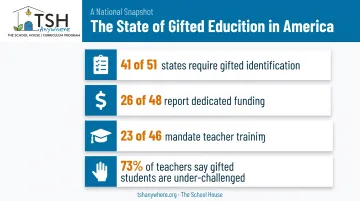
- 41 of 51 respondents legally require gifted identification
- Only 26 of 48 report dedicated state funding for gifted education
- Just 23 of 46 mandate any gifted-specific teacher training
That patchwork means differentiation depends heavily on which district — and even which teacher — a child happens to get. NAGC has also found that 73% of teachers agree the brightest students in their classrooms are too often bored and under-challenged.
Homeschooling among gifted and advanced learners has grown against that backdrop. Davidson Institute reported that even before the pandemic, roughly one-third of its Davidson Young Scholars (a cohort of profoundly gifted students) were in some form of homeschooling at any given time. For many families, it has become a practical response to a real gap in school support.
Choosing the Right Curriculum Model for Your Gifted Learner
There's no universal "best" curriculum for gifted kids. The right model depends on your child's learning style, interests, and goals, not on what worked for someone else's family.
Project-Based Learning
This approach hands kids an open-ended, real-world problem and lets them run with it. Gifted learners often hyperfocus when they're genuinely interested in something, and project-based work channels that intensity into a finished product instead of letting it fizzle out on worksheets.
Self-Paced and Mastery Learning
Mastery-based programs let a child move quickly through concepts they've already grasped and slow down on genuinely challenging ones. They avoid the two most common gifted-education failures: boredom from moving too slowly, and frustration from being rushed past something they haven't actually mastered.
Unit Studies and Interdisciplinary Learning
Gifted kids tend to be pattern-recognizers. Thematic unit studies (exploring ancient Rome through history, art, math via aqueduct engineering, and literature at once) play directly to that strength instead of siloing subjects into disconnected 45-minute blocks.
Classical and Eclectic Approaches
Many experienced gifted homeschoolers don't pick just one model. They blend classical rigor (logic, rhetoric, primary texts) with project-based flexibility, adjusting the mix as their child grows.
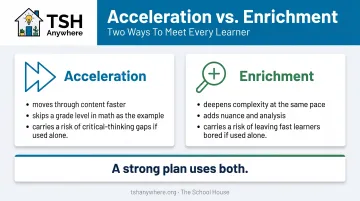
One clarification that trips up a lot of parents: acceleration and enrichment are not the same thing.
- Acceleration means moving through content faster, such as skipping a grade level in math
- Enrichment means going deeper into the same material with more complexity, not more speed
Both matter. Acceleration without enrichment can leave gaps in critical thinking; enrichment without acceleration can still leave a fast learner bored. A strong plan uses both, depending on the subject and the child.
Must-Have Components of an Effective Gifted Homeschool Curriculum
Whatever model you choose, certain ingredients need to be present. Skip these, and even a well-intentioned homeschool plan will underdeliver.
- Differentiated instruction: tiered assignments and independent research pitched to ability level, not age or grade
- Academic rigor and depth: materials that demand critical and divergent thinking, not worksheets labeled "advanced"
- Interdisciplinary connections: subjects woven so kids see relationships across math, science, and history
- Social-emotional support: coping skills, resilience, and self-awareness for the intensity gifted kids often carry
- Flexibility: room for mentors, community classes, dual enrollment, or competitions as interests shift
These pieces work best as a set, which is how TSH Anywhere's American Emergent Curriculum (AEC) is built. AEC weaves reading, math, and science together with civics, entrepreneurship, and critical thinking inside single lessons, delivered in 8-week sessions long enough for real depth.
Families can preview the approach through curriculum and film samples before committing.
Supporting Twice-Exceptional (2e) Learners at Home
Twice-exceptional (2e) describes a child who is both gifted and has a diagnosed learning difference — ADHD, dyslexia, autism, or similar. The tricky part is that the two can mask each other. A 2e child's giftedness might hide their learning disability from teachers, while the disability might mask just how capable they really are.
Generic gifted curricula often miss this population entirely, and generic remediation programs tend to ignore the gifted side altogether. What works better at home is a strength-based strategy: teach from what the child does exceptionally well, then layer in accommodations for the challenge area—not a deficit-first remediation model.
Practical moves that support both sides:
- Lead with advanced content in strength areas so giftedness stays visible
- Pair that work with targeted supports (extra time, audiobooks, movement breaks)
- Plan gifted stretch and learning supports in one weekly rhythm, not two separate tracks
- Adjust pace day to day; capacity can swing with regulation and interest
For families navigating this, specialized organizations offer guidance standard gifted programs don't:
- SENG — emotional and social support for gifted and 2e families
- CEC-TAG — educator and parent community focused on twice-exceptional learners
- Davidson Institute — 2e resource library with practical planning guidance
Use them when you need help designing one plan that holds both the gifted stretch and the learning supports—not two tracks running side by side.
Building Your Curriculum: Steps, Tools & Community Options
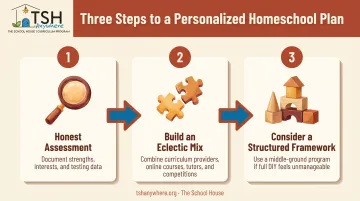
Building a gifted homeschool plan is a process, not a purchase. Here's how experienced homeschool families typically approach it:
- Start with an honest assessment. Before buying anything, document your child's strengths, interests, and any testing or achievement data you already have. Picking a curriculum first and hoping it fits backward rarely works.
- Build an eclectic mix of resources. Combine gifted-specific curriculum providers, online courses, community classes, tutors, and academic competitions instead of relying on one boxed program to do everything.
- Consider a structured framework if full DIY feels like too much. Building every lesson from scratch is exhausting, and few parents have the bandwidth to do it well for years on end.
This is where a model like The School House fits as a middle-ground option. Its American Emergent Curriculum grew out of a decade of research and more than six years of live testing at its flagship school. Enrolled learners reportedly test at least twice above the national average, without academic admissions screening.
Families get practical support that removes the guesswork from rigorous, interconnected lessons:
- 400+ educator training films
- Custom printables for daily use
- Live weekly support from a curriculum director
Whichever tools you choose, treat the plan as a living document. Reassess every few months, not once a year.
Frequently Asked Questions
What is the best type of school for a gifted child?
There's no single best option. It depends on the child. In-school gifted programs, online schools, and homeschooling all work for different kids—personalization and pacing matter more than the program label.
What are some educational programs for gifted children?
Common options include talent search programs, academic competitions like Math Olympiad or Odyssey of the Mind, and specialized gifted curriculum providers. Many homeschool families combine several of these alongside their core curriculum.
What IQ does a child need to be in the gifted program?
Thresholds vary by program, typically falling between the 95th and 99th percentile on standardized testing. Most gifted education organizations, including NAGC, caution against relying on IQ scores alone for identification.
Do gifted kids do well in school?
Not always. Many gifted kids underachieve in unchallenging environments despite obvious potential, which is a main reason families explore homeschooling or alternative models.
How much does it cost to homeschool a gifted child?
Costs vary widely depending on materials and support. As a reference point, a full curriculum subscription like TSH Anywhere's AEC runs $1,200 per year per learner, with costs rising if you add specialized tutors, competitions, or enrichment programs.
Can homeschooled gifted students get into competitive colleges?
Yes. Colleges regularly accept homeschooled applicants and have processes to evaluate portfolios, transcripts, and standardized test scores in place of a traditional class rank or GPA.