The right online program can cut your daily workload, boost academic outcomes, and stretch to fit almost any budget. The wrong one leaves parents grading papers at midnight and kids bored by January. Here's what actually separates the two — and which programs are worth your money in 2026.
TL;DR
- Match format to your child first: full curriculum platforms vs. supplemental practice tools
- Weigh accreditation, pricing structure, and parent involvement over brand name
- 2026 picks: Miacademy, Time4Learning, Power Homeschool, The Good and the Beautiful, and IXL
- Budget from free printables up to about $99/month per student, by subjects and support
Overview of Online K-12 Homeschool Programs in the U.S. Education Market
An online K-12 homeschool program is a curriculum platform that delivers lessons, assignments, and grading online. The parent, not a certified teacher, remains legally responsible for instruction.
That differs from an online public school, where licensed teachers run the classroom virtually and the state tracks enrollment.
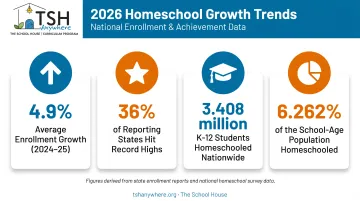
This market has grown fast. NHERI estimates roughly 3.408 million K-12 students were homeschooled in 2024-25, about 6.262% of the school-age population. That's a nonfederal estimate, not an official NCES count, but it lines up with the broader trend of families moving away from conventional schooling.
Below are the five online K-12 homeschool programs worth serious consideration in 2026, based on rigor, flexibility, and actual value for the money.
Top Online K-12 Homeschool Programs for 2026
We evaluated each program on accreditation status, curriculum depth, affordability, and the quality of parent and student support available after purchase.
Miacademy
Miacademy delivers a full K-8 curriculum, with high school covered through its sister platform, MiaPrep, for grades 9-12. Both are self-paced and customizable across core subjects and electives.
MiaPrep's curriculum carries ACS WASC accreditation as a Supplementary Education Program. The platform also includes accessibility tools like text-to-speech, untimed testing, and dark mode that support neurodivergent learners.
| Feature | Details |
|---|---|
| Grade Levels | K-8 (Miacademy); 9-12 (MiaPrep) |
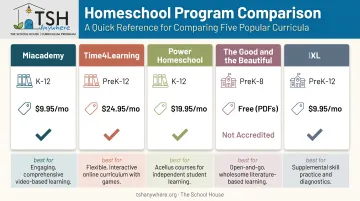
| Pricing | Miacademy: $48/month or $480/year; MiaPrep: $54/month or $540/year |
| Key Features | Customizable course catalog, progress tracking, ESA/state funding compatibility via ClassWallet |
Time4Learning
Time4Learning has been around for years, offering an affordable, all-in-one curriculum from Pre-K through 12th grade. It's built for independent learners who don't need much hand-holding.
The appeal here is price and simplicity. Lessons are prerecorded, grading is automated, and reports export cleanly into a portfolio or transcript. Time4Learning is upfront that it's not accredited — it positions itself as a curriculum provider, not a school.
| Feature | Details |
|---|---|
| Grade Levels | Pre-K to 12th grade |
| Pricing | $39.95/month per student (up to 7 courses); extra courses $5/month each |
| Key Features | Automated grading, interactive lessons, minimal parent involvement required |
Power Homeschool
Power Homeschool runs entirely on Acellus video lessons, built for students comfortable learning independently on a screen. There's no live teacher. Parents administer the program using self-paced video coursework.
It suits tech-savvy kids who can work through material without much daily oversight. Just don't assume accreditation carries over from the Acellus school brand; confirm current status directly with the provider before enrolling.
| Feature | Details |
|---|---|
| Grade Levels | K-12 |
| Pricing | $99/month per student |
| Key Features | 100% online delivery, self-paced video lessons, low daily parent involvement |
The Good and the Beautiful
This faith-based provider blends print workbooks with digital tools across Pre-K through 12th grade, built around Christian values and character education.
Pricing runs per-subject rather than as a single subscription — some K-8 language arts and math materials are even free to download. High school Language Arts courses are explicitly not accredited, which the company states plainly for families not chasing an accredited transcript.
| Feature | Details |
|---|---|
| Grade Levels | Pre-K to 12th grade |
| Pricing | Per-subject bundles (such as Preschool Basic Bundle: $95.94); some free digital downloads |
| Key Features | Christian values integration, workbook/digital hybrid, active parent community |
IXL
IXL began as a public-school classroom tool and is now a go-to supplement for homeschool families. It's not a full curriculum — think of it as targeted skill practice layered on top of whatever you're already using.
Its diagnostic engine estimates a child's level in about 45 minutes per subject, then builds a personalized skills plan. A SmartScore of 100 means true mastery, not just a passing grade.
| Feature | Details |
|---|---|
| Grade Levels | K-12 |
| Pricing | Starts at $9.95/month; some subjects (like PreK-12 Language Arts) run $15.95/month |
| Key Features | Standards-aligned practice, diagnostic tracking, best paired with a full curriculum |
How We Chose the Best Online K-12 Homeschool Programs
Parents commonly make three mistakes when choosing a program:
- Picking based on slick marketing
- Skipping accreditation checks entirely
- Underestimating how much daily involvement the program will require once school starts
Those pitfalls shaped how we scored each option. We weighed programs against:
- Accreditation status: whether it covers the curriculum only, a supplementary program, or the whole school
- Curriculum rigor and flexibility: self-paced versus structured, and how easily it adapts to different learning speeds
- Pricing transparency: monthly rates, per-subject add-ons, and hidden costs like shipping or optional support
- Parent and teacher support: how much oversight the program assumes you'll provide
- State funding compatibility: whether ESAs, vouchers, or other homeschool funding can apply toward the subscription
Accreditation deserves extra scrutiny. A curriculum can carry a "Supplementary Education Program" designation without being an accredited, diploma-granting school. Those are two different things, and providers don't always make the distinction obvious.
Conclusion
There's no single "best" program here — only the best fit for your family's budget, your child's learning style, and how much independence you're ready to hand over. Before you lock in a full year:
- Trial the program first
- Confirm accreditation status in writing
- Reassess each fall as your child's needs shift
If you want something outside the typical online-curriculum mold, consider The School House. Rather than a subscription platform built for a screen, its TSH Anywhere Homeschool program delivers a Pre-K through 8th grade curriculum developed over a decade of research and validated across six-plus years in a real classroom, with a deliberately screen-minimal approach.
It is not a K-12 replacement for the programs above. For families who want a curriculum rooted in an actual school rather than a tech company, it is a different kind of option.
Frequently Asked Questions
What states give you money for homeschooling?
Several states offer education savings accounts, vouchers, or public online school funding that homeschoolers can access, including Arizona, Florida, Texas, and 15 others through 21 active ESA programs. Eligibility rules vary widely, so check your state's current homeschool funding page before assuming coverage.
Are online homeschool programs accredited?
Some providers hold program-level accreditation; others have none. Accreditation matters most for transcripts and college admissions, so verify status on the provider's site rather than assuming.
How much does an online homeschool program typically cost?
Costs range from free printable resources to premium subscriptions around $99/month per student. Price depends on subject count, whether you pay monthly or annually, and how much built-in support the program includes.
What's the difference between an online school and an online homeschool curriculum?
An online school employs licensed teachers who run instruction and assessment. An online homeschool curriculum gives you the platform and materials while you remain the teacher and administrator. That split shapes daily workload and who signs off on grades.
Can online homeschool programs count toward a high school diploma?
Accredited programs typically issue their own transcripts and diplomas. Non-accredited curricula still work for high school credit, but the parent or an umbrella program issues the diploma instead.
How do I switch between online homeschool programs mid-year?
Export gradebooks, attendance records, and work samples before canceling your current subscription. A brief overlap between the old and new program can prevent access gaps and ease the transition for your child.