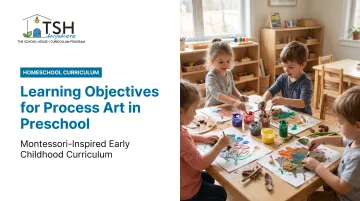
The second room is messier. It's also where the real learning happens.
That contrast is the difference between product art and process art. Many educators and parents feel instinctively that open-ended art matters more than matching a template, but that instinct is hard to write down. What exactly is a child learning while smearing paint with their palms?
This guide breaks that instinct into concrete, documentable learning objectives across five developmental domains, plus a simple framework for writing your own. Programs like The School House build this kind of objective-mapping directly into their science-based early curriculum, so teachers don't have to start from scratch.
Key Takeaways
- Process art touches five developmental domains at once: cognitive, language, physical, social-emotional, and creative growth.
- A strong objective names a skill a child practices, not the artwork they produce.
- Objectives need two parts: an observable action and the material or context it happens in.
- One activity, like finger painting or clay, can support several objectives simultaneously.
- Written objectives make it far easier to track progress and update families without over-explaining.
What Is Process Art in Preschool?
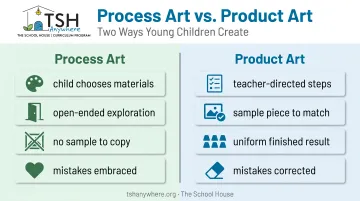
Process art centers on the experience of making something, not on a specific finished result:
- Children choose their own materials
- They use those materials however they want
- No sample to copy or match
Product art works differently:
- Teacher-directed, step-by-step instructions
- A sample piece children try to match
- "Mistakes" corrected toward a uniform outcome
If an objective is written around the product ("child will create a butterfly"), it misrepresents what is happening developmentally.
A child gluing tissue paper onto a butterfly outline is practicing pincer grasp and following directions—not exploring color, texture, or cause and effect on their own terms.
NAEYC's guidance makes this explicit: process-focused experiences have no prescribed model, and children keep full ownership of tools, media, and direction. NAEYC's 2014 overview of process-focused art points to examples that meet this standard:
- Easel painting without a sample
- Homemade dough
- Printing with unconventional tools
- Open-ended collage
For lesson planning, write objectives around what the child does, not what the artwork looks like when they're done.
Key Learning Objectives of Process Art in Preschool
Because process art stretches across every area of development, the clearest way to track it is domain by domain. A teacher can point to a single finger-painting session and say exactly which skills a child practiced, rather than lumping everything under "did art today."
Cognitive Development Objectives
- Tests material behavior through trial and error, such as adding water to paint and observing how the consistency changes.
- Sustains attention on a self-chosen task for an extended stretch, showing growing concentration without adult prompting.
- Makes and tests a simple prediction, such as guessing what color two mixed paints will produce, then checking the result.
Language & Literacy Objectives
- Uses descriptive vocabulary (texture, color, and size words) to talk about materials mid-activity.
- Practices pre-writing motions, including lines and patterns, while building a functional grip on brushes, crayons, or tools.
- Narrates the story behind their piece to a peer or teacher, strengthening oral storytelling skills.
Physical & Motor Development Objectives
- Strengthens fine motor control through squeezing glue bottles, using droppers, or pinching and rolling clay.
- Improves hand-eye coordination by guiding a brush, sponge, or stamp toward a specific spot on the paper.
- Builds gross motor and spatial awareness through large-format art, or by carrying materials and cleaning up independently.
Social-Emotional Development Objectives
- Uses materials to express feelings, supporting early self-regulation skills.
- Practices sharing limited tools with peers, which leads to negotiation and turn-taking.
- Manages frustration when a material doesn't cooperate, whether paint won't blend or clay keeps cracking.
Creative & Artistic Expression Objectives
- Combines two or more media in one piece to explore how they interact.
- Uses symbols to represent real objects, feelings, or events, an early precursor to written language.
- Makes independent choices about color, tools, and composition, building creative confidence and ownership.
How to Write Strong Learning Objectives for Process Art Lessons
A well-written objective has three parts:
- An observable action verb: explore, combine, describe, persist. Avoid vague verbs like "understand" or "appreciate," which can't be seen or measured.
- The material or context the action happens in: paintbrush, clay, collage tray.
- The specific developmental skill being targeted: color mixing, fine motor grip, vocabulary use.
Compare these two versions:
- ❌ Vague: "Child will do a painting project."
- ✅ Specific: "Child will experiment with mixing two colors using a paintbrush and describe the new color created."
The second version tells you exactly what to look for and gives you clear language for family updates.
Practical rules to keep objectives manageable:
- Use one objective-writing template classroom-wide so notes compare cleanly week to week. Science-based models like The School House build objective-mapping into every learning area, including art.
- Set only one or two primary objectives per activity. Process art's open-ended nature means children touch multiple domains without extra planning on your part.
- Loosely tie objectives to a recognized framework such as the Head Start Early Learning Outcomes Framework. Age-banded observable skills make accreditation reviews and progress reports much easier to prepare.
Process Art Activities Aligned to Learning Objectives
Different materials naturally lean toward different domains. Here's how four staple activities map to learning objectives:
| Activity | Primary domains | What to watch for |
|---|---|---|
| Finger painting | Physical/motor, cognitive | Hand exploration, grip, color mixing, cause-and-effect |
| Printmaking with found objects (bottle caps, produce) | Cognitive, creative | Pattern recognition, composition choices, repeated shapes |
| Collage with loose parts (buttons, fabric, paper) | Fine motor, language | Pincer grasp on small pieces, describing textures aloud |
| Clay or play-dough molding | Physical, social-emotional | Hand strength, sharing tools, collaborative building |
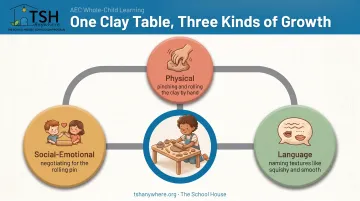
One activity can hit several objectives at once. A child at the clay table might strengthen finger muscles (physical), negotiate for the rolling pin (social-emotional), and narrate what they're building (language) in the same ten minutes. Pick one primary focus to document, and let the rest happen naturally.
Tips for Implementing Objective-Driven Process Art in Your Classroom
Turning these objectives into daily practice doesn't require a curriculum overhaul. A few adjustments go a long way:
- Stock open-ended stations. Fill art areas with paint, dough, loose parts, and recycled containers so children choose materials that support different objectives on their own.
- Document the process, not just the product. A quick photo mid-mix plus a one-line note ("predicted purple, got brown, tried again") tells you more than the finished paper.
- Translate objectives for families in plain language. Instead of "fine motor development," try "practiced squeezing the glue bottle today—that hand strength supports writing later." Families can then see the value in art that looks unfinished or messy.
Frequently Asked Questions
What are some good learning objectives for art lessons?
Good objectives target a specific, observable skill rather than a finished product. Examples: "child mixes two colors and names the result" or "child pinches and rolls clay to strengthen hand muscles."
What is the difference between process art and product art?
Process art is open-ended and child-directed, with no sample to copy. Product art follows teacher instructions toward a predetermined result. The distinction matters because objectives written around a "product" misrepresent what a child is actually practicing.
What are the main benefits of process art for preschoolers?
Process art supports cognitive skills (problem-solving, prediction), language (vocabulary, storytelling), and physical development (fine and gross motor). It also builds social-emotional growth (self-regulation, sharing) and creative confidence, often all in one session.
How do you write a learning objective for a preschool art activity?
Combine an observable action verb, the material or context, and the specific skill targeted, for example, "child explores texture using finger paint and describes what they feel."
What materials work best for process art activities?
Versatile, open-ended materials work best: paint, clay or play dough, loose parts (buttons, fabric, bottle caps), and recycled "junk" materials like cardboard tubes and containers.
How much time should preschoolers spend on process art?
Children need uninterrupted time to fully explore materials without rushing. Many programs aim for 20 to 30 minutes or more, though the right length depends on the group and activity.