You didn't take art history in college. You can't tell a Monet from a Manet. So the paints stay in the closet, the museum tab stays unopened, and art quietly slides off the weekly schedule, again.
You're not alone. Even schools with dedicated arts staff struggle to protect this subject. A 2024 NEA analysis of the NCES School Pulse Panel found that among the 82% of public schools offering visual arts, 29% give it less than one hour of instruction per week. If public schools with certified art teachers can't hold onto the time, homeschool parents shouldn't feel behind for struggling too.
This guide covers why art appreciation matters, a no-experience-needed teaching method, how to structure it by age, the top curricula worth your money, and simple activities that make it stick.
Key Takeaways
- Art appreciation builds visual literacy and critical thinking kids carry into reading and media
- Picture study needs zero art background, only curiosity and close looking
- A chronological multi-year path lets siblings learn together and go deeper with age
- Free museum tours through paid curricula mean budget never blocks a strong art program
Why Art Appreciation Deserves a Place in Your Homeschool Curriculum
Art appreciation is not the same as art class. Art class teaches technique: how to mix paint, shade a sphere, or throw a pot. Art appreciation teaches observation, meaning looking closely at a finished work, discussing what you notice, and forming your own response to it. No brushes required.
That distinction matters because the skills it builds go well beyond the canvas:
- Visual literacy: the ability to read an image the way you'd read a paragraph
- Historical empathy: understanding how people in another time and place saw their world
- Creative problem-solving: asking why an artist made a choice, not just what they made
These same skills transfer directly to decoding advertisements, news photos, and the images kids see on screens every day.
Those classroom gains show up in the data too. A 2019 Brookings study followed more than 10,000 students across 42 schools that received expanded arts programming through a lottery system. Students in arts-rich schools saw a 3.6-percentage-point drop in disciplinary infractions and a measurable gain in writing scores. Arts exposure sharpens thinking well outside the art room.
"I don't know anything about art" is not a disqualifier. Picture study, the method most homeschoolers use, was built for parents with zero art background. You're not lecturing. You're looking alongside your child and asking questions you're genuinely curious about too. The curriculum does the heavy lifting; you bring the attention.
Cost shouldn't be the reason art disappears from your homeschool either. At The School House, the American Emergent Curriculum weaves art into core lessons instead of treating it as an optional add-on.
That keeps art in the week even when budgets are tight—the same subject schools often cut first stays intact because it was never separated from the rest of learning.
The Picture Study Method: A Step-by-Step Approach to Teaching Art Appreciation
Picture study isn't a new invention. Charlotte Mason educators have used a version of it since at least 1901, when the Parents' Review School documented "Picture Talks." Those lessons aimed to build discriminating appreciation rather than a preference for merely colorful pictures. The method has barely changed since, because it works.
Getting Started With Picture Study
Pick one artist. Choose three to five of their works. Study them one at a time, spending real time on each before moving on.
- Display the artwork and let your child look at it silently for a minute or two, without commentary from you.
- Ask them to describe what they see: colors, objects, expressions, the story they think is unfolding.
- Reveal the title and artist only after they've formed their own impression.
- Leave the piece visible for the rest of the week, as a screen background, a printed page on the fridge, whatever keeps it in view.
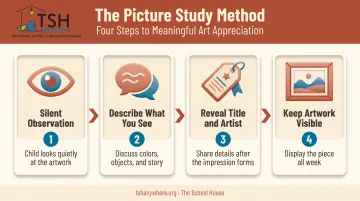
Simply Charlotte Mason recommends just 15 minutes a week for this, with one artist studied over several weeks and roughly three artists covered per year. That pace feels almost too slow, until your child recognizes a Van Gogh from across the room six months later.
Adding Depth for Older Students
Once a child has studied a handful of artists, layer in more:
- Read a short artist biography covering where they lived and what shaped their style
- Sketch one technique from the piece rather than copying the whole work
- Compare two artists working in the same period or style
Keep a simple record. A binder with sheet protectors or a plain spiral sketchbook works fine for storing prints, notes, and sketches for later review. Nothing fancier is needed.
Picture study also pairs cleanly with history. Connect the artist to whatever period you're already studying. Deep into ancient Rome? Pull up Roman frescoes. Covering the American Revolution? Look at Gilbert Stuart's portraits. The overlap reinforces both subjects at once, and it's one less thing to plan separately.
Structuring a Full Art Appreciation Curriculum by Age and Content
Art appreciation doesn't need a rigid syllabus, but a loose structure by age keeps it from disappearing into the "someday" pile.
Early Elementary (K–4th Grade)
Keep it light. One artist, a handful of paintings, casual conversation. Skip formal vocabulary entirely. A five-year-old doesn't need to know "Impressionism" to notice that Monet's water lilies look blurry up close. Exposure is the entire goal here.
Upper Elementary & Middle School (5th–8th Grade)
Chronology starts to matter now. Move through art movements in order: Renaissance, Baroque, Neoclassical, Impressionism, and tie each one to whatever history period your family is studying that year.
Light vocabulary fits here too. Terms like "perspective," "composition," and "patron" stick once kids see them applied to real paintings.
Families using an integrated curriculum often find this stage easiest to sustain, since art connects naturally to the history and civics content already on the schedule instead of competing with it for time.
High School (9th–12th Grade)
A structured, multi-year art appreciation study can satisfy a fine arts credit on a homeschool transcript. HSLDA's general benchmark for a non-core elective is 120 logged hours for a full credit or 60 hours for a half credit. A steady weekly lesson plus museum visits, research, and short written analysis can reach half-credit range without strain; full credit usually needs that deeper work logged across the year.
The same plan works for mixed-age families. Organize the whole study around one repeating cycle:
- Year 1: Ancient through Medieval art
- Year 2: Renaissance through Baroque
- Year 3: Neoclassical through Impressionism
- Year 4: Modern and Contemporary
Run the cycle every four years so every child passes through it at least twice by graduation, going deeper each time. Younger kids narrate what they see; older ones add analysis, research, and comparison essays on the same artist.
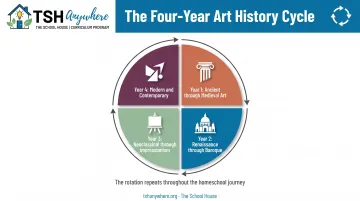
Keep the weekly cadence sustainable: one artist or one lesson per week is enough. Art appreciation earns its place by staying consistent, not by demanding hours you don't have.
Top Homeschool Art Appreciation Curricula & Resources to Consider
Not every family wants to build picture study from scratch. Here are four options worth a look, from structured paid programs to free resources.
You ARE an ARTiST (Chalk Pastel)
A K-12 art and music program built around a four-year chronological history cycle, with notebooking pages, coloring sheets, and video tutorials. The Clubhouse membership includes access to 800+ video lessons, starting around $40/month. It leans production-heavy, so expect chalk pastel projects alongside appreciation.
Daily Art by Music in Our Homeschool
A self-paced, video-based course sequenced by period. It covers Renaissance, Baroque and Dutch Golden Age, Rococo, Neoclassical, and Impressionism. Videos run four to five minutes each, making it easy to slot into family Morning Time. The full bundle runs $200, or $49 per course, and works well for a high school fine arts credit.
Beautiful Feet Books Art Appreciation Family Study
A two-year, once-weekly family curriculum for grades 5-12, built around a Book of Artists, 36 art cards, and hands-on activities. It's priced at $109.95 (list $120), with 64 lessons total across the two years.
Free and Low-Cost Alternatives
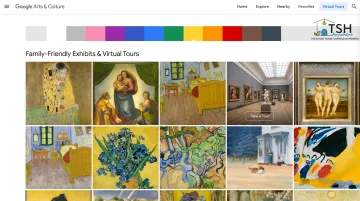
Google Arts & Culture hosts more than 2,000 museums and 100,000 artworks with virtual exhibits and 360-degree tours, at no cost. MetKids, the Metropolitan Museum of Art's kid-focused digital feature, offers another free starting point.
| Curriculum | Grades | Format | Price |
|---|---|---|---|
| You ARE an ARTiST | K-12 | Video + hands-on | From $40/month |
| Daily Art | 8+ (fits high school) | Self-paced video | $49–$200 |
| Beautiful Feet Books | 5-12 | Physical books/cards | $109.95 |
| Google Arts & Culture / MetKids | All ages | Free online | $0 |
None of these require an art background to run. Choose based on:
- How much week-to-week structure your family wants
- Whether you prefer paid, done-for-you planning or free DIY resources
- Your kids' ages and whether you need high school fine arts credit
Hands-On Activities That Bring Art Appreciation to Life
Picture study sticks better when it's followed by something hands-on, but that doesn't mean another full lesson plan.
Simple follow-ups that take 15 minutes or less:
- Sketch a section of the painting, not the whole thing: a hand, a shadow, a single flower
- Color a themed page tied to the artist or period
- Cook something from the artist's era or culture (a simple French pastry pairs naturally with an Impressionism unit)
Skip formal testing. At the end of each term, pull out the portfolio—the binder or sketchbook where past work is stored— and let your child flip through it. Ask what they remember. That's the review. No quiz needed.
When you can, take the study off the page entirely. A randomized study of over 10,000 students across 123 schools found that a single museum field trip measurably improved students' critical thinking about art versus peers who didn't go. Many major museums, including the Met, offer free lesson plans built for these visits.
If an in-person trip isn't realistic, a virtual gallery tour covers similar ground. Either way, seeing work at scale—actual size, real texture, in a real room—teaches something a printed page can't.
Frequently Asked Questions
What is the best age to start art appreciation in homeschool?
Even preschoolers benefit from simple picture study: looking, describing, and guessing at a story. Add vocabulary, biography, and analysis as your child gets older.
Do I need an art background to teach art appreciation?
No. Picture study runs on curiosity, not expertise, since you're looking alongside your child, not lecturing. Most curricula fill in any knowledge gaps for you.
How much time should art appreciation take each week?
Ten to twenty minutes, once or twice a week, is enough to build consistency without crowding out core subjects.
Can art appreciation count as a high school fine arts credit?
Yes. A structured, multi-year study logged consistently can meet the typical 120-hour benchmark most homeschool transcripts use for a full elective credit.
What's the difference between art appreciation and art history?
Art appreciation focuses on observation and personal response to a piece. Art history adds chronology, movements, and factual context around when and why it was made.
How do I choose which artists to study first?
Start with artists whose style is instantly recognizable, like Van Gogh or Mary Cassatt, or pick one tied to the history period your family is already studying.