
Introduction
Most homeschool graduates can solve for x, name every U.S. president, and diagram a sentence. Ask them how to read a pay stub or what APR means on a credit card, and you'll often get a blank stare.
That gap is getting harder to ignore. According to the Council for Economic Education's 2024 Survey of the States, 35 states now require a personal finance course for graduation — 12 more than in 2022. Fifteen of those states require a full semester of instruction, which CEE calls the "gold standard."
Homeschool families are closing that gap on their own terms. This guide covers why personal finance belongs in your plan, the core skills a solid curriculum should teach, four popular options to compare, and how to match a program to your teen's age, worldview, and learning style.
Key Takeaways
- Financial literacy is a graduation requirement in 35 states—treat it as a curriculum priority, not an afterthought.
- Strong courses cover six to seven core skills, from earning income to managing risk.
- Format matters: self-paced, live, and co-op options each suit different learners.
- Real household budgets and free stock simulators reinforce lessons better than worksheets alone.
Why Personal Finance Deserves a Spot in Your Homeschool
Homeschooling has one advantage traditional classrooms rarely offer: flexibility. You can hand your teen the actual electric bill, walk through the grocery budget together, or let them help plan a family trip cost breakdown. That's a level of real-world application a 30-student classroom simply can't replicate.
This kind of hands-on, life-relevant learning isn't just a homeschool trend. It reflects a broader shift toward practical, skills-based education.
That same idea sits at the center of TSH Anywhere's approach. Built on the American Emergent Curriculum used at its flagship school, The School House in New York, it weaves civics, budgeting, and basic profit-and-loss thinking into learning years before high school. The premise is simple: kids absorb money habits earlier than most programs assume.
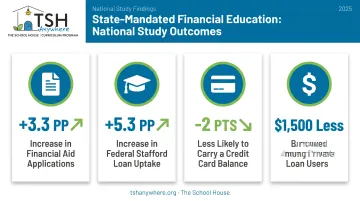
Research on structured financial education suggests those habits stick. A 2018 study funded by the National Endowment for Financial Education tracked college students exposed to state-mandated financial education. The results:
- Financial aid applications increased by 3.3 percentage points
- Federal Stafford loan uptake rose by 5.3 percentage points
- Exposed students were about 2 points less likely to carry a credit card balance
- Among private loan borrowers, they borrowed roughly $1,500 less on average
Structured instruction changes behavior. In a homeschool, that is reason enough to give personal finance its own place on the schedule instead of tucking it inside math class.
The 7 Core Components of a Personal Finance Curriculum
The Jump$tart Coalition and Council for Economic Education jointly publish the National Standards for Personal Financial Education, the framework most curriculum developers build from.
Officially, those standards group skills into six content areas. Decision-making and planning run through all of them so thoroughly that most homeschool curricula break planning out as a seventh standalone unit. Here's how that typically looks:
- Earning Income — Understanding paychecks, payroll deductions, and how education and career choices affect lifetime earnings.
- Spending & Budgeting — Tracking income against expenses and separating needs from wants.
- Saving — Building an emergency fund and setting short-term financial goals.
- Investing — Grasping compound interest, the stock market, and long-term wealth building.
- Managing Credit & Debt — Credit scores, loan terms, interest rates, and responsible borrowing.
- Managing Risk (Insurance) — Protecting against accidents, job loss, or medical emergencies.
- Financial Planning & Decision-Making — Goal-setting, taxes, and retirement planning that ties everything together.
A curriculum missing two or three of these isn't giving your teen the full picture. Before buying anything, check the table of contents against this list.
Top Personal Finance Homeschool Curriculum Options
Curricula vary by format, target age, and worldview, so "best" really depends on your family's situation. Here's a quick side-by-side before the details:
| Curriculum | Price | Format | Best Fit |
|---|---|---|---|
| Beyond Personal Finance | $160 | Self-paced, live, or host-your-own | Ages 13-18, simulation-style learners |
| Personal Finance Illustrated | $99 / 180 days | Online, self-paced with calculators | Full-credit seekers, dual enrollment |
| KidVestors | $99/yr or $64.99/6 mo | Gamified app | Younger teens, ESA-fund families |
| 7Sisters Financial Literacy | $44.99 | Printable e-text | Christian homeschoolers on a budget |
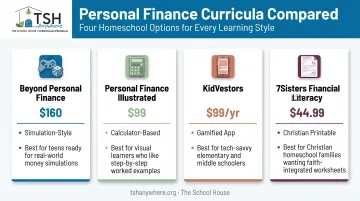
Use the snapshots below to match format, worldview, and credit needs before you commit.
Beyond Personal Finance
Students run a 20-lesson life simulation from age 22 to 42, making choices about careers, housing, cars, marriage, and retirement.
- Secular program aimed at ages 13–18
- Delivery: self-paced, live, or host-your-own for co-ops
- Strong fit for teens who learn by doing, not only reading
Personal Finance Illustrated (PEM LIFE)
Built on the Personal Economic Model, this course pairs 64 lessons with 30 interactive financial calculators.
- Standard and Biblically Based editions available
- Dual Enrollment version connects to Bryan College for college credit
- Solid pick when you need a full-credit, calculator-heavy path
KidVestors
A gamified app that teaches budgeting, investing, and entrepreneurship with videos, avatars, and progress tracking.
- Spans grades 3–12 with a parent dashboard
- Common fit for families paying with ESA funds
- Best when younger teens stay motivated by games and levels
7Sisters Financial Literacy from a Christian Perspective
A downloadable, one-credit e-text on budgeting, credit, insurance, and taxes through a biblical lens.
- About $45 — the lowest-cost option in this set
- Many states accept it toward a Consumer Math requirement
- Practical when you want printables and a clear Christian frame
How to Choose the Right Curriculum for Your Family
Start with three practical questions before you buy anything.
1. Is your teen ready for abstract money concepts? Most personal finance curricula target grades 7-12. Younger students often struggle with abstract ideas like compound interest or amortization, so wait until math skills catch up.
2. Secular or faith-based? Half-credit or full-credit?
- Secular options (Beyond Personal Finance, KidVestors) fit families avoiding religious content.
- Faith-based options (7Sisters, PEM LIFE's Biblically Based edition) weave in a biblical worldview.
- Full vs. half credit depends on your state — confirm transcript rules before you commit.
3. How does your teen learn best?
- Self-paced video suits independent learners
- Live classes add accountability
- Co-op groups work well for teens who thrive on peer discussion
Bringing Personal Finance to Life Beyond the Curriculum
No curriculum replaces hands-on practice. Supplement whatever program you choose with:
- Real household documents — Show your teen an actual utility bill, bank statement, or grocery receipt so lessons connect to your family's real numbers.
- A free stock market simulator — HowTheMarketWorks gives students $100,000 in virtual cash to trade real-time stocks and ETFs—used by thousands of teachers each year.
- A running family budget project — Let your teen track one category, like groceries or gas, for a full month.

That hands-on mindset is central to how The School House founder Mimosa Jones Tunney approaches education: build real skills early, keep the model practical, and skip the waste. Choose a personal finance curriculum that works the same way at home. Give your teen real tools now, and they head into adulthood with fewer expensive money mistakes.
Frequently Asked Questions
What are the 7 components of personal finance?
Most curricula cover seven areas: earning income, spending and budgeting, saving, investing, managing credit and debt, managing risk (insurance), and financial planning. Use this list to check that a program is truly comprehensive before you buy.
Does personal finance count as a math credit for homeschool transcripts?
Usually not. It's typically classified as an elective or social studies credit, though some states, like Florida and Utah, list it as its own required 0.5-credit course. Check your state's specific graduation rules.
What age should you start teaching personal finance to homeschoolers?
Most formal curricula begin around 7th or 8th grade, when students can handle abstract money concepts. Informal money conversations, like saving allowance or comparing prices, can start much earlier.
Is personal finance a full credit or half credit high school course?
It depends on the state and the curriculum. Florida and Utah require 0.5 credit; Virginia counts it as a full credit. Some programs, such as 7Sisters, are also built as one-credit courses. Confirm your state's rule before you plan.
Are there free or low-cost personal finance curriculum options for homeschoolers?
Yes. Free tools like Banzai's high school course, EconEdLink's budgeting lessons, and stock market simulators can supplement—or fully replace—a paid curriculum.
Can a personal finance curriculum be used in a homeschool co-op setting?
Yes. Beyond Personal Finance offers group licensing, and 7Sisters is commonly used in co-op classrooms. Check each vendor's group terms before you enroll multiple families.