Many parents pick Montessori because they want independent, focused, confident kids. Then they bring home the freedom-of-choice model, the "no rewards" approach, and start to panic. Common challenges include no homework, mixed-age classrooms, and long uninterrupted work blocks that look nothing like the education parents grew up with.
That gap between what parents want and what they're comfortable reinforcing is where good parent education comes in. Schools that explain the reasoning behind Montessori practices turn hesitant parents into committed partners.
This guide covers the core Montessori parent education topics worth teaching, real practices families can use at home, how to structure a parent night that actually works, and the widely searched "7-7-7" rule, including what it actually is and isn't.
Key Takeaways
- Montessori success depends on home-school consistency, not just enrollment
- Cover sensitive periods, freedom within limits, screen time, and homework philosophy to align home and school
- Simple home practices like limited choices and practical life reinforce classroom skills
- The "7-7-7" rule isn't official Montessori, but its limits-and-rhythm logic still supports core principles
- Surveying parents before an event beats guessing at topics
Why Parent Education Is Core to the Montessori Approach
Dr. Maria Montessori didn't see the classroom as separate from the household. She believed children absorb behavior from every adult around them, and that a parent who does everything for a child (dressing them, solving every problem, filling silence with entertainment) can accidentally become an obstacle to the child's own development.
That idea sits at the center of why Montessori schools invest in parent education. A three-hour classroom day can't outweigh fourteen waking hours at home if the two environments contradict each other.
Consistency between home and school isn't a nice-to-have. Broader research on family engagement backs this up, even outside Montessori specifically. A large study of more than 100,000 K-8 students across four urban districts found that structured family engagement—such as a teacher home visit—was linked to 21% lower odds of chronic absence. Schools that reached at least 10% of families saw a similar drop. The finding is associative, not causal, but the pattern is hard to ignore.
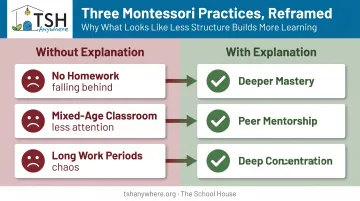
Unexplained Montessori practices create doubt fast:
- No homework? Parents worry their child is falling behind.
- Mixed-age classrooms? Parents assume their child isn't getting individual attention.
- Long uninterrupted work periods? Parents picture chaos, not concentration.
Left unaddressed, those doubts turn into mid-year pull-outs or constant second-guessing at home. Explained with the developmental reasoning behind each choice, the same practices become why parents stay and advocate for the approach.
At The School House, parent conversations are led by Montessori-credentialed educators (AMI/NAMC) with long classroom tenures, so guidance stays practical—not generic reassurance. Parent education protects the home–school alignment the model depends on.
Common Topics for Montessori Parent Education Nights
Ask ten Montessori parents what confuses them most, and you'll get answers ranging from "why doesn't my kid get grades" to "why can't I just buy the toys myself." A well-run parent night tackles both the philosophy and the practical, everyday questions.
Foundational Topics for Every Age Group
These apply whether a family's child is 3 or 12:
- Montessori 101: How mixed-age classrooms, self-directed work, and a prepared environment differ from grade-level schooling
- Sensitive periods and "follow the child": Why materials appear when a child is primed for order, language, or movement—not on a fixed calendar
- Freedom within limits: Children choose work inside firm community boundaries under a trained adult—not a free-for-all
Age-Specific Topics That Resonate With Families
Different stages bring different anxieties. Strong parent nights split time between toddler/primary practical life, elementary motivation and media, and a few cross-level themes everyone shares.
Toddler and primary families want hands-on guidance:
- Letting a two-year-old pour water without soaking the kitchen
- Building a child-height space for dressing and snack prep
- Supporting independence at home without constant adult takeover
Elementary parents ask about homework, motivation, and screen time. Pediatric guidance has moved away from one-size-fits-all hourly caps. The American Academy of Pediatrics now recommends weighing the child, the content, and the context. Protecting sleep, outdoor time, and screen-free meals matters more than counting minutes.
Cross-level favorites pull every age group into one room:
- Educating for Peace
- Promoting Independence
- Summer Parenting the Montessori Way
These stick because every parent wants the same outcome: a calmer, more capable kid.
Examples of Montessori Parenting Practices You Can Use at Home
Montessori philosophy means nothing if it stays in the classroom. Here's what it actually looks like at the kitchen table and in the hallway closet.
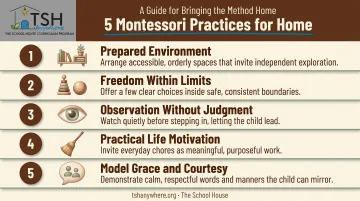
Build a prepared environment. Give kids real access, not a pretend station:
- Low, open shelves with natural materials over plastic
- A rotating selection of a few toys instead of a bin with fifty options
- One low corner in the kitchen or bathroom where they can pour, sweep, or dress themselves
Offer freedom within limits. Open-ended questions like "what do you want to wear today?" overload a developing brain, and zero choice shuts kids out. Try "red cup or blue cup?" instead: two acceptable options chosen by the adult, decided by the child.
Practice observation without judgment. Watch before you jump in. If a child is struggling to zip a jacket, wait. Offer help only when they signal a real need—a sigh, a request, or clear frustration—not the moment you assume they can't manage.
Use practical life to build intrinsic motivation. Include kids in real chores: folding laundry, prepping snacks, sorting mail, running small errands. Skip the allowance-for-chores model.
A meta-analysis of 128 studies found that tying rewards to task completion lowered kids' free-choice motivation to keep doing the task later, while specific positive feedback increased it. Saying "you carried that basket so carefully" works better long-term than a dollar for doing it.
Model grace and courtesy out loud. Narrate your own problem-solving: "Hmm, this lid won't open, let me try turning it the other way." Praise effort and process—"you worked patiently on that"—instead of only the finished product.
None of this requires a Montessori credential. It requires slowing down and trusting the process more than the shortcut.
Understanding the 7-7-7 Rule and Other Montessori-Inspired Routines
Parents searching "Montessori parenting" keep bumping into the "7-7-7 rule," but it isn't a Montessori term at all.
The 7-7-7 rule, as popularized in parenting media, means seven minutes of distraction-free connection at three daily transition points: morning, reunion after school, and bedtime, for 21 minutes total, phones away. It comes from general parenting commentary, not from AMI, AMS, or any Montessori source, and no formal study has validated exactly seven minutes as a magic number.
That said, the logic behind it lines up neatly with Montessori thinking. Predictable rhythms and clear boundaries are exactly what freedom within limits is built on. A child who knows bedtime always includes ten quiet minutes with a parent feels the same security a child feels knowing work time is uninterrupted at school.
Other simple routines Montessori families use to build that same predictability:
- Fixed work-and-rest blocks at home: a predictable stretch of quiet, focused activity followed by outdoor or free time, mirroring the classroom's uninterrupted work cycle.
- A consistent bedtime sequence: the same three or four steps, in the same order, every night, so the child's body and brain know what's coming.
- A prepared morning sequence: clothes, bag, and breakfast set up the night before so the child can move through the start of the day with minimal adult prompting.
The exact minutes matter less than the predictability. Call it 7-7-7 or simply a family rhythm—what steadies children is knowing what comes next.
How Schools Can Structure an Effective Parent Education Event
Guessing at topics is the fastest way to an empty room. Survey parents first. A two-question form asking what confuses them most and how they prefer to learn beats picking a topic based on what worked at another school.
Once you have a topic, keep the session tight:
- One clear theme, not "Montessori philosophy" broadly, but something specific like "why we don't assign homework"
- Three key takeaways, stated plainly, that parents can repeat to a spouse who didn't attend
- A hands-on component, like a kid's-eye-view walkthrough of the classroom or a chance to handle the actual materials
- Logistics that respect family schedules: childcare options, a start time after work but before bedtime, and a recording for anyone who can't attend live
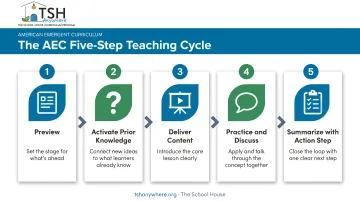
Deliver the session with this simple sequence:
- Preview what the session covers and why it matters to them specifically.
- Activate prior knowledge by asking what parents have already noticed at pickup.
- Deliver the content with stories and visuals, not just definitions.
- Let parents practice or discuss. Even five minutes of table talk beats a lecture.
- Summarize with one action step they can try that week.
Adults engage most when content connects to their current life, not abstract theory. Run these events consistently rather than as one-offs, and you build the parent buy-in that makes classroom partnerships actually work.
Turning Parent Education Into a Stronger School Community
A single great parent night fades fast. What actually shifts a school's culture is consistency: monthly touchpoints—in-person sessions, newsletters, or recorded workshops parents can watch after bedtime.
Over time, that steady rhythm turns parents from skeptical observers into active partners in their child's development. They stop asking why their kid has no homework and start asking how to support the work she's already doing.
The School House's model is a useful example of how this happens without a large events budget. Rather than flying in outside speakers, its TSH Anywhere platform runs on:
- Weekly live educator and founder Q&A sessions, recorded for anyone who can't attend live
- Bi-weekly newsletters and weekly email updates that keep families in the loop between sessions
- A library of 400+ training films parents can work through on their own schedule
- Members-only community where families troubleshoot together
None of this requires a large operating budget. It requires deciding that ongoing family dialogue is part of the curriculum, not an afterthought. When schools treat family partnership as curriculum—not an add-on—parent education stops being an event and becomes culture.
Frequently Asked Questions
What are some common topics for Montessori parent education nights?
Foundational sessions cover Montessori 101, sensitive periods, and freedom within limits. Age-specific sessions cover practical life for toddlers, homework philosophy and screen time for elementary families, plus cross-level favorites like Promoting Independence.
What is the 7-7-7 rule for parents?
It's a popular parenting rule of thumb, not an official Montessori term: seven distraction-free minutes at morning, reunion, and bedtime—21 minutes a day total. That focus on predictable routine and boundaries echoes core Montessori principles.
What are some examples of Montessori parenting practices?
Common everyday examples include:
- A prepared home with low shelves and limited toy choices
- Offering two acceptable options instead of open-ended choices
- Involving kids in real chores without allowance-based rewards
How often should Montessori schools hold parent education events?
Monthly or quarterly in-person sessions work well, supplemented by ongoing digital resources like newsletters, recorded workshops, or weekly email updates so families stay engaged between events.
Do parents need any special training to practice Montessori principles at home?
No formal certification is required. Learning the core principles through school resources or training films helps you apply them more consistently at home.
How is Montessori parenting different from traditional parenting styles?
Montessori parenting favors child-led independence, natural consequences, and intrinsic motivation. Traditional approaches tend to be more directive, relying on adult-led instruction and reward-based systems like allowances or grades.