
Many new parents worry about picking the wrong curriculum, whether their kid will make friends, and whether they're "doing it wrong." Here's the truth: there's no single correct way to homeschool. This guide walks through the practical, research-backed steps that make your first year manageable instead of chaotic.
Key Takeaways
- Homeschooling doesn't need to mirror a traditional school day; flexibility is the point
- Start with a dedicated space and 3-4 core subjects before adding anything else
- Consistent routines matter more than rigid hour-by-hour schedules
- Support networks reduce isolation and burnout quickly
- Expect to adjust your curriculum; trial and error is a normal part of getting started
Understand Your "Why" and Set Realistic Expectations
Before you buy a single workbook, get clear on why your family is homeschooling. According to federal survey data, parents' top reasons include concerns about school environment (cited by 80%), wanting more family time together (75%), and dissatisfaction with academic instruction elsewhere (73%). Parents cited these motivations in NCES's 2019 National Household Education Survey.
Your "why" becomes your compass. When a curriculum feels wrong or a friend's homeschool looks totally different from yours, you'll have something to measure against besides comparison.
A few things to keep in mind:
- Comparing your homeschool to a public-school benchmark—or another homeschool family's Instagram feed—creates unnecessary stress
- Define your own version of success: is it academic mastery, more family connection, or something else?
- Expect a learning curve. Both you and your child are building new habits, and the first two or three months are often the bumpiest
Programs like The School House's TSH Anywhere American Emergent Curriculum build around values such as civics, executive functioning, and curiosity about the natural world. Once you know what you want your child to walk away with, you can judge every curriculum against your goals—not someone else's feed.
Set Up a Homeschool Space and Daily Routine
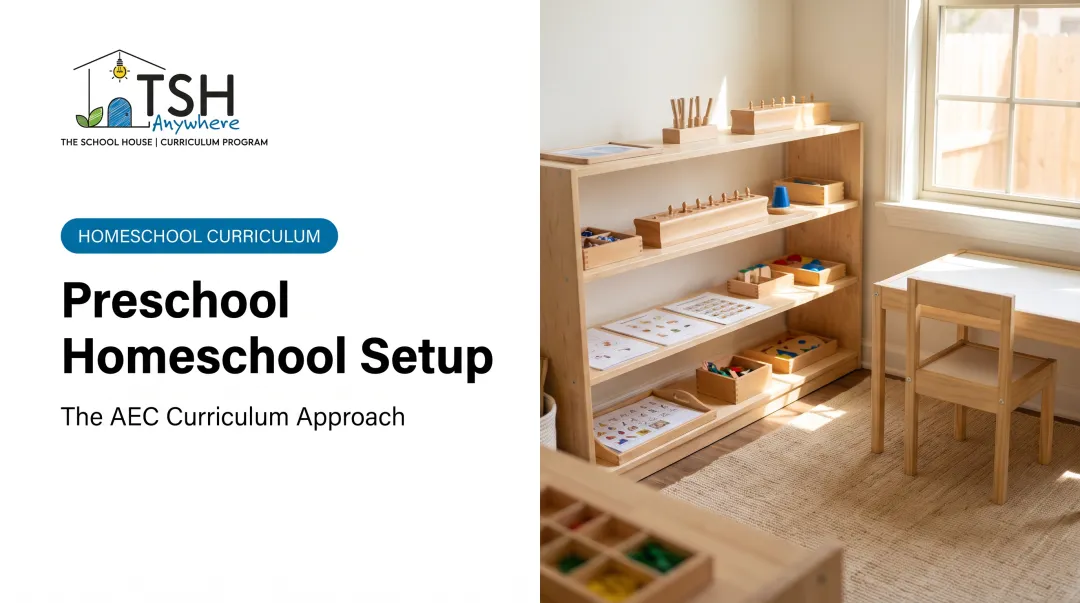
You don't need a Pinterest-worthy classroom. A quiet corner with a table, good light, and minimal distractions works fine.
Choosing Your Space
Kids aged 3 to 12 usually focus better in organized, visually calm spaces—ideally with easy access to the outdoors for breaks. Keep supplies within reach:
- Pencils, paper, and books in labeled bins
- A visible daily checklist or schedule card
- A small shelf for "finished work" so kids see progress

Building the Routine
Start each day with a "soft start": breakfast, a few minutes of quiet reading, maybe a short walk, then lessons. That gentle ramp signals the shift from home mode to learning mode without an abrupt flip.
A sustainable weekly rhythm typically includes:
- Consistent start and end times (even if the hours are short)
- Short transition breaks between subjects to reset attention
- Built-in flexibility for hands-on projects or unexpected detours
- Regular check-ins so you can drop what isn't working
End the day with a short reflection: what went well, what was hard. Structure helps, but only up to a point. A 2024 systematic review in the Journal of Family Theory & Review (drawing on 170 studies) links consistent routines to better focus, self-regulation, and academic outcomes—while warning that too much rigidity can backfire. Aim for steady rhythms, not a packed schedule.

Choosing the Right Curriculum and Learning Approach
No single curriculum works for every family. Match the approach to your child's learning style, your daily schedule, and your state's homeschool requirements.
The Major Approaches
| Approach | What It Looks Like |
|---|---|
| Traditional/textbook | "School at home"—grade-level, parent-directed, classroom-style |
| Unit studies | Multiple subjects taught around one theme |
| Unschooling | Child-led, interest-driven, no fixed schedule |
| Hybrid/eclectic | Mix-and-match based on subject and family needs |

When you compare options, weigh:
- How much parent prep time you can give each week
- Whether your child learns best with structure or open exploration
- What your state requires for subjects, records, or assessments
- Cost of materials versus what you already have at home
Start with 3–4 core subjects—math, reading, writing, and one exploratory subject—instead of filling a full school day. Add complexity only after those basics feel steady.
Why Evidence-Based Curricula Matter
A 2026 systematic review found that 62% of studies comparing homeschool and institutional-school students showed positive academic effects for homeschoolers. One nationwide study reported mean scores in the 75th to 79th percentiles across subjects (Peabody Journal of Education).
Those findings have limits: the sample was not randomly selected nationally and underrepresented Hispanic and Black children. Use them as a signal that strong home instruction can work—not as proof that every program will.
Research-backed frameworks help close that gap. The School House has built its American Emergent Curriculum since 2017 on current learning science and validated it for six-plus years in its brick-and-mortar School House. First-time parents often borrow that structure—clear scope, sequenced skills, built-in review—rather than assembling every lesson from scratch.
After you choose a curriculum, protect retention with spiral review: short, repeated practice of earlier material woven into new lessons. You reinforce learning without piling on extra content.
Avoid Common First-Year Mistakes
New homeschool parents tend to make the same handful of missteps. Watch for these:
- Over-scheduling extracurriculars. Piano, soccer, co-op, and art class in the same week sounds enriching, but it often crowds out core learning and burns everyone out.
- Trying to replicate an eight-hour school day. Kids often match public-school progress with just 2-3 focused academic hours daily, thanks to one-on-one attention and no transition downtime.
- Planning all of K-12 upfront. It's tempting to map out twelve years of curriculum in August. Don't. Focus on the year in front of you, maybe two, and adjust as your child grows.

HSLDA's 2024 summary of the Duvall study on 3rd- and 4th-graders supports the shorter-day approach. It wasn't a controlled comparison, so treat it as a helpful data point, not a hard rule.
Build Community and Support Systems
Homeschooling in isolation is exhausting. Joining a co-op, local group, or online community gives you a place to trade curriculum tips, navigate state requirements, and vent when a lesson plan implodes.
What support networks typically offer:
- Shared resources and lesson ideas from other parents
- Co-op instruction for subjects you don't feel confident teaching
- Practical guidance on state-specific paperwork and testing rules
- Built-in socialization opportunities for kids
Communities like The School House's Mighty Networks group connect parents and educators nationwide, offering lesson ideas and ongoing conversations. It's open to anyone, not just families using a specific curriculum.
Some families want more structure than a co-op without jumping into full traditional enrollment. Shared microschools and similar community models can fill that gap—parents still guide learning at home, with backup instruction and built-in peer time for kids. Programs like The School House's Build a School initiative help neighborhoods stand up those options, which can be a strong fit when you want community support from day one.
Frequently Asked Questions
How many hours a day should a homeschool day be?
For elementary-age kids, 3-4 focused hours is often plenty, thanks to one-on-one attention and no classroom transition time. Many families find even 2-3 hours can match a full public-school day's progress for younger grades.
What is the best curriculum for beginners?
There isn't a universal "best" option. Start simple with core subjects, watch how your child responds, and adjust from there.
How do I handle socialization concerns?
Co-ops, sports leagues, community groups, and regular adult interaction all provide socialization. Many homeschool families report their kids interact with a wider age range than traditional classrooms allow.
What subjects are essential in the early years?
Reading, writing, and basic math should be your priority. Everything else (science, art, social studies) can supplement once those foundations are solid. Check your state's specific requirements, since they vary.
How do I know if homeschooling is working?
Track small wins: reading progress, engagement during lessons, curiosity about topics. Skip the urge to compare against public-school benchmarks: your metrics should match your own goals.
Can I switch curriculum mid-year if it's not working?
Absolutely. Dropping or swapping a curriculum that isn't clicking is common and expected. Treat your first choice as a starting point, not a permanent commitment.