Introduction
Most states require foreign language credits for homeschool high school graduation. Choosing the right curriculum early decides whether your child actually speaks the language or only remembers a few verb conjugations.
Casual apps won't get you to real proficiency. A structured curriculum builds the sequential grammar, vocabulary, and assessment that apps skip—and those gains compound when study starts early and stays consistent.
This guide breaks down what a solid homeschool foreign language curriculum needs, ranks the top options by age and language, and helps you match a program to your family's goals.
Key Takeaways
- A true curriculum includes sequential lessons, grammar instruction, and assessment, not just app-based practice
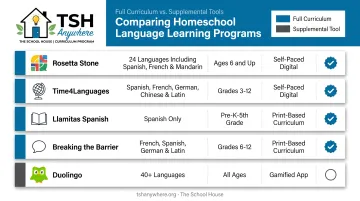
- Rosetta Stone, Time4Languages, Llamitas Spanish, and Breaking the Barrier lead the pack for different ages and goals
- Duolingo works well as a daily supplement but can't replace a credit-worthy course on its own
- Instructional method, age fit, and homeschool ease-of-use matter more than brand recognition
- Consistency and real-life practice determine outcomes far more than which curriculum you pick
Overview of Foreign Language Curriculum in Homeschool Education
A curriculum is a planned sequence of lessons with clear objectives, content, methods, and built-in assessment aimed at a defined proficiency outcome—the same framework UNESCO uses.
A podcast or app is a supplement, not a curriculum, unless you add the missing sequence and testing. Apps like Duolingo, for example, skip the grammar progression and formal evaluation a credit-worthy course needs.
Credit Requirements Vary by State
There's no single national homeschool average for foreign language credits. Each state's homeschool law differs, so check yours before assuming a public-school rule applies to your transcript. As a planning benchmark, HSLDA recommends at least 150 logged hours for one full credit in a core subject like foreign language.
Why Timing and Consistency Matter
A landmark study of nearly 670,000 English speakers found that grammar-learning ability stays strong through childhood and begins to decline around age 17. Researchers concluded that starting language study by roughly age 10-12 gives kids the best shot at native-level grammar, though vocabulary and pronunciation may follow different timelines.
Proficiency comes down to a few factors working together:
- A strong curriculum that supplies sequence and structure
- Real-life practice through conversation, media, and community exposure
- Consistency—regular short sessions beat occasional marathons
- Years of study, not weeks
- Motivation: kids who want to communicate learn faster
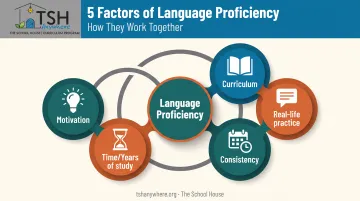
Curriculum lays the foundation; practice, time, and drive build on it. Here's how the top homeschool programs stack up.
Top Homeschool Foreign Language Curricula
These picks were ranked on instructional depth, age fit, language variety, native-speaker involvement, and ease of use. Each one can work for a homeschool parent with no prior language-teaching experience.
Rosetta Stone
Rosetta Stone has been a household name in language software for decades, with more than 20 languages in self-paced digital lessons. Families like it because a child can work through it independently once they understand the routine.
Its Dynamic Immersion method skips English translation entirely, pairing images and audio to build intuitive comprehension. The built-in TruAccent speech-recognition tool gives real-time pronunciation feedback, something few competitors offer at this scale.
| Feature | Details |
|---|---|
| Languages Offered | 20+ languages including Spanish, French, German, Mandarin |
| Best For | Independent learners wanting broad exposure across ages |
| Format | Self-paced digital lessons with speech recognition |
Time4Languages
For families already on Time4Learning, Time4Languages adds foreign language as a bundled elective—no separate subscription required.
It runs on the same no-translation, Rosetta Stone-powered method but folds into Time4Learning's broader dashboard, so parents can track language progress alongside math, science, and language arts in one place. That integration is the real draw here.
| Feature | Details |
|---|---|
| Languages Offered | Spanish, French, German, Latin |
| Best For | Families already using Time4Learning who want a bundled elective |
| Format | Online, self-paced with progress tracking |
Llamitas Spanish
Llamitas Spanish was designed by homeschoolers, for homeschoolers, with scripted lessons that work whether or not the parent speaks a word of Spanish. It's built specifically for preschool through upper elementary ages.
Every lesson includes bilingual scripts, native-speaker audio, and thematic units built around Hispanic culture. Kids pick up vocabulary through songs, art, and stories rather than flashcard drills. Levels run from a preschool track through several years of guided instruction, and you don’t need prior Spanish knowledge to teach it.
| Feature | Details |
|---|---|
| Languages Offered | Spanish only |
| Best For | Non-Spanish-speaking parents wanting a guided, culturally rich program |
| Format | Print-at-home, scripted lessons with audio support |
Breaking the Barrier
When high school transcript credit is the goal, Breaking the Barrier is the grammar-heavy option most parents reach for. It’s built as a full academic course, not casual enrichment.
Each level covers a full year of grammar, vocabulary, reading, writing, and culture, complete with tests, quizzes, answer keys, and a 36-week pacing guide. Currently available in Spanish and French, it's structured for middle school through high school with both 3-year and 4-year pathways.
| Feature | Details |
|---|---|
| Languages Offered | French, Spanish |
| Best For | High schoolers needing rigorous, credit-ready coursework |
| Format | Textbook-based with workbooks and audio components |
Duolingo
Almost every family has tried Duolingo: a free, gamified app covering 40+ languages with streaks, points, and leaderboards that keep kids coming back daily.
It’s genuinely effective as reinforcement. A Cambridge University Press study found beginner French learners who used Duolingo alongside class instruction improved on nearly every measure. It still lacks the grammar sequence and formal assessment transcript credit requires, so treat it as a companion tool—not the main course.
| Feature | Details |
|---|---|
| Languages Offered | 40+ languages |
| Best For | Daily practice and reinforcement alongside a formal curriculum |
| Format | Free gamified app, self-paced |
How We Chose the Best Foreign Language Curriculum
The most common mistake homeschool parents make is leaning entirely on free apps or scattered resources, then discovering none of it counts toward a real transcript credit. A structured curriculum solves that problem from the start.
To find programs that deliver that structure, four factors drove these rankings:
- Instructional method — immersive, no-translation programs versus grammar-first academic sequences
- Age and level appropriateness — whether the pacing actually fits the child using it
- Native-speaker involvement — audio, video, or scripted native pronunciation models
- Homeschool ease-of-use — open-and-go scripts versus programs that assume parent fluency
Programs that scored well on most or all four factors made the final list; those relying purely on gamification without sequential instruction landed as supplements instead.
Choosing the Right Language and Building Long-Term Success
Picking the language itself matters as much as picking the curriculum. Consider these factors before committing:
- Family heritage — a language already spoken by grandparents or relatives gives kids a reason to stick with it
- Community and location — proximity to speakers for real conversation practice accelerates progress
- Academic or career goals — some colleges and careers favor specific languages
- Difficulty for English speakers — Spanish and French rank among the easiest for native English speakers; languages with different alphabets or grammar take longer
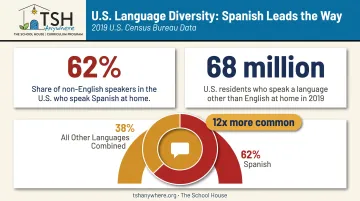
Spanish remains the most practical default for U.S. families. Roughly 68 million U.S. residents spoke a language other than English at home in 2019, and Spanish accounted for 62% of that group. That makes Spanish about 12 times more common than the next runner-up. That prevalence means more resources, more native speakers nearby, and more real-world practice opportunities.
Curriculum Alone Won't Get You There
Even the best-designed course underperforms without regular, low-pressure practice. The success formula from earlier still applies: curriculum, consistent exposure, time, and motivation.
Blend your core program with:
- Children's books or graphic novels in the target language
- Age-appropriate shows or cartoons with subtitles off
- Podcasts or music during car rides
- Conversation with native speakers, even a few minutes weekly
A curriculum builds the skeleton. Everyday exposure puts muscle on it.
Conclusion
The best homeschool foreign language curriculum is the one that fits your child's age, learning style, and your family's actual goals for the language—not the brand that ranks first in a search.
Revisit that fit each semester. If your child has finished the workbook but can't hold a basic conversation, adjust pacing or method instead of checking a credit box.
That same evidence-first mindset applies beyond foreign language. The School House built its American Emergent Curriculum on measurable outcomes rather than brand reputation. Learners test at least twice above the national average, with a decade of research behind the design. Whatever subject you evaluate next, prioritize results over a familiar name.
Frequently Asked Questions
At what age is it recommended for children to start learning a foreign language?
Most families do well starting in preschool or elementary school, when young brains pick up sounds and vocabulary more easily. Older kids and teens can still build strong proficiency with steady, consistent study.
What is the best language for a homeschooler to start with?
Spanish is often the practical pick for U.S. families because of abundant resources and community use. The best choice still depends on your family's heritage, goals, and interest.
How many foreign language credits do homeschoolers need for high school?
There's no single national average, since credit rules vary by state homeschool law. HSLDA's benchmark of 150 logged hours per credit is a useful planning guide, but check your specific state and target colleges' expectations.
Can I teach a foreign language if I don't speak it myself?
Yes. Scripted, open-and-go curricula like Llamitas Spanish are built specifically for non-fluent parents, pairing bilingual instructions with native-speaker audio support.
How much time should be spent on foreign language study each day?
Aim for short, consistent sessions of about 10–15 minutes a day. Daily practice beats occasional long lessons for long-term retention.
Is Duolingo enough to homeschool a foreign language?
Duolingo is a strong supplemental tool for daily reinforcement, but it lacks the structured grammar instruction and formal assessment needed to serve as a standalone, credit-worthy curriculum.