Introduction
Your child finishes a chapter, closes the book, and looks up at you expectantly. "Now what?" You reach for a grammar workbook. They groan.
If you've ever felt torn between "doing language arts" and what Charlotte Mason actually recommends, you're not alone. Many homeschooling parents assume CM language arts means a specific workbook or grammar program. It doesn't.
Charlotte Mason builds language arts through daily habits of hearing, speaking, reading, and writing. These skills grow over years of practice, not through isolated drills checked off a list.
This guide breaks down what Charlotte Mason language arts actually looks like: its core components, how it shifts as your child grows, and which curriculum options can help you put it into practice.
Key Takeaways
- Charlotte Mason language arts blends reading, narration, copywork, and dictation into daily habits, not separate workbooks.
- Formal grammar waits until Form II, around age 9-10, after children absorb sentence structure through books.
- Narration, or telling back what's read, is the method's core tool for comprehension and later composition.
- Living books, not simplified "twaddle," build vocabulary through context rather than word lists.
- Free (AmblesideOnline) and paid (Simply Charlotte Mason, LLATL) curricula both follow this same sequence.
What Is Charlotte Mason Language Arts?
Charlotte Mason defined language arts as the art of using language well. In practice, it means building four connected skills through real books and daily practice—not a stack of workbooks:
- Hearing
- Speaking
- Reading
- Writing
This is where CM diverges sharply from conventional programs. Traditional curricula split grammar, vocabulary, spelling, and composition into standalone subjects, each with its own book and schedule. Charlotte Mason rejected that separation, believing these skills develop together through rich literature.
Living Books Over "Twaddle"
Central to her philosophy are "living books": literature written with real literary power, by authors who care about their subject, rather than diluted textbook prose. Mason was blunt about this. In Parents and Children, she wrote that "children must have books, living books; the best are not too good for them; anything less than the best is not good enough."
She had a name for the alternative: twaddle. Watered-down texts, she argued, starve children of the vocabulary and sentence structure they need to absorb naturally.
A Deliberately Delayed Approach
CM also delays certain instruction on purpose. Formal grammar, free composition, and systematic writing wait until around Form II, roughly age 9-10. Before that, oral narration and steady exposure to well-written books do the heavy lifting.
This method isn't new. Mason developed it more than a century ago in England through the Parents' National Educational Union (PNEU) schools she helped establish. She trained teachers at her House of Education in Ambleside, the town that lends its name to today's AmblesideOnline.
Homeschoolers now carry on that tradition through that free resource and paid programs like Simply Charlotte Mason.
The Core Components of a Charlotte Mason Language Arts Curriculum
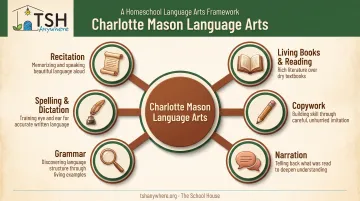
Charlotte Mason language arts breaks into six interlocking habits. Here's how each one works.
Living Books and Reading
Reading instruction blends phonics with sight-word recognition, whichever helps a particular child crack the code fastest. Once a child reads fluently, often by fourth grade, they take over reading most of their own schoolbooks.
From there, good books do the vocabulary work. A child reading narrative history, quality biographies, and well-written fiction absorbs advanced words and sentence patterns in context, no separate vocabulary list required.
Copywork and Transcription
Starting around age 7-8, children copy short passages chosen for quality, not length. This single habit builds handwriting, spelling awareness, and an eye for good sentence construction all at once.
Mason's guideline: perfect work in small amounts. A few flawless lines beat a full page done carelessly. Most sessions run just 10-15 minutes.
Narration (Oral and Written)
Narration is Charlotte Mason's signature tool: after hearing or reading a passage once, attentively, the child tells it back in their own words. No re-reading, no notes.
Oral narration typically starts around age 6. Written narration follows years later, usually around age 9-10. By then, handwriting and spelling are steady enough that the act of writing doesn't block the thinking.
Grammar
Mason introduces grammar only after children have absorbed sentence structure naturally, through years of reading well-constructed prose. Formal study typically begins in Form II, around fourth grade.
Even then, Mason recommended starting with sentence analysis: how a sentence works as a whole, before diving into parts-of-speech drills.
Spelling and Dictation
Studied dictation is CM's answer to the weekly spelling test. The child studies a short passage in advance, notes any tricky words, and pictures them mentally. Then they write the passage from memory as it's read aloud, clause by clause.
Mason believed this beats memorizing disconnected word lists, since the child learns spelling inside real sentences rather than as arbitrary strings of letters.
Recitation
Memorizing and reciting poetry, Scripture, or prose passages builds fluency, a feel for rhythm, and expressive delivery that silent reading rarely teaches.
How Charlotte Mason Language Arts Unfolds by Age
Grades 1–3 (Form I)
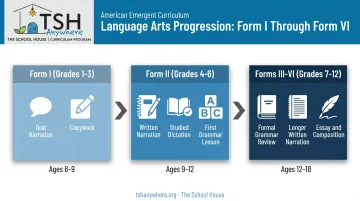
Form I is about foundations, not output. Children read (or are read to), narrate orally after each lesson, and begin simple copywork around ages 7–8. Phonics and reading instruction take center stage.
Formal grammar doesn't appear here. The only "grammar" happening is intuitive: absorbing sentence structure by hearing hundreds of well-written ones.
Grades 4–6 (Form II)
Form II marks the biggest shift in the sequence. Written narration begins with one short narration a week, then builds gradually. Studied dictation enters the routine, alongside the first real grammar lessons.
Independent reading expands significantly here. Most children take over reading the bulk of their own schoolbooks during this stage.
Grades 7–9 and Beyond (Forms III–VI)
Here's where the sequence commonly gets muddled: Forms III-IV actually correspond to roughly grades 7-9, not a full 7-12 span. Forms V-VI pick up from there, covering roughly grades 10-12.
Across these years, several skills advance together:
- Formal grammar becomes a genuine review subject
- Written narration grows longer and more frequent
- Editing enters the picture
By the upper forms, narration gives way to structured composition assignments, essays, and research-based writing.
Charlotte Mason vs. Traditional Language Arts: Key Differences
Traditional curricula separate grammar, spelling, vocabulary, and writing into standalone subjects, each with its own book and weekly quiz. Charlotte Mason integrates all of it through literature and daily habits:
- No vocabulary workbook — words come from living books
- No early grammar drill — formal rules wait until a child already senses how sentences work
- Writing grows from narration and copywork, not isolated prompts
The other major difference is pacing:
- Traditional programs cover set content at fixed grade levels, ready or not.
- Charlotte Mason prioritizes developmental readiness, trusting that a child who has spent years narrating good books will pick up formal rules quickly once introduced.
That gentler pace draws real criticism. Some parents worry that delaying formal grammar and free writing until age 9 or 10 leaves gaps. Proponents counter that years of narration practice build stronger long-term writing skills. Hard outcome data is still limited, so the choice often comes down to whether you value early coverage or deep readiness.
Popular Charlotte Mason Language Arts Curriculum Options
A few well-established resources map Mason's method onto a usable weekly schedule. Use the snapshot below to match format, structure, and budget to your family.
| Curriculum | Focus | Cost |
|---|---|---|
| AmblesideOnline | Complete scope and sequence with book lists, copywork, and grammar guidance for every grade | Free |
| Using Language Well (Simply Charlotte Mason) | Integrated spelling, grammar, and usage built around dictation passages, grades 3-10 | Paid |
| Learning Language Arts Through Literature (Common Sense Press) | All-in-one program covering spelling, copywork, grammar, and phonics through weekly literature selections | Paid |
| Spelling Wisdom + Know and Tell | Dictation passages paired with Karen Glass's guide to narration and its link to composition | Paid |
In practice, the fit breaks down like this:
AmblesideOnline is still the go-to free path when you want a full CM scope and sequence—book lists, copywork, and grammar guidance—without buying a packaged program.
Simply Charlotte Mason's Using Language Well builds each level around dictation from real literature, not generic sentences. Choose it when spelling, grammar, and usage are the main gaps.
Learning Language Arts Through Literature keeps literature central but leans more workbook-adjacent. It suits families who want tighter weekly structure without leaving the CM orbit.
Spelling Wisdom paired with Karen Glass's Know and Tell is the stronger pick when you want dictation practice plus a clear bridge from narration into composition.
Bringing Charlotte Mason Principles to Life at Home or in the Classroom
Getting started doesn't require buying every resource at once. Begin with narration and copywork, since these two habits form the foundation everything else builds on. Add dictation and grammar only once those feel natural.
A few practical guardrails help:
- Keep individual lessons short: 10-20 minutes is plenty for copywork, dictation, or narration.
- Choose genuinely excellent literature over simplified retellings, even if it feels harder at first.
- Resist correcting every narration mistake. Let comprehension build before worrying about polish.
- Read aloud daily—even after a child reads independently—to keep building vocabulary and narration skill.
Families drawn to this approach are often looking for something specific: literature-rich learning that doesn't feel outdated or overly rigid. That search has fueled modern approaches that borrow the same instincts without formally adopting Charlotte Mason's method.
The School House, for instance, isn't a Charlotte Mason school. Its American Emergent Curriculum is its own model, built around Montessori-aligned instruction and screen-minimal, hands-on learning. Still, it shares the same core bet: real books over worksheets, connected lessons over isolated drills.
Children learn language by using it, not by filling out a workbook about it. Families exploring TSH Anywhere's homeschool curriculum will recognize that same value, even when the method looks different on paper.
Frequently Asked Questions
What is Charlotte Mason language arts?
Charlotte Mason language arts develops hearing, speaking, reading, and writing together through living books, narration, and daily habits—not isolated workbooks. Skills build in tandem rather than in separate lessons.
When does Charlotte Mason introduce formal grammar?
Formal grammar typically begins in Form II, around fourth grade, after children absorb sentence structure through years of reading and oral narration. Sentence analysis usually comes before parts-of-speech drills.
What is narration in the Charlotte Mason method?
Narration means telling back what was just read or heard, in the child's own words. It starts orally around age 6 and shifts to written form around age 9-10.
What's the difference between copywork and dictation?
Copywork means copying a chosen passage to build handwriting and spelling awareness. Dictation means studying a passage in advance, then writing it from memory as it's read aloud.
Is the Charlotte Mason method good for reluctant writers or spellers?
Its gradual, narration-first approach often reduces writing anxiety, since children build confidence before facing a blank page. Results still vary by child and by how consistently dictation is practiced.
What curriculum should I use for Charlotte Mason language arts?
AmblesideOnline offers a free, complete scope and sequence, while Simply Charlotte Mason and Learning Language Arts Through Literature are solid paid options. Choice depends on budget and how much structure you want.