Introduction
It's 11 p.m., and you're still scrolling. Five browser tabs deep, comparing math workbooks in one tab and a phonics program in another, trying to figure out how to build a homeschool year from scratch.
If this sounds familiar, you're not alone. Many parents hit this exact wall in their first year of homeschooling.
That's where all-in-one curricula come in. Instead of sourcing math from one company, science from another, and language arts from a third, you get every core subject bundled under one provider, often with a built-in schedule you can simply open and follow.
The appeal is obvious for busy families: less planning, fewer decisions, fewer late-night searches. But "all-in-one" covers a huge range of products, from free faith-based programs to $950 literature-based kits.
This guide breaks down the top-reviewed options, what to check before committing a full school year, and how to tell a rigorous program from one that's just flashy marketing.
Key Takeaways
- All-in-one curricula bundle math, language arts, science, and social studies into one open-and-go package.
- Worldview ranges from young-earth Christian to fully secular, so verify alignment before you buy.
- Cost and format range widely, from free online programs to $950+ literature kits with shipped materials.
- Legitimacy hinges on sample lessons and verified family reviews, not testimonials alone.
What Is an All-in-One Homeschool Curriculum?
An all-in-one homeschool curriculum means one provider covers every core subject with a built-in scope and sequence—so you're not piecing together five separate programs.
HSLDA classifies homeschool curricula into several categories, including all-in-one, by-subject, online, and unit-study, though the lines often blur in practice.
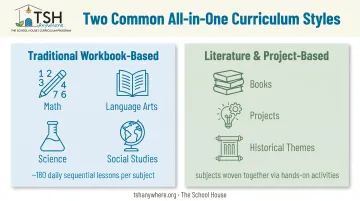
Two common styles dominate this category:
- Traditional workbook/lesson-based programs cover math, language arts, science, and social studies as sequential courses—often around 180 daily lessons per subject.
- Literature or project-based unit studies weave subjects together around children's books, historical themes, or hands-on projects instead of separate textbooks.
Neither style guarantees completeness. Some "all-in-one" programs skip math entirely. Others skip early phonics. Read the fine print before assuming a package covers everything your child needs.
Who Benefits Most From This Approach
All-in-one curricula tend to work best for:
- New homeschooling families who want structure without building a curriculum from scratch
- Multi-child households juggling different grade levels at once
- Parents who want less daily prep and more predictable pacing
That said, package use isn't universal. A 2017 NHERI survey found only 21% of homeschoolers used a package curriculum, with just 5% relying on a single package exclusively. The majority, 68%, described their approach as eclectic.
Highly self-directed kids, or those with a specific passion like competitive math, sometimes outgrow the bundle and need extra resources on top. An all-in-one is a strong starting point—not necessarily a forever plan.
What to Evaluate Before Choosing an All-in-One Curriculum
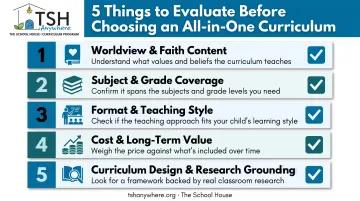
Secular vs. Faith-Based Content
Worldview is the first filter, and it's often buried several pages into a sales site. Take Easy Peasy: it's marketed as free and comprehensive, but its creator openly describes it as a Christian curriculum.
Independent reviewer Cathy Duffy documents a literal six-day creation framework showing up directly in science and history lessons.
Secular families using programs like this often end up pre-reading every science and history lesson to decide what to skip or adapt, which is no small task across a 180-day school year. Ask two questions before buying:
- Does the provider state its worldview explicitly, or do you have to dig for it?
- Are religious references confined to a devotional add-on, or baked into core science and history content?
Subject and Grade-Level Coverage
Most all-in-one programs are built around a 180-lesson school year, mirroring common state attendance rules. But "covers everything" is a marketing phrase, not a guarantee. Before buying, check:
- Does it include math, language arts, science, and social studies, or just some of them?
- Does it span every grade level you'll need for the next 3 to 5 years?
- Are phonics and early math foundations included, or assumed to come from elsewhere?
Torchlight and Blossom and Root, for example, both intentionally leave out math and expect you to pair a separate program alongside them.
Format and Teaching Style
Delivery format changes both your daily workload and your total cost. Options generally fall into three camps:
- Digital/app-based is often cheapest since there's nothing to print or ship
- Downloadable PDFs are flexible, but you supply the paper, ink, and binding
- Printed workbooks are convenient, but shipping adds up fast for multi-child households
A fully online program might look cheaper upfront than a printed one, until you factor in what it costs to print 180 days of lessons at home. Run the math both ways.
Cost and Long-Term Value
Sticker price rarely tells the whole story. A curriculum priced at $30 per grade sounds cheap, until you multiply it across three kids for eight years. Others charge more upfront but cover every child in the household for life.
Before buying, calculate:
- Total cost per child, per year, including books, printing, and shipping
- Whether the license covers one child or the whole household
- Whether pricing is one-time, annual, or per-grade
A $300 lifetime multi-child license can beat a $30-per-child model quickly once you have more than one kid moving through the program.
Curriculum Design and Research Grounding
Price and format are easy to compare. Pedagogy is harder to judge, but it matters more. A curriculum built around rote memorization produces different long-term results than one designed around how children actually retain and apply information.
TSH Anywhere built its model around this distinction. Its American Emergent Curriculum (AEC) grew out of a decade of pedagogical research and more than six years of classroom testing at The School House, its Montessori-based campus on Long Island.
Rather than drilling isolated facts, AEC lessons weave reading, math, science, and civics together and follow a developmental pace instead of a fixed test-prep calendar. The company reports that learners test at least twice above the national average across subjects, with no academic admission requirements.
Whatever program you choose, ask the same question: is this design backed by research and classroom data, or just a catchy name?
Top All-in-One Homeschool Curricula Worth Reviewing
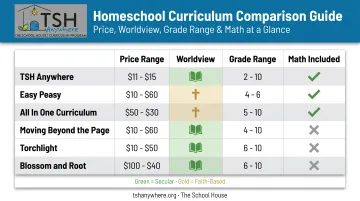
Here's how six of the most-discussed all-in-one options compare, based on official program details and independent reviews.
TSH Anywhere Homeschool Curriculum
TSH Anywhere delivers the American Emergent Curriculum as a per-learner subscription for Pre-K through 8th grade, priced at $125 a month or $1,200 a year in 8-week sessions. Families get printable lesson materials plus a library of 400+ training films that walk parents through each subject. An optional physical materials box is available as an add-on for hands-on learners.
What sets it apart on this list is the research behind it. AEC was developed over a decade of curriculum research and refined through more than six years of live testing at The School House, a Montessori-certified flagship campus staffed by educators with 14 to 20-plus years of classroom experience.
The curriculum is fully secular, updated annually, and deliberately screen-minimal. Drawing on research the program cites—young children retain only about 4% of screen-based instruction—lessons lean on printed materials and hands-on work instead of video drills.
Easy Peasy All-in-One Homeschool
Easy Peasy is free, covers preschool through 8th grade (with a separate site for high school), and remains one of the most complete no-cost options available. Its phonics and sight-word sequence is a genuine strength for early readers, and math stays low-prep, pulling from tools like Khan Academy and MathIsFun for older grades.
The catch: it carries clear young-earth Christian content in its science and history lessons, according to independent reviewer Cathy Duffy. Secular families who've used it often describe pre-reading each day's science and history lesson to decide what to skip or swap. Worth knowing too: Easy Peasy keeps no student records. That responsibility falls entirely on the parent.
All In One Curriculum
This program covers K-8 math, language arts, science, and social studies with student books, parent guides, and answer keys included. The vendor markets it as fully secular and standards-aligned. It's positioned as an affordable, self-paced, open-and-go option. Sale pricing runs about $30 per grade (closer to $150 regular), or $300 for a full K-8 bundle.
The standout feature for larger families: licensing covers the whole household for life, not just one child. That changes the math significantly if you're homeschooling multiple kids through the same grade levels over the years. Note that "standards-aligned" here is a vendor claim, not an independently verified certification.
Moving Beyond the Page
Moving Beyond the Page uses literature and real books as the spine for science, social studies, and writing, aimed at gifted and hands-on learners. It's organized by age band rather than grade, and placement runs off a short reading/writing check instead of birth year alone.
It's also the priciest option here. A full Age 5-7 package runs $953.18, before required books are added. A pared-down Age 4-5 curriculum-and-materials kit runs about $207. Families who choose it usually say the project depth justifies the cost for the right learner.
Torchlight Curriculum
Torchlight takes a Socratic, discussion-driven approach to humanities, science, and social-emotional learning, and it's popular in gifted and neurodivergent homeschool communities for its inquiry-based style. Level 1 runs about $42, with bundles slightly higher.
The gap: Torchlight doesn't include math or early literacy beyond preschool. You'll need to pair it with a separate math program, and often a phonics program too. If you want a true single-source solution, this isn't it, but as the humanities half of a two-curriculum setup, it has a loyal following.
Blossom and Root
Blossom and Root offers a secular, nature-based, literature-rich approach spanning pre-K through grade 6, with full-level bundles priced between $79 and $162. Like Torchlight, it leans heavily on parent involvement and daily preparation.
Also like Torchlight, it isn't a true all-in-one past the earliest grades. Math, spelling, handwriting, and formal history are left out of grade 1-plus bundles, so you'll need to source those separately. Cathy Duffy recommends adding a dedicated math program starting in first grade. If nature study and living books are your priority, it's a strong secular option.
Is an All-in-One Curriculum Legit? Spotting Red Flags
Short answer: legitimacy isn't about the phrase "all-in-one" at all. That term isn't regulated or standardized by anyone. A shallow, test-prep-driven program can call itself all-in-one just as easily as a well-researched one.
What actually signals legitimacy:
- Standards alignment you can verify, not just a claim on a sales page
- Transparent lesson structure, meaning you can see a full sample week, not just a marketing clip
- Verifiable reviews from real homeschooling families, not curated vendor testimonials
Cathy Duffy's review framework is a useful gut-check here. She evaluates programs on educational approach, learning style fit, content depth, parent prep load, worldview, and format, not marketing polish.
Curriculum accreditation generally applies to institutions and full-time programs, not standalone homeschool packages. An "accredited curriculum" claim on its own deserves a second look.
Before committing a full year and a full budget, read or watch a complete sample week, not just the intro lesson. Shallow programs often front-load their best material into preview samples.
One practical check: look for a documented outcome, not just an inspirational quote. Standardized test comparisons, third-party recognition, or long-term family retention data carry more weight than a homepage full of adjectives.
Red flags worth remembering:
- "Complete curriculum" claims that quietly exclude math or early literacy
- No available sample lessons or scope-and-sequence document
- Standards claims with no named framework attached
- Testimonials presented as if they were outcome data
Frequently Asked Questions
Is an all-in-one curriculum legit?
Legitimacy depends on standards alignment, transparent lesson plans, and verified family reviews, not marketing claims. Most established providers publish sample lessons so you can judge quality before buying.
How much does an all-in-one homeschool curriculum cost?
Costs range from free (Easy Peasy) to several hundred dollars a year, with some literature-based packages running over $900 once books are included. Lifetime or multi-child licensing can lower your long-term cost per family.
Can I customize an all-in-one curriculum to fit my child's pace?
Most programs let you skip, repeat, or reorder units rather than forcing strict grade-by-grade pacing. Placement tests, where offered, help match your child's actual level instead of relying on age or grade alone.
Are all-in-one homeschool curricula secular or religious?
Both types exist, and worldview shapes science and history content. Easy Peasy embeds young-earth Christian content in science and history, while programs like All In One Curriculum and Blossom and Root market themselves as fully secular.
What age groups do all-in-one curricula typically cover?
Most cover preschool through 8th grade, with a few extending further. Some, like Torchlight, exclude specific subjects such as math even within their covered age range.
Can I switch curricula mid-year if it's not working?
Yes. Switching mid-year is common in homeschooling and rarely causes lasting setbacks. Keep records or a portfolio of completed work so the transition doesn't disrupt your tracking for state reporting or future placement.