Introduction
Every February, a lot of homeschool parents hit the same wall. You pull out a few library books about Rosa Parks and Martin Luther King Jr., squeeze in a lesson or two between your regular ELA and math blocks, and then March arrives and Black history quietly disappears from the schedule until next year.
Parents care. The real problem is that most curricula treat Black history as a seasonal add-on instead of weaving it into American history, science, and literature all year.
The gap is real. A 2023 Education Week survey found that 65% of teachers said their state didn't require Black-history instruction at all, so most families have to build that coverage themselves.
This guide lays out a full framework for teaching Black history year-round, across every subject and grade level, without turning your homeschool into a second full-time job.
Key Takeaways
- Year-round Black history builds lasting understanding; February-only units stay surface-level.
- Weave Black history into ELA, science, and fine arts—not a standalone subject.
- A seasonal, monthly-theme framework keeps year-round teaching manageable for busy households.
- Match depth and format to grade band, from picture books to primary-source analysis.
Why Black History Deserves a Year-Round Place in Your Homeschool
Squeezing Black history into one month tends to reduce it to a checklist: a few names, a few dates, done. That's not how kids build genuine historical understanding.
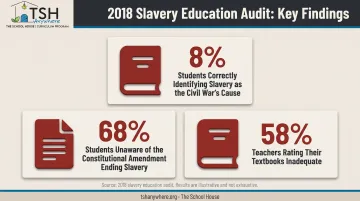
A 2018 audit of slavery education backs this up. Researchers surveyed 1,000 high school seniors and nearly 1,800 teachers, and reviewed 15 state standards and 12 major textbooks. The results were rough (Learning for Justice, 2018):
- Only 8% of students correctly identified slavery as the central cause of the Civil War
- 68% didn't know a constitutional amendment formally ended slavery
- 58% of teachers rated their own textbooks inadequate
Textbooks Reflect Who Wrote Them
History textbooks aren't neutral. A peer-reviewed analysis of 19 Texas-adopted U.S. history textbooks found racial violence was frequently framed as isolated bad behavior rather than tied to the systems and institutions that enabled it. Coverage also clustered heavily around slavery and Reconstruction while largely skipping violence and injustice after the civil rights era.
That pattern is why The School House, founded in 2017 after research into systemic failures in American education, rebuilt its curriculum framework from the ground up. Gaps like these don't fix themselves.
Spacing Beats Cramming
There's a learning-science case for year-round teaching too. A major meta-analysis covering 317 experiments and nearly 15,000 participants found spaced learning consistently outperformed massed, single-session study. Average recall hit 47.3% for spaced study versus 36.7% for cramming (Cepeda et al., 2006).
One intensive February unit simply doesn't stick the way monthly touchpoints do.
ELA, science, and civics already give you natural entry points. You don't need an extra class period—just a shift in how you use the one you already have.
Building the Blocks of an All-Year Black History Curriculum
Once you accept that Black history belongs in every season, the next question is practical: how do you actually structure it?
Cross-Subject Integration
Instead of a standalone unit, fold Black history into subjects you're already teaching:
- ELA: Novels, memoirs, and poetry by Black authors as part of your regular reading rotation
- Science: Black scientists, inventors, and astronauts tied to whatever unit you're already covering
- Fine Arts: Music genres and visual art movements shaped by Black artists
- Social Studies: Pivotal events studied in chronological context, not isolated from the rest of U.S. history
A monthly-theme approach works well here, similar to the unit-study models many homeschoolers already use. Rotate through themes such as:
- Early Black history
- Civil rights
- STEM pioneers
- Arts and culture
- Entrepreneurship
Hang reading, writing, and discussion assignments off whichever theme is in play that month.
Setting Goals, Structure, and Accountability
Without some structure, "year-round" can quietly become "whenever we remember." A few fixes:
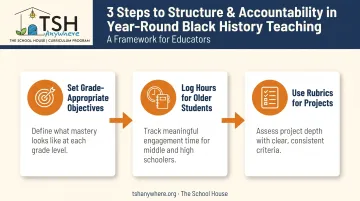
- Set grade-appropriate objectives per theme. A third grader might identify three contributions from a figure; a seventh grader might analyze primary sources.
- Log hours for older students. For middle schoolers, keep a simple record: date, subject connection, time spent, and final product.
- Use rubrics for book reports and projects. National History Day, for reference, weights historical quality at 80% and presentation at 20%, a useful ratio to borrow.
If you want a reference model beyond a fully DIY plan, look at how The School House structures its American Emergent Curriculum. It uses 8-week session blocks for deep dives, pairs them with a Cultural Explorations component, and tracks work in a portfolio tool over time.
You don't need that exact system. Themed deep-dives plus a simple place to log output translate directly to a self-built year-round plan.
A Season-by-Season Framework for Spreading Black History Across the Year
Black history belongs across the full school year—not only in February. This seasonal framework keeps coverage steady without crowding one month.
| Season | Months | Focus |
|---|---|---|
| Fall | Sep–Nov | Early African American history, Reconstruction, oral storytelling |
| Winter | Dec–Feb | Civil Rights Movement, MLK Day, Black History Month deep-dive |
| Spring | Mar–May | Black scientists, astronauts, inventors, overlap with Women's History Month |
| Summer | Jun–Aug | Arts, music, culture, Juneteenth, community service, museum visits |
Fall is a natural fit for back-to-school literature units built around oral storytelling traditions, which the Library of Congress describes as drawing on African, Latin American, and Southern folk traditions passed down through generations.
Winter builds toward Civil Rights Movement history and MLK Day, but frame February as the culmination of months of learning rather than the only stop. Use winter readings to show how years of organizing led to laws like the Civil Rights Act, signed July 2, 1964, which outlawed major forms of segregation.
Spring overlaps naturally with your science curriculum. Katherine Johnson's trajectory calculations supported the 1961 Freedom 7 mission. Mae Jemison became the first African American woman in space in 1992. Both make strong tie-ins during a physics or astronomy unit.
Summer is the loosest season, which makes it ideal for a Juneteenth study. On June 19, 1865, Union troops reached Galveston and announced freedom for more than 250,000 enslaved Texans, an event that became a federal holiday in 2021.
Build a simple year-at-a-glance planner with one of each per month:
- One book
- One documentary
- One hands-on activity
If a student's interest spikes on a theme, let it grow into a deeper project instead of forcing it back into the schedule.
Age-Appropriate Approaches for Every Grade Band
The right format depends on your learner’s age, reading level, and maturity—especially in a Pre-K–8 homeschool path.
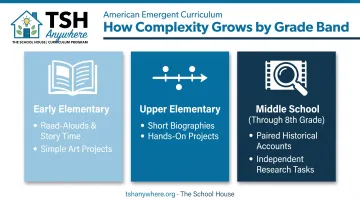
- Early elementary: Picture books, read-alouds, simple art, and oral storytelling introduce ideas without overload.
- Upper elementary: Short biographies, illustrated timelines, and hands-on projects build context kids can discuss.
- Middle school (through 8th): Documentaries, paired accounts of the same event, memoirs, and short research tasks sharpen comparison skills.
Many children notice differences earlier than parents expect, so gentle, age-right conversation can start in the early years. Use these as starting points, then adjust to your child—not a fixed grade rule.
Best Books, Documentaries, and Media to Anchor Your Curriculum
A good media library rotates formats so kids don't burn out on any single type of resource.
Core categories to build from:
- Novels and memoirs: Brown Girl Dreaming by Jacqueline Woodson (National Book Award) for middle grades
- Biography: Claudette Colvin: Twice Toward Justice by Phillip Hoose for ages 12+
- Picture books: The Undefeated by Kwame Alexander and Kadir Nelson (2020 Caldecott Medal) for elementary read-alouds
- Documentaries: PBS's Eyes on the Prize, a 14-hour series on Civil Rights events from 1954 to 1985
- Primary sources: Library of Congress Civil Rights History Project — 1,200+ free oral history recordings
Rotate audiobooks, films, and podcasts monthly to keep engagement up and match different learning styles.
For older students, pair curated media with primary documents such as speeches, letters, and court rulings. Comparing firsthand accounts with secondary summaries builds critical thinking skills.
Frequently Asked Questions
What is the best history curriculum for homeschooling?
There isn't one single "best" option. The strongest approach blends diverse, well-researched resources with a structured framework that integrates history across subjects instead of relying on a single textbook.
How can I teach kids about Black history?
Combine age-appropriate books, documentaries, and discussions with hands-on projects. The key is consistency across the whole year, not a single concentrated unit.
Do I need to buy a special Black history curriculum, or can I build my own?
You can absolutely build your own using library books, free documentaries, and a monthly theme planner. Pre-made unit studies can save time, but they're not required.
How much time should I spend on Black history each week if teaching it year-round?
One to two lessons or activities per week, integrated into subjects you already teach, is a manageable target for most families.
At what age should I start teaching Black history to my kids?
You can start as early as preschool with picture books and simple stories, then grow in depth and complexity through each grade.
How do I keep Black history lessons engaging without overwhelming young learners?
Rotate formats—stories, videos, art, and hands-on projects—and follow your child's curiosity. Letting interest guide the depth keeps lessons age-appropriate without feeling forced.