Introduction
Search "best Latin curriculum" and you'll find list after list pushing $100+ boxed sets, DVD courses, and subscription programs. Many homeschool parents assume rigorous Latin instruction requires that kind of budget.
It doesn't.
Dozens of genuinely free, complete Latin resources exist for every grade level, from full video lecture series to printable grammar drills. The catch is separating what's actually free from what's a free trial or a teaser sample.
This guide walks through real, no-cost Latin options organized by grade band, then shows you how to combine two or three of them into a full curriculum without spending a dime.
Key Takeaways
- Free, structured Latin programs cover elementary through high school learners.
- Video and audio courses such as the London Latin Course and Latinum Institute can replace paid DVD sets.
- Perseus and Project Gutenberg supply free classical texts once basic vocabulary is in place.
- Pair a video course with printable worksheets—no single free resource covers everything.
Why Add Latin to a Homeschool, Even for Free
Latin's rigid grammar structure, with its declensions and case endings, forces students to think analytically about how sentences are built. That skill transfers directly to English grammar and reading comprehension.
Vocabulary payoff is larger still. According to Dictionary.com, over 60% of English words trace back to Greek or Latin roots, and that figure climbs to more than 90% in science and technology vocabulary. A student who learns Latin roots like "port," "dict," and "ject" gains tools to decode a huge share of English words.
Where Latin Fits in the Classical Trivium
Classical educators organize learning into three stages, and free Latin resources map cleanly onto them:
- Grammar stage (K-6): Memorizing vocabulary, endings, and basic sentence patterns
- Logic stage (7-9): Parsing complex sentences and translating short passages
- Rhetoric stage (10-12): Reading and analyzing full classical texts
This framework comes from the Association of Classical Christian Schools. It's a helpful lens for matching free resources to your child's stage, even outside a faith-based context.
There's also a practical payoff. Two or more years of Latin study is widely accepted for foreign language credit. The University of California system, for instance, explicitly counts Latin toward its language admission requirement, treating it the same as Spanish or French.
Best Free Latin Curriculum Options for Elementary Grammar Stage (K-6)
The grammar stage is about repetition: vocabulary drills, chants, and simple sentence patterns. These free resources are built for that kind of practice.
Video and audio instruction:
- Linney's Latin Class: Recorded lectures built around a public-domain 1902 Latin textbook, aimed at true beginners with no prior background.
- The London Latin Course: A public YouTube playlist of 170 videos at a deliberately slow pace. Ideal for young or first-time learners who need patient instruction, not a rush ahead.
Printable practice material:
- Compass Classroom's free library: Teacher guide, worksheets with answer keys, quizzes, vocabulary lists through Lesson 30, plus audio of the Lord's Prayer and Apostles' Creed in Ecclesiastical Latin.
- Memoria Press posts a free sample teacher manual (Prima Latina) online. Treat this as a supplement to preview their teaching style, not a full-year curriculum on its own.
- Public domain readers on Project Gutenberg and Archive.org, including the 1906 Revised Latin Primer, give students simple reading practice once vocabulary is established.
- Homeschool blog printables: Free flashcards and worksheets (search "free Latin homeschool curriculum") for extra vocabulary drilling between lessons.
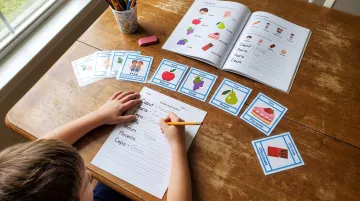
The strongest elementary combo pairs a video course for instruction with Compass Classroom's printables for practice. Neither one alone covers both halves of a real curriculum.
Best Free Latin Resources for Middle and High School Students
Older students need grammar depth plus real reading practice. This is where free resources genuinely rival paid textbooks.
Structured grammar courses:
- Latin Tutorial (YouTube): Grammar course for independent teens, from beginner through intermediate, at your own pace.
- The Latinum Institute: Evan Millner's free playlists and Substack build listening fluency through immersion. Use the labeled free playlists and written materials only; the full audio catalog is subscription-only.
- Open University's "Getting Started on Classical Latin": Free, self-paced 10-hour intro covering pronunciation, grammar, and reading as a bridge into classical texts. Start without an account; sign up unlocks quizzes and a completion certificate.
Reading and reference tools:
- Perseus Digital Library and Logeion provide free dictionaries, morphology lookup, and full classical texts for translation practice.
- Project Gutenberg hosts Caesar's Gallic Wars and Vergil's Aeneid in Latin, both public domain and free to download.
A note on AP Latin reading lists: the College Board's course description effective Fall 2025 requires specific Aeneid passages (including 1.1-33 and 6.450-476), while Caesar now appears only as a suggested, teacher-choice reading rather than a required text. Older "Caesar plus Vergil" lists floating around online are outdated.
Benchmarking progress: The National Latin Exam posts free past exams and answer keys from 2013 through 2026. Levels run from Introduction through Advanced Reading, with no login or payment required.
Free Latin Apps, Podcasts, and Digital Tools
Free Latin Apps and Digital Tools
Digital tools fill the gaps between formal lessons, particularly for pronunciation and listening skills.
- Memrise: Free entry-level vocabulary practice with spaced repetition. Community Courses have moved to a separate login-required site, so check current terms before relying on a full Latin deck.
- Latinitium: A free website with an audio archive of short Latin texts, beginner-friendly articles, and four searchable Latin dictionaries in one place.
- Luke Ranieri (ScorpioMartianus and polyMATHY): Free pronunciation guides and immersion-style videos built around active recall—ideal when students need to hear Latin spoken naturally.
None of these replace a structured course. Treat them as audio flashcards: quick, free practice for daily reinforcement.
How to Build a Complete Free Latin Homeschool Plan
No single free resource covers instruction, practice, and assessment the way a $150 boxed set does. The workaround is stacking two or three free tools together.
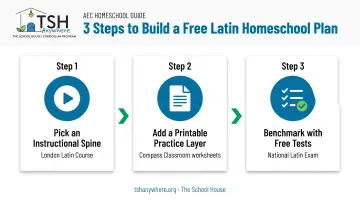
Follow this simple framework:
- Pick one instructional spine — a video course like the London Latin Course or an audio program like Latinum's free playlists.
- Add a printable practice layer — Compass Classroom's worksheets or public domain reader exercises.
- Benchmark with free tests — National Latin Exam past papers tell you when to advance a level.
Keep sessions short and consistent. Fifteen to thirty minutes, two or three times a week, beats an hour-long weekly cram session for language retention.
Stacking vetted free tools instead of buying an all-in-one box mirrors the affordability-first idea behind The School House: quality learning shouldn't require a big budget.
Use that same resourcefulness across your other homeschool subjects—or see how their research-backed curriculum applies the approach beyond Latin.
Frequently Asked Questions
What is the best free Latin curriculum for homeschoolers?
There's no single "best" free program. Linney's Latin Class works well for young beginners, while the Latinum Institute's free audio content suits students who prefer listening-based learning.
Which is harder, Spanish or Latin?
Latin's declensions and complex grammar can feel harder upfront, but Spanish demands more real-time conversational fluency. Difficulty depends on whether your child learns better through patterns or through speaking practice.
Can you really learn Latin completely for free online?
Yes. Combining a free video or audio course with public domain texts and practice tests like the National Latin Exam can replicate what a paid curriculum offers, just with more assembly required.
What grade level should a child start learning Latin?
Most classical programs suggest starting around grades 1-3, but free resources make it easy to start later without falling behind, since many courses assume no prior background.
Do colleges accept Latin as a foreign language credit?
Most colleges accept two or more years of Latin study for foreign language credit, similar to modern languages. Policies vary by school, so check each target college's specific requirements.
Is Latin worth learning if it's considered a "dead" language?
Latin isn't spoken conversationally, but its influence on English vocabulary, legal terminology, and scientific naming is still extensive. Studying it also sharpens grammar and analytical thinking skills that carry over to other subjects.