Introduction
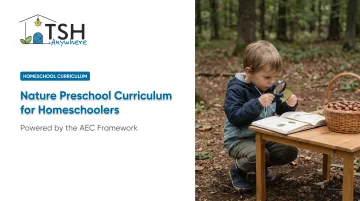
Your three-year-old stops mid-walk, crouches down, and stares at a ladybug for four straight minutes. That focused attention is the lesson—not a distraction from it.
Many homeschool parents assume "nature preschool" requires expensive kits, acreage of wilderness, or a teaching credential they don't have. It doesn't.
This guide walks through what a nature preschool curriculum looks like at home: the core building blocks, a realistic weekly rhythm, age-specific tips, and free resources that work on any budget. That same focus on affordable, evidence-based early learning is what The School House builds into its homeschool curriculum for Pre-K families.
Key Takeaways
- Child-led and emergent: prioritize outdoor exploration and free play over worksheets before age 6–7
- Four building blocks: unstructured outdoor time, gentle observation invitations, simple journals, seasonal rhythms
- Simple rhythm works: daily outdoor block, weekly nature walk, loosely followed monthly theme
- Free tools from Audubon, Cornell Lab, and NWF keep the approach accessible on any budget
What Is a Nature Preschool Curriculum, and Why It Works for Homeschoolers
Natural Start's framework defines nature-based early childhood curriculum as having dual goals: whole-child development and environmental literacy, with nature serving as the organizing concept rather than a subject you schedule in. It's emergent and child-initiated. The child's own curiosity drives what gets explored.
Compare that to traditional theme-based preschool, where a worksheet decides Tuesday is "insect day." In a nature preschool model, a child who spots deer tracks in the backyard might spend three weeks tracking animal footprints, sketching them, and asking why some are pointed and some are round. The curriculum emerges from that single moment of interest.
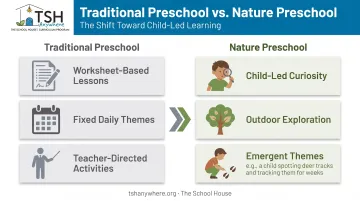
That model is spreading quickly. NAAEE's 2023 survey found an estimated 800 nature preschools serving roughly 25,600 children across the U.S. in 2022-23, a jump of more than 200% since 2017.
None of this requires forest land, costly equipment, or a teaching credential. A driveway, a windowsill, or a strip of grass behind an apartment building works just fine.
The Charlotte Mason Principle: Observation Over Instruction
Charlotte Mason argued that children under six or seven need no formal lessons at all: just generous outdoor time and light, invited observation. Her classic technique is simple. Name one small detail in a single sentence, then step back.
For example: "Look, this acorn has a little cap on top." No quiz. No follow-up question required. Just an invitation the child can take or leave.
The Core Building Blocks of a Homeschool Nature Preschool Curriculum
Unstructured Outdoor Time & Free Play
Long, uninterrupted outdoor stretches matter more than timed "lessons" because they give children room to get bored, then curious, then absorbed. A 15-minute rushed outing rarely gets past the boredom stage.
A common worry: "My backyard isn't real nature." It is. A patch of clover, a puddle, a single oak tree — all of it counts. Keep the time unstructured, and repeat it often.
Guided Observation & Naming (Invitation, Not Requirement)
Use gentle pointing-out, repeated with small variations over time. Point to a leaf and say, "This one feels rough." Next week, point to the same leaf type and say, "Look how the color changed."
Over months, this builds vocabulary and observational skill without ever feeling like school:
- Week 1: texture ("bumpy," "smooth")
- Week 3: color ("darker at the edges")
- Week 6: sound ("crunchy when it's dry")
Nature Journals, Stickers, and Simple Documentation
Preschoolers who can't yet write still benefit from documentation. Sticker-based nature hunt notebooks work well here — a child finds a bird, places a bird sticker, done. Older siblings can graduate to detailed sketch journals.
For verbal children, try transcribing what they say. If your four-year-old announces, "The bug had six legs and it was fast," write that down exactly. It supports pre-literacy and shows their words have weight.
Seasonal Rhythms & Loose-Parts Play
Let the calendar do some curriculum planning for you:
- Fall: leaf color, acorn collecting
- Winter: animal tracks in snow, bare branch shapes
- Spring: buds, birdsong, mud
- Summer: insects, shade patterns, growth
Add loose-parts materials — sticks, stones, pinecones, gems — for open-ended building and imaginative play. They spark creativity and problem-solving without a single instruction sheet.
How to Build Your Own Nature Preschool Rhythm and Schedule
Color-coded lesson plans fall apart by week two. What sticks is a simple rhythm you can bend without losing the habit.
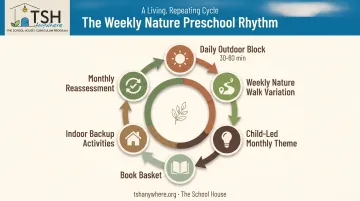
- Lock in one daily outdoor block (30-60 minutes). Head Start's Caring for Our Children guidelines recommend two to three outdoor play occasions daily for young children, weather permitting. Keep boots and rain gear by the door so weather isn't an excuse to skip it.
- Add a weekly nature walk variation. Same yard, different time of day. New trail. Different corner of the same park. The goal is exposure to seasonal change, not novelty for its own sake.
- Let a monthly theme emerge from your child. Don't impose "insects" if your kid is obsessed with clouds. Follow what they're already noticing.
- Layer in a simple book basket. If your child keeps finding worms, grab two or three worm-related picture books from the library and leave them out.
- Prepare 3-4 indoor backups. Keep sensory bins, nature-themed art, and animal-track drawing sheets ready for days weather truly won't cooperate.
- Reassess monthly. Notice what held their attention longest, then quietly shift the rhythm. Resist locking anything into a rigid plan.
Age-by-Age Guide: Nature Study from Toddler to Kindergarten
Toddlers (18 Months–2 Years)
Keep it sensory-first. Close supervision matters more than structure, and attention spans are short—so a five-minute pause at an anthill counts as a full success.
Simple sensory moments work best:
- Touching bark and leaves
- Splashing in puddles
- Watching leaves fall
Preschoolers (3–4 Years)
Simple names and notice-prompts start to stick at this age. Try sticker-based nature hunt notebooks and questions like "what do you notice?" There's no wrong answer, and silence is fine too.
Pre-K and Kindergarten (5–6 Years)
Stretch observation sessions a bit longer and bring in basic tools:
- Beginner field guides or a simple laminated bird card
- Light nature journaling as a bridge toward more formal study around age six or seven
Top Resources and Tools for Nature Preschool Homeschoolers
You don't need to build anything from scratch. Several free national programs already do the heavy lifting:
- Cornell Lab's BirdSleuth K-2 collection: free Explorer's Guidebooks and habitat scavenger hunts, designed for families as well as classrooms
- National Wildlife Federation's Green Hour: encourages one hour of daily outdoor time and links to nature notebooks and weekly activity ideas for all ages
- KidsGardening: five free preschool lesson plans covering plant life cycles and pollinators, available via newsletter signup
- Audubon Adventures: geared toward grades 3–6, with low-cost homeschool packets around $7–$38 if you want more structure sooner
If free-form planning feels overwhelming, paid nature study memberships and preschool nature hunt kits can help. Structured homeschool options such as The School House's AEC curriculum (Pre-K–8) also bundle printables, outdoor-ready lessons, and parent training so you are not building the week from scratch.
Low-cost supporting tools worth keeping on hand:
- A basic magnifying glass
- A simple, blank notebook (stickers work as a substitute for writing)
- One or two seasonal picture books
- A beginner field guide or free nature ID app
Frequently Asked Questions
What age should I start a nature preschool curriculum?
You can begin sensory-based outdoor time as early as toddlerhood. More structured observation activities—gentle naming, nature notebooks—typically fit best around ages 3–4.
Do I need to live near woods or a nature reserve to do nature preschool at home?
No. A backyard, local park, or windowsill garden works fine. The philosophy is about intentional, repeated attention, not access to wilderness.
How much outdoor time do preschoolers need each day for nature study?
Roughly 30-60 minutes daily is a practical target, though consistency matters more than hitting an exact number every single day.
Does nature preschool count as meeting homeschool curriculum requirements?
This varies by state, so check your local homeschool regulations. Nature study typically layers alongside required subjects rather than replacing them once children reach school age.
What supplies do I need to start nature preschool at home?
A simple notebook, a magnifying glass, weather-appropriate outdoor gear, and one or two seasonal picture books cover the basics. Nothing fancier is required.
What comes after nature preschool — how do I continue this philosophy into elementary homeschooling?
Carry the same child-first, nature-rooted approach into elementary years with a program that adds academic structure gradually. The School House’s Pre-K–8th grade American Emergent Curriculum (AEC) keeps the natural world central while deepening science, civics, and hands-on learning as children grow.