It's a fair question, and the answer is frustratingly vague — because it depends entirely on how you homeschool. Costs range from under $500 a year for a DIY family using library books and free printables to well over $35,000 for a family hiring a private instructor.
Homeschooling enrollment keeps climbing too. State-recorded homeschool numbers grew an average of 4.9% in the 2024-25 school year according to Johns Hopkins researchers, more than double the pre-pandemic growth rate. More families are asking this cost question than ever before.
This guide breaks down real 2026 pricing tiers, the factors that drive your costs up or down, and how homeschooling stacks up against public and private school.
Key Takeaways
- Most families spend $500–$2,500 per child per year; extremes run under $500 to $70,000+ with private teachers
- Curriculum type, number of kids, grade level, and extracurriculars drive most of the cost swing
- DIY setups cost the least; shared tutors or private teachers push costs up sharply
- Even premium homeschooling usually costs far less than private school tuition
How Much Does Homeschooling Cost in 2026? (Pricing Overview)
There's no single price tag on homeschooling. Your total depends on your curriculum choice, how many kids you're teaching, your state's filing requirements, and how much outside instruction you bring in.
The most-cited benchmark comes from HSLDA's 2024 survey of more than 4,000 homeschooling families, which lands the typical annual cost between $500 and $2,500 per child. That figure covers curriculum, supplies, printing, co-op fees, and some tutoring or online classes.
Inflation and the rise of online and hybrid homeschool programs have nudged these numbers up slightly compared to a few years ago. Before you build a budget, watch for three mistakes that trip up new homeschool parents:
- Underestimating recurring costs: testing fees, co-op dues, and printer ink add up month after month
- Ignoring lost income: if one parent steps back from work to teach, that's often the biggest cost of all
- Over-buying curriculum in year one: many families spend heavily upfront on materials they end up not using
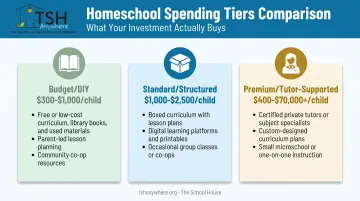
Most families' annual spending falls into one of three tiers.
Budget / DIY Homeschooling
This is the leanest approach, and it can run $300 to $1,000 per child per year. You're piecing together free or low-cost resources rather than buying a packaged program.
Typical costs in this tier include:
- Free or open-source curriculum (many state library systems and nonprofits offer full K-8 sequences at no cost)
- Library books and printable worksheets
- Basic supplies: notebooks, pencils, a few workbooks
This works best for parents who are comfortable designing their own lesson plans, or who don't mind researching and assembling curriculum from multiple free sources rather than buying one complete package.
Standard / Structured Curriculum Homeschooling
Most families land here: roughly $1,000 to $2,500 per child annually. You're buying a complete, pre-built curriculum package instead of assembling one yourself.
What you usually pay for:
- An all-in-one boxed curriculum with lesson plans, workbooks, and answer keys
- Testing and assessment materials
- Occasional online course add-ons for specific subjects
TSH Anywhere's homeschool subscription fits squarely in this range at $125 a month, or $1,200 a year, per learner. It delivers the American Emergent Curriculum framework with printables plus a library of 400+ training films, so parents get structure and accountability without the guesswork of building lessons from scratch.
This tier suits families who want a clear plan and progress tracking, but don't need or want to hire outside teachers.
Premium / Tutor-Supported or Online Program Homeschooling
At the top end, costs climb fast. Online programs with live instruction run $400 to $6,000 per child per year, while supplemental tutoring adds another $700 to $7,000 annually, depending on subject and frequency.
Hiring dedicated instruction gets expensive quickly:
- Part-time private tutor: $20–$60 per hour
- Shared private teacher (split between two or three families): $12,000–$35,000 per family annually
- Full-time private teacher: $35,000–$70,000 for a nine-month school year
This tier makes sense for dual-income families who need flexible scheduling, students requiring specialized instruction, or parents replacing traditional school entirely with a paid instructor.
Key Factors That Affect the Cost of Homeschooling
Your final number comes down to a handful of variables. Get these right, and you'll build a far more accurate budget than any generic average can give you.
Curriculum Type and Structure
Curriculum costs typically fall into three tiers:
- Free and DIY options cost almost nothing beyond printing and supplies
- Boxed, all-in-one programs cost more but save planning time
- Distance or accredited online programs sit highest, since they include teacher access and grading
One thing that consistently lowers cost: reusing curriculum for younger siblings. A workbook or program you buy for your oldest child often works for the next one down the line, cutting per-child spending over the years.
Number of Children and Grade Level
Costs rise as kids get older. According to HSLDA's survey data, families spend an average of $1,295 per elementary student versus $1,636 per middle or high school student, a difference of about 26% driven by lab materials, electives, and test prep.
Multiple children can actually work in your favor:
- Share curriculum across siblings instead of buying a full set per child
- Stack group co-op enrollment discounts when several kids join
- Cover more than one student with a single set of core supplies
State Requirements and Testing
Some states require standardized testing, portfolio reviews, or annual filings, each adding a modest fee. Others require almost nothing beyond a simple notification letter.
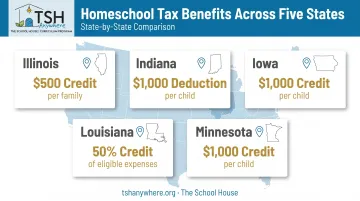
A handful of states currently offer tax credits or deductions for homeschool expenses, including:
- Illinois — 25% credit on qualified expenses above $250, capped at $750
- Indiana — $1,000 deduction per homeschooled dependent
- Iowa — 25% credit on the first $2,000 of expenses, capped at $500
- Louisiana — 50% deduction on qualified expenses, capped at $6,000 per dependent
- Minnesota — subtraction caps of $1,625 (K-6) or $2,500 (grades 7-12)
Rules shift year to year, so verify current details with your state's Department of Revenue before filing.
Extracurriculars, Tutoring, and Enrichment
Sports, music lessons, field trips, and co-op memberships typically add $100 to $1,000+ per year, depending on how much your family participates. Part-time tutors run $20 to $60 an hour, with online sessions usually landing at the lower end and in-person specialized instruction at the higher end.
Lost Income and Location
The biggest hidden cost is often the parent income you give up to teach full-time. For many families, that trade-off dwarfs anything spent on books or supplies.
Where you live shapes the rest of the budget. HSLDA's survey data suggests rural families tend to report lower homeschooling costs than suburban and urban counterparts, likely tied to co-op availability and cost of living.
Homeschooling vs. Public School vs. Private School: Cost Comparison in 2026
| Option | Typical Annual Cost | What's Included |
|---|---|---|
| Homeschooling | $500–$2,500/child | Curriculum, supplies, testing, some extracurriculars |
| Public school extras | $100–$1,000+/child | Supplies, technology fees, activities (tuition-free) |
| Private school | $5,000–$40,000+/child | Tuition; 2026 national average is $14,927 |
The gap between homeschooling and private school is enormous. Even at the premium end of homeschooling, most families save tens of thousands of dollars a year compared to private tuition, while still shaping every part of the curriculum themselves.
Public school remains tuition-free, but it offers far less control over what and how your child learns. The real trade-off is cost control versus curriculum control.
For families who want more structure or values alignment than public school offers, without private-school tuition, a third path is growing: community-built affordable school models.
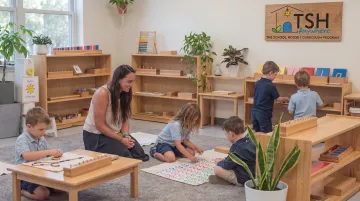
The School House, a Montessori-influenced school in East Northport, New York, was built to show a school can run for roughly a third of typical costs and still deliver strong results. Its learners have tested at roughly 2x the national average across subjects, using a science-based framework refined over six-plus years in live classrooms.
Weigh the annual numbers against how much control, flexibility, and community support your family actually needs. The lowest line item is not always the best fit.
Smart Ways to Budget for Homeschooling (and Mistakes to Avoid)
A simple budget keeps homeschool costs predictable—so testing fees, co-op dues, and a curriculum that didn’t stick don’t ambush you mid-year.
Money-saving strategies:
- Join a homeschool co-op to split curriculum and activity costs across several families
- Buy used curriculum through resale groups once you know what fits your teaching style
- Use free library resources and reputable open-education sites before you buy anything
- Save and reuse materials for younger siblings instead of buying new each year
Common mistakes to avoid:
- Over-purchasing curriculum in your first year before you know what actually works for your child
- Forgetting recurring costs like testing fees, co-op dues, and printing
- Overcommitting to paid extracurriculars that quietly balloon your monthly spending
Build a simple annual budget in two columns: one-time costs (initial curriculum, starter supplies) and recurring costs (consumables, testing, activities). That split makes it far easier to see where your money is going.
Frequently Asked Questions
What states pay for homeschooling?
Most states don't pay parents directly. A small number, including Illinois, Indiana, Louisiana, Minnesota, and Iowa, offer tax credits or deductions that offset expenses. Rules change often, so check your state's current guidance.
How many hours a day should a child be homeschooled?
It varies by age — typically 1 to 3 hours a day for early elementary and 4 to 6 hours for middle and high school. One-on-one teaching is often more time-efficient than a full classroom day.
What is the hardest age to homeschool?
Many parents point to the middle school years, roughly ages 11 to 14, when academic content gets more complex and kids need more specialized subject instruction and social support.
Is homeschooling really worth it?
For many families, the personalized pace, values alignment, and savings over private school make it worthwhile. It does require real time, planning, and often an income trade-off.
How much does homeschooling cost per month?
Based on the typical $500–$2,500 annual range, most families spend roughly $40 to $210 a month. Costs are often front-loaded at the start of the school year.
Can homeschooling be done for free?
Free curriculum, library resources, and open educational websites can bring costs close to zero. Most families still spend something on supplies, printing, or occasional materials.