Introduction
Ask any 5-year-old why the sky is blue or what happens when you mix two colors, and the reaction is instant: they want to know. Kindergartners are wired for this. They ask, they poke, they test things out. That makes ages 5 and 6 the perfect window for hands-on science.
Many homeschool parents worry they need a lab, an expensive kit, or a science degree to teach "real" science. You don't. A kitchen counter, some vinegar, and 20 minutes will get you further than most store-bought kits ever could.
This guide organizes easy, low-cost experiments by science domain (physical, life, and earth science), plus tips for building a simple, repeatable science routine at home.
Key Takeaways
- Household materials and 15–30 minute sessions build observation, prediction, and cause-and-effect skills
- Group activities by physical, life, and earth science to mirror early learning standards
- A few short sessions each week beat fancy kits for lasting science habits
- Use an ask–predict–test–observe routine to turn play into real learning
Why Science Belongs in Your Kindergarten Homeschool Day
Kindergarten knowledge doesn't just stay in kindergarten. A large longitudinal study following 7,757 children found that early general knowledge (including basics like predicting and drawing conclusions) was the strongest predictor of first-grade knowledge, which in turn predicted science achievement all the way through eighth grade.
62% of children who entered kindergarten with low general knowledge were already struggling in science by the end of third grade, according to Penn State's summary of this research. Early exposure matters, even if one volcano experiment won't guarantee lifelong scientific literacy on its own.
Modeling How Scientists Actually Think
Five- and six-year-olds ask constant questions. Instead of only answering them, homeschool parents can model the pattern scientists actually use:
- Ask a clear question ("Why is the sky blue?")
- Predict what might be going on
- Test the idea together with a simple activity
Curiosity becomes investigation, not just a quick lookup.
A Curriculum Built Around This Idea
That same lab-free habit is the premise behind The School House on Long Island, NY, and its American Emergent Curriculum (AEC). Meaningful science education does not require a fully equipped lab. The model runs on a decade of pedagogical research paired with over six years of live classroom testing.
Its Lead Science Educator holds an AMI Montessori diploma and a Master's in Molecular Biology from the University of Naples. Students consistently test at least twice above the national average, with no academic admissions requirement.
Founder Mimosa Jones Tunney built the curriculum around one question: why hasn't a school actually been designed around how children learn? Homeschool parents can borrow that logic without needing a building at all.
Setting Up a Simple Home Science Toolkit
You don't need a supply closet. A handful of reusable staples covers most kindergarten experiments:
- Vinegar and baking soda — easy go-tos for safe chemical reactions
- Food coloring — makes liquid changes easy to see
- Measuring cups — teaches early math alongside science
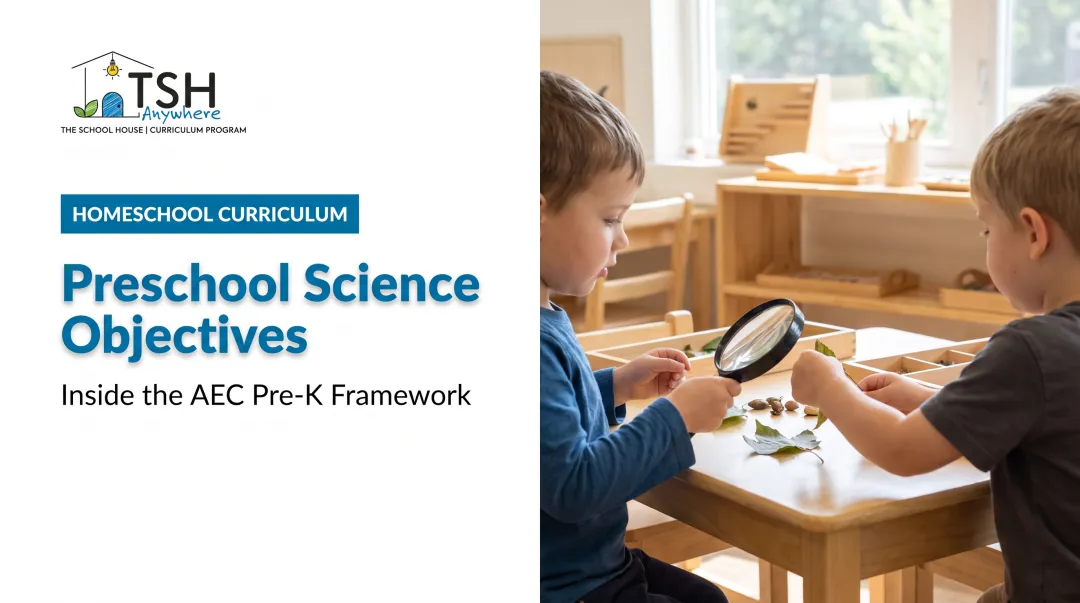
- A magnifying glass — turns backyard walks into investigations
- Paper towels — cleanup, capillary action tests, and more
A Kid-Friendly Scientific Method
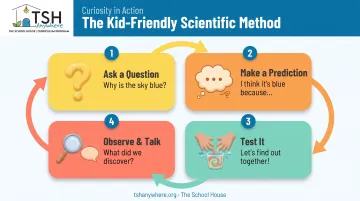
Supplies help most when kids also have a simple way to think through each experiment. Organizations like Head Start and NSTA frame early science as asking, observing, predicting, testing, and discussing. For a 5- or 6-year-old, simplify that cycle to four steps:
- Ask a question — "What happens if I mix these?"
- Make a prediction — "I think it will turn purple."
- Test it — Do the experiment together.
- Observe and talk — "What actually happened? Were you right?"
Recording Discoveries
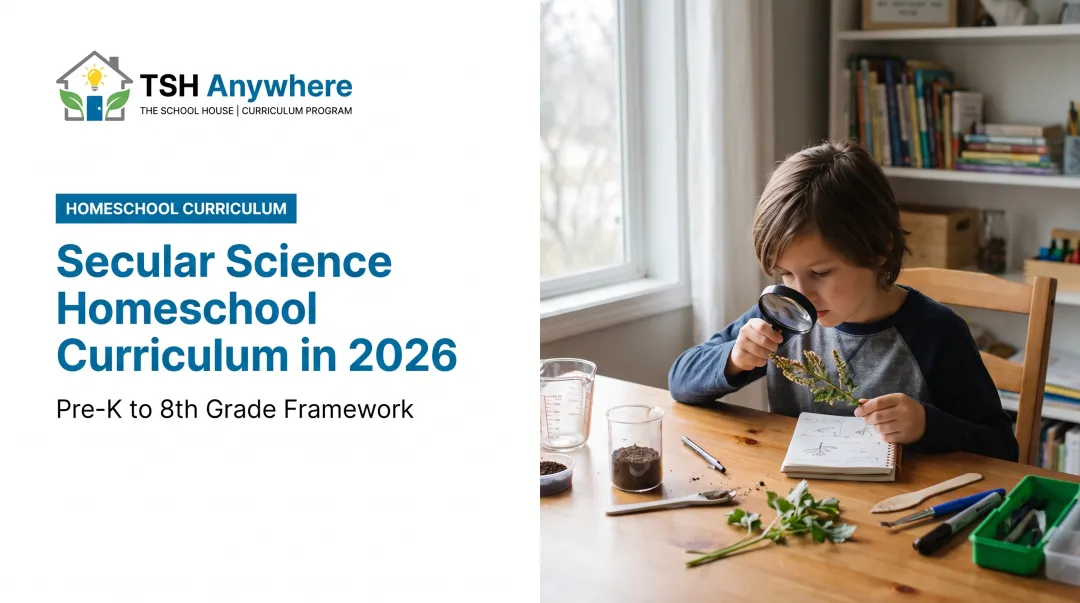
One last toolkit staple: a simple science journal. Even a few stapled pages let kids draw predictions and observations, and practice words like "predict," "observe," and "experiment" while they write.
Physical Science Experiments Kids Will Love
Physical science lets kids see and feel big ideas: reactions, states of matter, and forces they can touch with their own hands.
Baking Soda & Vinegar Volcano
Materials: baking soda, vinegar, dish soap, food coloring, a tray
Add baking soda, a squirt of dish soap, and food coloring to a cup on the tray, then pour in vinegar. The acid-base mix releases carbon dioxide gas for a fizzy "eruption." Ask afterward: What happens with more vinegar? Less? Let them test it.
Magic Milk Color Explosion
Materials: milk, food coloring, dish soap, cotton swab
Drop food coloring into a shallow dish of milk, then touch a soap-dipped cotton swab to the surface. Soap lowers the milk's surface tension, and the colors swirl and scatter. Ask: What happens if you touch a second color?
Oobleck: The Solid-Liquid Mystery
Materials: cornstarch, water
Mix roughly two parts cornstarch to one part water. Squeeze it and it feels solid; let it sit still and it flows like a liquid. That's a non-Newtonian fluid: its thickness changes with how much force you apply. Try walking fingers across the top, then letting a hand sink slowly.
Static Electricity Balloon
Materials: balloon, hair or a wool sweater, tiny paper bits
Rub the balloon on hair for 10-15 seconds. Electrons transfer and charge the balloon so it sticks to walls or pulls paper bits toward it like a magnet. Ask: Does it still work after you touch the balloon with your hand?
Life Science & Nature Exploration Experiments
These activities help kindergarteners watch living things grow, stay clean, and interact with water and air in simple, visible ways.
Growing a Bean Plant
Materials:
- Clear jar
- Paper towel
- Bean seed
- Water
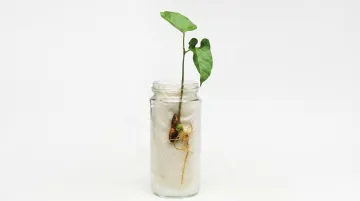
Line a jar with a damp paper towel, tuck a bean seed against the glass, and keep it moist. Seeds need water and air to germinate. Roots emerge first, then the stem and leaves — all visible day by day through the glass.
Sink or Float Density Test
Materials:
- Water bin
- Assorted small objects (a coin, a cork, a spoon, a toy)
- Nature finds (a leaf, a twig, a seed pod)
Let kids predict before dropping each item in. Objects denser than water sink; less dense ones float. Comparing toys with leaves and seed pods turns buoyancy into a hands-on nature test kids will want to repeat.
Walking Water Rainbow
Materials:
- Clear cups
- Water
- Food coloring
- Paper towels
Alternate cups of colored water with empty cups, then fold paper towel strips between them. Within hours, color "walks" across. This works through capillary action, where water moves through porous fibers using adhesion, cohesion, and surface tension, the U.S. Geological Survey explains. Plants rely on the same process to pull water from roots up into their leaves.
Germs & Glitter Handwashing
Materials:
- Glitter
- Soap
- Water
Sprinkle glitter on a child's hands to represent germs, then have them try to wash it all off. Kids quickly see why thorough scrubbing (not just a quick rinse) actually matters.
Earth & Weather Science Experiments
Weather concepts are huge and invisible. These experiments shrink them down to something a 5-year-old can hold in a jar.
Rain in a Jar
Materials:
- Jar
- Shaving cream
- Water
- Blue food coloring
Fill a jar with water, top it with a shaving cream "cloud," and drip in blue food coloring. When the cloud gets too full, color drips through as a simplified stand-in for how water vapor condenses and eventually falls as precipitation, according to NOAA. It's a model, not a lab replica of real clouds, but it makes the idea click.
Tornado in a Jar
Materials:
- Jar with a tight lid
- Water
- A small squirt of dish soap
Fill the jar with water and soap, seal it, and swirl in a circular motion. The spinning water forms a funnel-shaped vortex kids can watch form and fade. Real tornadoes spin air, not water, but the shape is a fair first look at storm rotation.
Rainbow Light Prism
Materials:
- A prism or clear glass of water
- Sunlight
- White paper
Rainbows in the sky happen when sunlight passes through water droplets. You can show the same idea at the table: hold the prism in a sunbeam and let the light hit white paper. White light holds many colors, and the prism bends each wavelength a little differently, splitting them into a visible rainbow.
Frequently Asked Questions
What science skills should a kindergartner learn at home?
Focus on observation, prediction, and basic cause-and-effect reasoning. Introduce vocabulary like "experiment," "predict," and "observe" naturally as you go, rather than as a formal lesson.
How many science experiments should a homeschool kindergartner do per week?
One to three short sessions per week is plenty at this age. Consistency matters far more than volume. A repeated 20-minute habit beats an occasional elaborate project.
What household items are best for kindergarten science experiments?
Vinegar, baking soda, food coloring, water, and recycled containers cover most experiments on this list. They're cheap, reusable, and safe with adult supervision.
Do I need to follow a specific science curriculum for kindergarten homeschool?
No. A loose framework covering physical, life, and earth science is enough at this age. Formal curricula are optional, though programs like the American Emergent Curriculum (AEC) integrate science with reading, math, and art if you want more structure.
How can I make science experiments safe for young children?
Choose non-toxic materials, supervise directly, and simplify or skip any step involving heat, flame, or small swallowable parts. Wash hands afterward and keep materials away from mouths and eyes.
What is the best way to record science observations with a 5-year-old?
Simple drawings, dictated sentences, or checkbox-style recording sheets work better than written journaling at this age. The goal is capturing their thinking, not testing their handwriting.