Here's the reassuring part: cost and quality don't have to move together. The School House, a Pre-K through 8th grade curriculum model, built its American Emergent Curriculum on a decade of research and six-plus years of live classroom testing. Its learners consistently test at least twice above the national average, all while running on a model designed to cost communities a third of what school-building usually runs. The same logic applies at home: free, well-chosen French resources can outperform an expensive box set.
This guide breaks down the best free French resources by age, the teaching methods that make them stick, and how to build a routine your family will actually keep up with.
Key Takeaways
- Free, high-quality French resources exist for every age, from toddler flashcards to teen-level government courses
- Short daily sessions (10-30 minutes) tend to build retention better than occasional long lessons
- Blending storytelling and action-based methods with app-based practice covers more skills than either alone
- You don't need to speak French yourself — native-audio apps and video courses do the heavy lifting
What to Look for in a Free French Homeschool Curriculum
Free doesn't mean one-size-fits-all. Before picking a resource, figure out where your child actually stands.
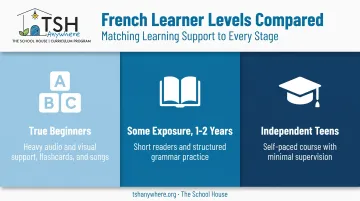
- True beginners need heavy audio and visual support: flashcards, songs, simple phrases
- Kids with a year or two of exposure can handle short readers and structured grammar practice
- Independent teens can work through a full self-paced course with minimal supervision
Matching resources to skill level prevents a familiar trap: curricula that drill grammar and reading while skipping speaking and listening entirely. It's a common homeschool (and classroom) story. A student aces every worksheet, then freezes in an actual conversation.
The American Council on the Teaching of Foreign Languages recommends teaching grammar inside meaningful, real-use contexts rather than as an isolated rule set. Every grammar point should come with listening and speaking practice, not just fill-in-the-blank exercises.
Format matters just as much as content. Games, audio, and video-based resources tend to hold a child's attention far longer than textbook-only study. A workbook page might get finished out of obligation; a subtitled French cartoon gets watched twice because it's genuinely fun.
When building a free curriculum from scratch, lean toward resources that mix formats: some listening, some reading, some active response.
Best Free French Resources for Elementary-Age Homeschoolers (Ages 4-10)
For younger learners, the priority is exposure, not grammar mastery. Kids this age absorb sounds and patterns through play, song, and repetition rather than rule memorization.
| Resource | Best For | What It Offers |
|---|---|---|
| BBC Bitesize KS2 French | Kids who already read basic English/French | Thematic units on food, family, and calendar, plus games, songs, and cultural videos |
| French Baby Flashcards app | Toddlers with non-French-speaking parents | Core vocabulary paired with native-speaker audio |
| Duolingo | Ages 6+, short daily practice | Gamified, communicative lessons that favor practical phrases over grammar drills |
| Conjuguemos | Kids already reading in French | Free games and printables reinforcing vocabulary and early grammar |
| BookBox read-alouds | Building listening comprehension | 500+ free animated storybooks with same-language subtitles and select bilingual PDFs |
| Library media (Muzzy, bilingual song kits) | Passive, screen-based exposure | Free DVDs, CDs, and story kits available through many public library systems |
Keep these caveats in mind before you build a routine around these:
- BBC's content is officially labeled Key Stage 2 (roughly ages 7-11), so it suits the upper half of this range better than preschoolers.
- Duolingo works well as daily review, not a standalone curriculum. Duolingo recommends a few short lessons a day rather than one long session, which fits young attention spans.
- Check your library's catalog before assuming Muzzy or similar kits are available. Access varies by system, but many libraries do carry them for free checkout.
- Not every BookBox story comes with a downloadable PDF translation. Treat that extra as a bonus when you find it, not a guarantee.
None of these resources alone covers listening, speaking, reading, and writing. Pair an input-heavy resource (BBC, BookBox) with a practice tool (Conjuguemos, Duolingo), and you'll cover far more ground than any single free app manages on its own.
Best Free French Resources for Middle and High School Homeschoolers (Ages 11-18)
Older learners can handle more independence and a faster pace. This age group is where genuinely complete free courses start to appear.
| Resource | Best For | What It Offers |
|---|---|---|
| FSI French Basic Course | Highly self-directed teens | Public-domain, U.S. government-developed audio course (dated in style, but complete and free) |
| Français Interactif | Independent learners wanting real structure | University of Texas OER with 320+ videos, grammar, vocabulary, and culture lessons |
| Mango Languages | Families with library access | Structured, multimedia lessons covering all four language skills, free through most library cards |
| Le Point du FLE | Self-paced grammar review | A directory of 17,000+ free grammar, vocabulary, and listening links |
| Bonjour de France | Intermediate/advanced teens | Free online magazine with graded articles, exercises, and level tests |
| Coffee Break French | Commute or downtime listening | Free podcast episodes for listening practice (lesson notes and video are paid extras) |
A quick reality check on a couple of these: FSI is public domain (U.S. government works aren't copyrighted), but it was built in the 1970s for diplomats, not teenagers. Expect a dry, repetitive style.
Français Interactif is the strongest fully free structured course here, though it's pitched at first-year college level rather than advanced high school French. Mango's free access depends entirely on your local library carrying it, so confirm before planning a semester around it.
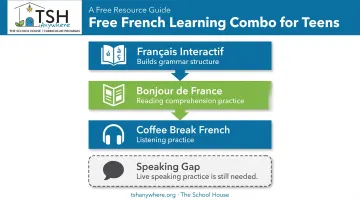
For teens working independently, a solid free stack looks like this:
- Français Interactif for grammar and structure
- Bonjour de France for reading and comprehension checks
- Coffee Break French for car-ride listening practice
That covers grammar, reading, and listening without spending a cent. Speaking still needs live practice: a conversation partner, a co-op, or even talking through a recipe out loud beats any app for that skill.
Proven Teaching Methods to Make Free French Curriculum More Effective
Free resources go further when paired with a method that mirrors how kids actually pick up language.
Act It Out: The Gouin Series and TPR
Long before apps existed, 19th-century linguist François Gouin noticed something simple: children learn language by narrating actions as they happen, not by memorizing word lists.
His Gouin Series method, still used in many Charlotte Mason homeschools, has a parent model a short action sequence ("Je prends la tasse. Je verse le lait.") while physically performing it. The child then repeats the lines and eventually acts the sequence out solo.
Total Physical Response (TPR) taps the same instinct. James Asher developed it in the 1960s after observing how toddlers absorb their first language — they hear a command, respond physically, and speak later. At home, that might mean saying "Assieds-toi" while pointing to a chair. Both methods cost nothing beyond your own energy and voice.
Borrow From AIM Without Buying the Program
The Accelerated Integrative Method combines gestures, simplified high-frequency vocabulary, and repeated storytelling to build fluency faster than plain vocabulary lists. You don't need the paid AIM materials to use its core idea: tell the same simple story several times, add a gesture for each new word, and let repetition do the work.
One classroom comparison of AIM found no significant proficiency advantage over other approaches. Treat it as one useful tool among several, not a silver bullet.
Blend Grammar Practice With App-Based Repetition
Grammar-only instruction and app-only instruction each have a blind spot. Grammar drills build accuracy but rarely produce a kid who chats comfortably. Apps like Duolingo build comfort with everyday phrases but go light on grammar depth. Blending both works better than either alone:
- Use a structured resource for the "why" behind sentence structure
- Use Duolingo or Conjuguemos for daily repetition and confidence
- Use TPR or storytelling for actual spoken practice
Match the mix to how your child learns. Visual learners often prefer flashcards and subtitled videos; auditory learners get more from songs, podcasts, and read-alouds. Watch what they gravitate toward in the first few weeks and lean into it.
Tips for Building a Sustainable Homeschool French Routine
Keep Sessions Short and Frequent
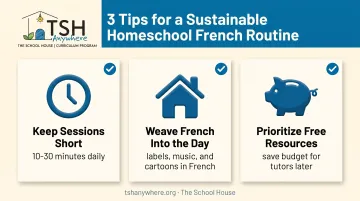
Ten to thirty minutes a day beats a two-hour Saturday cram session. A 2025 meta-analysis of classroom learning found that spacing practice out over time produced a moderate advantage over massed, one-time study sessions. Little and often adds up faster than most parents expect.
Weave French Into the Day, Not Just Lesson Time
Passive exposure reinforces active lessons:
- Label the fridge, pantry, and furniture with French words
- Play French children's music during breakfast or car rides
- Switch a favorite cartoon to French audio once a week
- Count stairs, dishes, or toys out loud in French
None of this replaces structured lessons, but it keeps vocabulary alive between sessions.
Prioritize Free Resources, Then Spend Where It Counts
Homeschool French works best when you put free, proven resources first and hold budget for what actually needs it—like a tutor for conversation once your child is ready.
That same affordability mindset guides The School House: quality learning for Pre-K through 8th grade without a premium price tag. You do not need an expensive packaged French curriculum to build a routine that sticks.
Frequently Asked Questions
What is the best French curriculum for homeschoolers?
It depends on age and goals. For most families, pairing a structured free course (FSI or Français Interactif for teens) with a daily practice app like Duolingo covers both depth and consistency.
What is the 80/20 rule in French?
It's shorthand for prioritizing the most frequently used vocabulary and grammar structures first, since a relatively small set of words covers most everyday conversation. Treat it as a useful study heuristic, not a literal guarantee.
Is Duolingo enough to learn French for homeschooling?
Duolingo is a strong supplementary tool for daily practice and vocabulary, but it works best paired with a more structured resource for grammar depth and real speaking practice.
Can I teach my child French if I don't speak it myself?
Yes. Many free resources, including native-speaker audio apps, video courses, and subtitled storybooks, are built specifically for non-French-speaking parents to guide their child's learning without translating a word themselves.
How many hours a week should homeschoolers study French?
Plan on about 15–30 minutes a day (roughly 2–3 hours a week), adjusted for age and goals. Short, consistent daily sessions beat one long weekly lesson.
What age should homeschooled kids start learning French?
Children can start as early as toddlerhood with audio and flashcard exposure, though structured lessons usually work best from around ages 4-6 onward.