Introduction
If you've started researching "kindergarten homeschool objectives," you've probably noticed the term means two very different things. In some states, it's a legal filing requirement tucked into your home education paperwork. Elsewhere, it's simply the academic and developmental roadmap you build for your five- or six-year-old.
Many new homeschool parents feel stuck between these two definitions. You want to satisfy your state's requirements, but you're also genuinely unsure what a kindergartner should be learning this year.
This guide covers both angles. First, we'll clarify how to write objectives that meet legal requirements without overthinking them. Then we'll walk through a full subject-by-subject breakdown of academic and developmental goals for kindergarten, so you have a real starting point either way.
Key Takeaways
- Kindergarten objectives serve two purposes: state notification (where required) and instructional planning
- Core academic goals span four areas: language arts, math, science, and social studies
- Social-emotional and physical development matter as much as academics at this age
- Homeschool associations recommend broad, flexible wording over rigid checklists
- Objectives should shift as you learn your child's actual pace throughout the year
What Are Kindergarten Homeschool Objectives?
Homeschool objectives are broad statements describing what subjects and skills you plan to cover during the year. They're not the same as a lesson plan. You won't find "Tuesday: introduce the letter B" in an objectives document. Instead, you'll see something closer to "develop letter recognition and phonemic awareness."
The term shows up in two distinct contexts:
As a legal requirement. Some states require homeschooling parents to file "an outline of proposed education objectives by subject area" as part of their annual home education paperwork. Pennsylvania is a clear example. Its Public School Code specifically requires this outline alongside the annual affidavit or unsworn declaration.
As a planning tool. For most parents, objectives simply describe the academic and developmental goals guiding the school year, whether or not any state agency ever sees them.
For Pennsylvania families and others in similar states, the filed objectives outline is explicitly not used by the superintendent to judge whether your program complies with the law. It's a proposed plan, not a performance contract. You don't need to hit every item perfectly, and you're not being graded on it.
Core Academic Objectives for Kindergarten Homeschoolers
Most state frameworks and homeschool curricula lean on national benchmarks like the Common Core State Standards as a reference point. Common Core isn't a homeschool law. It's a set of grade-level expectations for English language arts and math, currently adopted in some form by 41 states, the District of Columbia, four U.S. territories, and the Department of Defense Education Activity.
Even in states that don't formally use Common Core, it's a useful, research-backed starting point for what "kindergarten level" typically means.
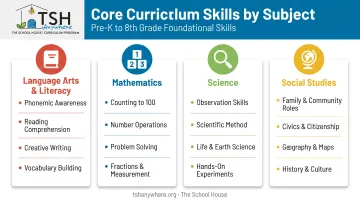
Language Arts & Literacy Objectives
By year's end, most kindergarten frameworks expect:
- Phonemic awareness: recognizing rhymes, blending and segmenting syllables, isolating beginning and ending sounds in words
- Letter and sound recognition: naming upper- and lowercase letters and connecting them to their most common sounds
- Emergent reading: reading simple leveled texts with understanding, retelling key details, and connecting pictures to the story
- Writing progression: moving from letter formation to phonetic spelling (writing "kat" for "cat" is a good sign, not a mistake)
- Speaking and listening: taking turns in conversation, asking for clarification, and describing familiar people or events clearly
Mathematics Objectives
Kindergarten math objectives typically cover:
- Counting to 100 by ones and by tens, and counting forward from any given number
- Reading and writing numerals 0–20, and matching them to real quantities
- Basic addition and subtraction within 10, including simple word problems
- Comparing shapes, sizes, and measurable attributes like length or weight
- Sorting and classifying objects into categories
Science Objectives
Kindergarten science is less about facts and more about habits of inquiry: observing, asking questions, and testing simple ideas. Common goals include:
- Making observations and asking questions about the natural world
- Identifying what plants, animals, and people need to survive
- Observing local weather patterns over time
- Comparing how pushes and pulls affect how objects move
Research-driven programs like The School House ground these inquiry objectives in current learning science rather than memorization. A five-year-old learns more from handling a plant and predicting what it needs than from reciting a fact sheet about photosynthesis.
Social Studies Objectives
At this age, social studies stays close to home, literally. Typical objectives include:
- Understanding one's own role within a family and community
- Recognizing basic economic concepts like needs versus wants
- Following group rules and understanding why they exist
- Building early concepts of past, present, and future ("yesterday," "today," "tomorrow")
Social-Emotional and Physical Development Objectives
Academics are only half the kindergarten picture. Most national frameworks treat social-emotional learning (SEL) and physical development as equally important goals for this age.
Social-emotional objectives generally include:
- Self-regulation — managing frustration, waiting for a turn, calming down after excitement
- Following classroom or household rules independently
- Sharing, cooperating, and showing empathy toward others
- Growing independence in self-care routines like dressing or handwashing
Physical development objectives split into two categories:
- Gross motor skills: running, jumping, throwing, and balancing
- Fine motor skills: holding a pencil correctly, cutting with scissors, drawing recognizable shapes
The CDC advises that children ages 3 to 5 should be physically active throughout the day to support healthy growth and development. The familiar "60 minutes daily" benchmark applies to ages 6 and up, not younger kindergartners.
Build movement into transitions between subjects rather than saving it for one big block at the end of the day.
Writing Objectives That Meet Your State's Requirements
If your state requires a written objectives outline, don't overthink the language.
Pennsylvania's affidavit process is a useful case study. The law asks for "an outline of proposed education objectives by subject area," but Homeschool Pennsylvania's own guidance confirms that not every listed objective needs to be finished by year's end — and the superintendent cannot use the outline to judge compliance.
State homeschool associations generally recommend the same approach:
- Keep it broad, not narrow. Write "master phonetic spelling patterns" rather than "spell these 40 specific words by March."
- Leave room to adjust. Language like "continue to expose the student to concepts in science" preserves flexibility if your curriculum shifts.
- Use a template. Many state associations publish sample elementary objectives you can adapt instead of starting from scratch.
- Check your own state's law. Requirements vary enormously — some states ask for nothing, others want detailed filings. Don't assume Pennsylvania's rules apply to you.
If your state doesn't use objectives to determine compliance, there's no reason to stress over perfect wording on paper.
Turning Objectives Into a Working Homeschool Plan
Writing objectives is step one. Actually using them day to day is where most new homeschool parents struggle.
A few practical steps:
- Break the year into chunks. Annual objectives are too abstract to act on weekly. Split them into monthly or quarterly benchmarks instead.
- Track coverage, not perfection. A simple checklist or log of which subjects you've touched each week catches gaps before they become problems.
- Choose curriculum that maps to your objectives. Buying materials first and matching goals later wastes time. Pick programs built around your objectives from the start.
- Revisit and adjust regularly. Kindergarten development varies wildly child to child. An objective that felt right in September might need loosening or tightening by January.
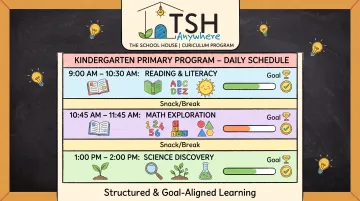
The School House's kindergarten (Primary) model is one example: reading, math, and science sit in defined session blocks so content stays tied to stated goals instead of getting bolted on later.
Objectives aren't a fixed contract. They're a working document you return to, cross off, and rewrite as your child's pace becomes clearer.
Frequently Asked Questions
What is the difference between homeschool objectives and a homeschool curriculum?
Objectives are the goals and skills you want your child to reach during the year. Curriculum is the actual materials, books, and methods you use to reach those goals.
Do all states require kindergarten homeschoolers to submit written objectives?
No. Requirements vary widely by state. Pennsylvania requires an objectives outline in its annual affidavit, while other states have no such requirement at all. Check your state's specific home education law before assuming.
What academic skills should a kindergartner master by the end of the year?
Most benchmarks expect solid letter/sound recognition, early reading with comprehension, and counting to 100. Many also include basic addition and subtraction within 10, plus simple scientific observation skills. Pace varies significantly by child.
How specific should my written homeschool objectives be?
Keep them broad and flexible rather than rigid or narrowly measurable. Homeschool associations generally recommend general language that leaves room to adjust as the year unfolds.
Can I change my homeschool objectives partway through the year?
Yes. Objectives are planning tools, not binding agreements, especially in states where they aren't used to judge legal compliance. Adjust them as your child's actual pace and interests become clear.
Where can I find sample kindergarten homeschool objectives to use as a template?
State homeschool association websites often publish sample elementary objectives documents you can adapt. These make a solid starting point rather than writing from a blank page.