Introduction
Many homeschool parents freeze the first time they grade a spelling test. Is 7 out of 10 correct a B or a C? Does effort count? Does it even matter if no one else will ever see the number?
Homeschool grading is flexible, especially in the early years. That flexibility narrows fast once transcripts and college applications enter the picture.
The Washington Post reported in 2023 that eleven states don't even require parents to notify anyone they're homeschooling, so how much structure you need depends heavily on where you live.
This guide covers the different grading methods homeschoolers use, how to calculate and record scores, what to actually grade, and how to build a transcript that holds up under college scrutiny.
Key Takeaways
- Before high school, grading is optional for most subjects — always verify your state’s rules
- Match the method to your goals: letter grades, checklists, rubrics, mastery tracking, or narratives
- High school changes the equation: transcripts and GPA calculations become non-negotiable
- No universal homeschool grading scale exists. Consistency and documentation matter more than the method
Do Homeschool Kids Need Grades?
Short answer: not necessarily, and definitely not the way public schools do it.
Many homeschool families measure mastery through work samples, narratives, or day-to-day observation instead of A–F grades—and that can be enough for learning and for most next-step applications.
Legal rules are a separate question. State oversight ranges dramatically. Some states ask for nothing more than a one-time notification. Others require standardized test scores, portfolio reviews, or a certified evaluator's sign-off every year.
Eleven states don't require notification at all, which means grading, portfolios, and progress reports are entirely a parent's call in those places.
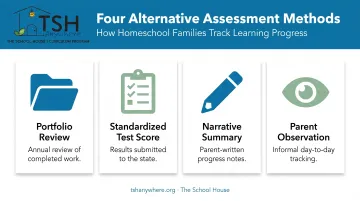
Even where grades aren't legally required, "assessment" still happens. It just might look like:
- A portfolio of completed work reviewed once a year
- A standardized test score sent to the state
- A narrative summary written by the parent
- Nothing at all, beyond the parent's own observation
If you'd rather not build grading and curriculum from scratch, programs like The School House include a structured Pre-K through 8th grade curriculum with assessment tools already built in—so you can track progress without inventing rubrics on your own.
Types of Homeschool Grading Systems
There isn't one "right" homeschool grading system. Most families mix a few methods depending on the subject and the child's age.
Percentage-to-Letter Grading
This is the version most parents remember from their own school days: total the correct answers, convert to a percentage, then assign a letter.
HSLDA's standard example runs 90–100% for an A, 80–89% for a B, down to 59% and below for an F. It also outlines a stricter scale that requires 93% for an A (HSLDA, 2020). Homeschoolers can adjust these cutoffs however they like.
Checklist-Based Assessment
For early elementary learners, a checklist often beats a percentage. Instead of scoring a worksheet, you mark whether a skill has emerged: counting to 20, identifying sight words, holding a pencil correctly. It's about tracking whether a skill exists yet, not ranking performance.
Rubric Grading
Rubrics work well for essays, science projects, and presentations where there's no single correct answer. A rubric breaks work into criteria (content, organization, grammar, creativity) and scores each one separately, giving more useful feedback than one letter grade.
Mastery-Based Grading
Common in homeschool math and reading instruction, mastery grading means a student doesn't move to the next concept until they've fully demonstrated understanding of the current one. There's no partial credit for "mostly getting it." Students practice until they do.
Narrative and Qualitative Evaluation
Some states allow written, descriptive feedback instead of numeric grades. A narrative might read: "Shows strong number sense; needs more practice with multi-step word problems." This suits subjects like art or character development, where a letter grade feels arbitrary.
Matching method to age and subject:
- Checklists for early elementary skill-tracking
- Rubrics for writing, projects, and presentations
- Mastery grading for math, phonics, and reading fluency
- Percentage or letter grades for middle school and up, especially near transcript years
- Narrative evaluation for subjects that resist numeric scoring, where state law permits it
How to Calculate and Record Homeschool Grades
Recording grades doesn't need to be complicated, but it does need a consistent process.
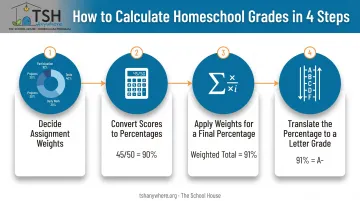
Step 1: Decide Assignment Weights
Before grading anything, decide how much each assignment type counts toward the subject grade. A typical split:
- Tests and quizzes: 40%
- Daily assignments: 30%
- Projects and essays: 20%
- Participation and effort: 10%
Adjust these to fit your priorities. A writing-heavy curriculum might weight essays more than daily worksheets.
Step 2: Convert Scores to Percentages
Use the standard formula: correct answers divided by total possible, multiplied by 100. A student who gets 25 out of 30 questions correct scores (25 ÷ 30) × 100 = 83.3%.
Step 3: Apply Weights for a Final Percentage
Average scores within each category, multiply each average by its weight, then add the results. Using the weights above: (tests 88% × 0.40) + (daily work 92% × 0.30) + (projects 85% × 0.20) + (participation 95% × 0.10) = 89.3%.
Step 4: Translate the Percentage to a Letter
| Percentage | Letter Grade |
|---|---|
| 90-100% | A |
| 80-89% | B |
| 70-79% | C |
| 60-69% | D |
| Below 60% | F |
That 89.3% lands in the B range; the single-quiz 83.3% from Step 2 would also be a B on its own.
Recommended Tools and Update Cadence
You don't need fancy software, but you do need somewhere consistent to log scores:
- A basic spreadsheet, one tab per subject
- A homeschool planner app with built-in grade tracking
- A portfolio platform such as Transparent Classroom—built into some subscriptions, including TSH Anywhere's AEC program
Update daily work weekly, then roll everything into a subject summary at the end of each quarter or semester. Waiting until year-end to reconstruct grades invites guesswork that won't hold up on a transcript.
What Should You Grade in a Homeschool Setting?
Most homeschool grades fall into four buckets:
- Tests and quizzes — direct measures of retained knowledge
- Daily assignments — practice work, worksheets, reading logs
- Projects and essays — longer-form work assessed with a rubric
- Participation and effort — engagement, persistence, willingness to revise
Adjusting for Learning Differences
Grading standards shouldn't be one-size-fits-all. A dyslexic student's essay, for instance, might be graded primarily on content and ideas, with spelling addressed separately, or set aside entirely if spelling isn't the skill being tested that day.
Letting a child dictate an answer, type instead of handwrite, or use extra time measures the skill you mean to assess—not an unrelated obstacle like handwriting speed or timed pressure.
Separate Effort From Mastery
Keep two distinct records: one for mastery (did they get the concept?) and one for effort and growth (did they improve, try again, ask good questions?).
A child who bombs a math test but pushes through three revision attempts deserves credit for that persistence, even if the final score doesn't show it. Blending both into a single letter can hide real progress.
Grading Homeschool High School for Transcripts and College Readiness
Once high school starts, grading stops being optional in practice. Colleges need a transcript, and a transcript needs consistent, documented grades behind it.
Building the Transcript
A basic homeschool transcript needs four things:
- Course list — every subject taken, labeled clearly (Algebra 1, not just "Math")
- Credit hours — typically 1 credit for a year-long course, 0.5 for a semester course
- Final grades — one letter or percentage per course, per year
- Cumulative GPA — calculated across all courses and years combined
Calculating GPA
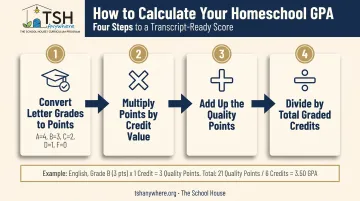
Calculate GPA in four steps:
- Convert each final letter grade to points (A = 4, B = 3, C = 2, D = 1, F = 0)
- Multiply those points by the course's credit value
- Add up the quality points
- Divide by total graded credits
Cumulative GPA uses the same method across every year combined. It is not a simple average of each year's GPA (HSLDA, 2024).
Weighted GPA for Advanced Coursework
Honors and AP courses often earn extra points on a weighted scale:
| Course Level | Points for an A |
|---|---|
| Standard | 4.0 |
| Honors | 4.5 |
| AP | 5.0 |
Dual enrollment credits usually don't get extra weighting automatically. Whether to weight them is a judgment call parents make themselves.
Getting Outside Eyes on the Work
A parent-issued grade can look self-reported to an admissions officer. A co-op teacher, tutor, or outside grading service review of major essays will not change the transcript grade. It does prepare the student for outside critique and adds credibility if a college asks for writing samples.
Clear documentation matters just as much. Most colleges already evaluate homeschool transcripts under the same criteria as any other applicant's when the record is complete. The University of Georgia, for example, reviews home-educated applicants the same way it reviews traditional high schoolers who submit an official transcript.
Label your GPA scale and weighting policy directly on the document so admissions staff know how to read it.
Frequently Asked Questions
How do I record grades for homeschool?
Decide how much each assignment type is worth, convert scores to percentages, then map those to letter grades on your chosen scale. Log everything by subject and term in a spreadsheet, planner app, or portfolio tool.
Do homeschool kids have grades?
Not always. Many families skip letter grades and use checklists or narrative feedback instead. Formal grades usually matter once you need transcripts for high school records or college applications.
What is the hardest grade to homeschool?
Middle school and early high school tend to feel hardest, since subjects get more complex and grading shifts from casual tracking to formal recordkeeping. There's no single universally "hardest" grade; it depends on the child.
What grading scale do most homeschoolers use?
A 90-100=A, 80-89=B, 70-79=C, 60-69=D scale is common, similar to public schools. Families can adjust the cutoffs to fit their own standards.
Do you have to give your homeschooler grades before high school?
It depends on your state's homeschool laws. Where grades aren't required, many families rely on narrative feedback, checklists, or portfolios instead of formal letter grades.
How often should I update homeschool grades?
Update your grade log weekly so daily work doesn’t get lost. Roll scores into a full subject summary each quarter or semester for permanent records.