Introduction
Your kid can finish a worksheet in ten minutes flat. Ask them why the answer works, and you get a blank stare.
This is the quiet frustration a lot of homeschool parents run into. Drills produce fast hands but not always working brains. Kids memorize steps without ever grasping the idea underneath them (researchers call this the "illusion of competence").
Living math flips that order. It treats math as a connected, meaningful subject you meet in stories, cooking, games, and daily life, not a stack of disconnected procedures to memorize.
This guide covers what living math actually is, why it holds up under research, and how to bring it into your homeschool routine. You'll also get resource picks worth your time and straight answers to the concerns parents raise most.
Key Takeaways
- Living math builds conceptual understanding first, memorization second
- A teaching philosophy you can layer onto any mastery or spiral curriculum you already use
- Facts still matter, but they stick better once a concept is genuinely understood
- Everyday tools like books, games, cooking, and an allowance deliver living math at zero extra cost
What Is Living Math?
Living math is an approach to teaching mathematics as a connected, meaningful subject rather than a checklist of isolated procedures. Instead of jumping straight to "here's the formula, now practice it 30 times," a living math lesson starts with a compelling idea: a story, a real problem, a physical demonstration, and lets the procedure grow out of that understanding.
Where the Idea Comes From
The term traces back to Charlotte Mason's philosophy of "living ideas." She held that children learn best from rich, meaningful content rather than dry facts handed to them passively.
AmblesideOnline, a major Charlotte Mason resource, describes this as giving children ideas rather than mere information 1. Mason's own writing on math called for understandable word problems and hands-on counting with beans or buttons before any paper exercises 2.
That said, living math has grown well past Charlotte Mason households. Unschoolers, classical educators, and eclectic homeschoolers all use versions of it today.
It Doesn't Replace Structure — It Reframes It
A common misconception: living math means ditching textbooks entirely. It doesn't.
- It keeps structured lessons and sequencing
- It changes how a concept gets introduced — usually through a teacher-led "captain idea" instead of a passive worksheet
- It works alongside mastery-based curricula (stick with one concept until it's solid) or spiral-based curricula (revisit topics repeatedly across the year)
Either curriculum structure can absorb a living math layer. The structure decides when topics show up. Living math decides how they're introduced.
What the Research Actually Says
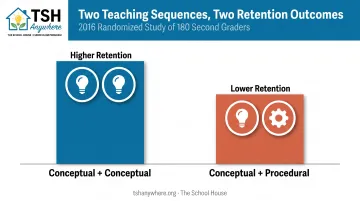
A 2016 randomized study of 180 second graders found a clear pattern. Students who received two rounds of conceptual instruction retained both conceptual and procedural knowledge better than students who got one conceptual round followed by one procedural round 3. Leading with understanding helped kids grasp the idea. It also improved how well they retained the steps.
That's one study on one topic (mathematical equivalence), so it's not proof that procedures are unnecessary. It does support starting with the idea before the algorithm.
Why Choose a Living Math Approach
Living math addresses three problems parents actually run into—not just a philosophy of learning.
It Builds Real Number Sense, Not Just Pattern Matching
Kids can get right answers on a worksheet by recognizing a pattern ("this page is all subtraction, so I subtract") without understanding what's happening numerically. Living math interrupts that shortcut by asking kids to reason through a real scenario (a grocery total, a scaled-up recipe, a board game score) where pattern-matching alone will not get them to the answer.
It Tends to Lower Math Anxiety
Math anxiety is a real, measurable phenomenon. A 2018 research review found it can actively consume working memory, making performance worse regardless of a child's actual ability 4.
That review points to math in real contexts (hobbies, sports, cooking) as one way to build a more positive relationship with the subject. Intervention research is still limited, but the direction is practical for home use.
It Flexes to the Learner
Living math principles adapt rather than dictate:
- Struggling learners get more hands-on repetition with real objects
- Advanced learners move into richer stories and problems sooner
- Multi-age siblings share one living idea at different depths
Spacing Beats Cramming
A 2025 meta-analysis of 27 studies found a small-to-medium benefit from spaced practice over massed, cramming-style practice in mathematics (effect size g = 0.28) 5. Living math revisits concepts across cooking, games, and daily tasks, so that spacing shows up in ordinary life without a separate review schedule.
The same push for genuine understanding over rote procedure shows up in how newer school models build curriculum.
The School House designed its American Emergent Curriculum from roughly a decade of pedagogical research and six-plus years of live classroom testing so learners practice math they can explain, not only procedures they can repeat.
How to Implement Living Math in Your Homeschool
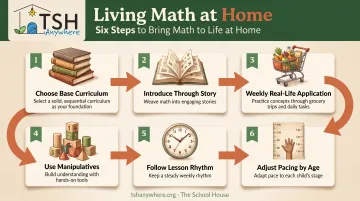
You don't need to overhaul everything at once. Here's a workable sequence.
- Choose a structured base curriculum. Pick a mastery or spiral program to keep skills building logically. Living math layers on top. It doesn't replace the backbone.
- Introduce concepts through story first. Before (or alongside) a formal lesson, read a story-based math book or a mathematician biography that touches the same idea. Curiosity opens the door for the lesson that follows.
- Build in real-life application weekly. Cooking measurements, a grocery budget, an allowance ledger, or a board game session all reinforce abstract ideas with something a child can touch and see.
- Use manipulatives with purpose. Counters, rods, coins, or an abacus let a child prove a concept to themselves. A 2013 meta-analysis of 55 studies (7,000+ learners) found moderate-to-large retention benefits when tools were used well, not merely present.
- Follow a simple lesson rhythm. Brief review, introduce the living idea, guided practice, have the student demonstrate it back, then a short wrap-up discussion.
- Adjust pacing by age. Young children absorb math informally through play and daily routines. Older students need progressively longer, more structured lessons layered on top of that same living-idea approach.
Best Living Math Resources to Explore
These categories are starting points — pick what fits your child's age and interests.
| Category | Example | What It Offers |
|---|---|---|
| Story-driven math books | Sir Cumference Math Adventures | Geometry and math history told through adventure stories |
| Mathematician biographies | Mathematicians Are People, Too | Human context behind big mathematical ideas |
| Rod-based manipulatives | Miquon Math Labs | Cuisenaire rods for visualizing number relationships |
| Abacus-based programs | RightStart Mathematics | Quantity visualization paired with strategy-building |
| Block manipulatives | Math-U-See | Integer blocks used from early lessons through Algebra 1 |
| Free fact practice | XtraMath | About 10 minutes daily, four operations |
| Free video instruction | Khan Academy | Self-paced lessons plus parent tracking tools |
One rule of thumb: save fact-practice apps and instructional videos for after a concept is understood. They're excellent for fluency, not first exposure.
Want to see story and hands-on work built into formal lessons? TSH Anywhere's curriculum samples show how concepts like congruence and similarity get taught through physical demonstration, not a worksheet alone.
Overcoming Common Living Math Challenges
Balancing Memorization and Understanding
Memorize facts only after your child understands the concept. Once they can explain why 7 × 8 works the way it does, short timed practice becomes reinforcement rather than a guessing game. Use games, oral drills, or quick written sets only after that understanding is solid.
Managing Your Own Math Anxiety
A 2015 study of first and second graders found that children of highly math-anxious parents learned less math and developed more anxiety themselves, but only when those parents helped with homework frequently [7]. When anxious parents helped less often, the effect disappeared.
Practical takeaways:
- Keep your tone neutral or positive during math time, even if you don't feel confident
- Learn alongside your child instead of pretending to have all the answers
- Bring in outside help (a tutor, co-op class, or online course) if daily homework help is triggering stress for either of you
Ensuring STEM and Test Readiness
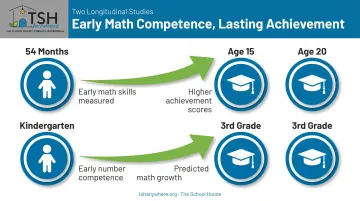
A study following 1,364 children found that stronger math skills at 54 months predicted higher achievement scores at age 15 [8]. Another study tracking children from kindergarten found that early number competence predicted math growth through third grade [9].
Early understanding supports later achievement, even if it does not guarantee a specific STEM career. For test readiness without over-testing, use periodic low-stakes check-ins (a quick oral quiz or game-based review) instead of frequent formal assessments.
Frequently Asked Questions
What is the best math curriculum for homeschoolers?
There isn't a single "best" one. The strongest setups usually pair a structured mastery or spiral program with living math elements matched to your child's learning style.
What age should you start living math?
Informal number exposure through play can start as early as toddlerhood. More structured living math lessons typically begin around age 5-6.
Does living math skip drill and memorization?
No. It delays fact memorization until a concept is understood, then supports fluency through consistent, purposeful practice — not by eliminating drill altogether.
Is living math the same as Charlotte Mason math?
It's rooted in her philosophy, but it's since grown into a broader approach used across many homeschooling styles, not just CM families.
How do I know if living math is working for my child?
Watch for your child explaining their reasoning out loud, applying a concept to a new situation on their own, and less resistance or stress during math time.
Can living math prepare my child for STEM careers or standardized tests?
When balanced with regular skill practice, the conceptual understanding living math builds tends to strengthen the problem-solving skills needed for advanced STEM coursework and standardized testing.