Introduction
Homeschooling in Georgia can cost next to nothing or climb past $2,500 a year, depending on the choices a family makes. Many parents underestimate how fast co-op dues, testing fees, and curriculum bundles add up. Others overcorrect, buying an all-inclusive package before knowing what their child actually needs.
Even the priciest homeschool budget in Georgia rarely comes close to private school tuition. In-state private schools commonly run $10,000 to $12,000 a year. That gap is a big reason more Georgia families are choosing to teach at home instead of writing a tuition check.
This guide breaks down realistic pricing tiers, the biggest cost drivers, a full expense breakdown, and how to budget so nothing catches you off guard.
Key Takeaways
- Annual homeschool costs per child in Georgia typically range from nearly free to about $2,500
- Georgia offers no blanket homeschool funding; Promise Scholarship and Dual Enrollment help some eligible families
- Curriculum choice, family size, and extras like co-ops and testing account for most of the cost range
- Even a top-tier homeschool budget costs far less than Georgia's average private school tuition
How Much Does It Cost to Homeschool in Georgia? (Pricing Overview)
Georgia doesn't set a homeschool budget for you. The state doesn't mandate a curriculum, a specific program, or a spending minimum, so your costs depend entirely on the materials and support you choose.
That flexibility helps, but it also causes common mistakes:
- Underestimating recurring costs like co-op dues or a testing administrator fee every three years
- Over-buying separate curriculum for each subject when one integrated program would cover the same ground
- Ignoring "hidden" costs such as field trip admission, sports fees, or art supplies that pile up mid-year
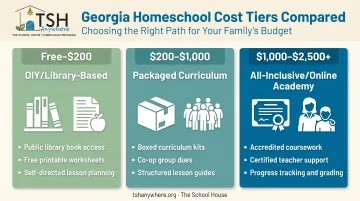
Here's how the typical pricing tiers break down:
| Tier | Annual Cost | What It Looks Like |
|---|---|---|
| DIY / Library-Based | Free–$200 | Library books, free printables, open-source curriculum |
| Packaged Curriculum | $200–$1,000 | Boxed kits, co-op dues, testing materials |
| All-Inclusive / Online Academy | $1,000–$2,500+ | Full online school, teacher support, extras |
Even at the high end, $2,500 a year is a fraction of the $10,000-plus that Georgia private schools typically charge.
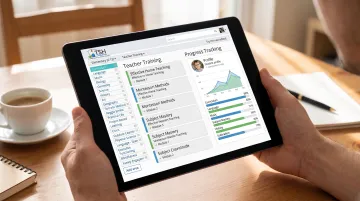
Families who want more structure than DIY, without the private school price tag, often choose an all-inclusive curriculum subscription. TSH Anywhere's plan, for example, runs $1,200 a year per learner and bundles curriculum, teacher training films, and progress tracking into one price.
Free / Budget Homeschooling ($0–$200/year)
This tier leans on what's already available: library books, free printables, and open-source curriculum. It works best for:
- Families comfortable planning their own lessons week to week
- Younger grades, where core skills like reading and basic math don't require specialized materials
- Households homeschooling multiple children who can share the same free resources
Mid-Range / Packaged Curriculum ($200–$1,000/year)
This is the most common range for Georgia families who want structure without building lessons from scratch. Typical costs include:
- Boxed curriculum kits for reading, math, and language arts
- Co-op dues and standardized testing materials
- Open-and-go plans you still teach yourself
All-Inclusive / Online Academy ($1,000–$2,500+/year)
At this level, families get a full online school experience bundled into one price:
- Accredited coursework with teacher support
- Extracurricular add-ons and progress tracking
- School-like accountability without writing every lesson plan
Key Factors That Affect the Cost of Homeschooling in Georgia
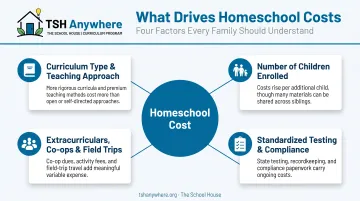
Georgia's homeschool law is light on regulation. Parents choose the curriculum, set their own schedule, and decide how much to spend, which means your costs mostly reflect your choices, not a state mandate.
Curriculum Type and Teaching Approach
Boxed, all-in-one curriculum (classical, Charlotte Mason, or unit-study kits) tends to cost more than mixing free and paid materials. A full classical curriculum box can run several hundred dollars a year, while a family blending free online resources with a few paid workbooks spends a fraction of that.
The tradeoff is convenience versus cost. Families who reuse materials across multiple children cut this expense further.
Number of Children Enrolled
Teaching three kids doesn't cost three times as much as teaching one. Curriculum, books, and co-op memberships can often be shared or discounted across siblings. Many packaged programs let you reuse teacher guides once an older child finishes them, and some co-ops charge per family instead of per student. Larger families often drive the per-child cost well below what a single-child household pays for the same materials.
Extracurriculars, Co-ops, and Field Trips
Co-op and support group dues add up. Georgia Home Education Association (GHEA) membership runs $35 a year, while CSRA Home Education Association charges $30 through August 31 and $65 afterward. On top of dues, most families also budget for:
- Museum and historic-site admission
- Sports leagues
- Art or music lessons
- Gas and travel to activities
None of this is legally required, but most Georgia homeschool families add at least one or two extras each year.
Standardized Testing and Compliance Costs
Georgia requires standardized testing at least every three years, starting at the end of third grade, according to GHEA's testing guidance. State law doesn't mandate a specific test or a universal bachelor's degree requirement for administrators.
Some tests, like the CAT, can be parent-administered without a special qualification. Others, including the Iowa Test and Stanford 10, typically require a proctor with a bachelor's degree under the publisher's rules, not Georgia law. That distinction matters for your wallet: self-administering a parent-friendly test costs far less than hiring a qualified administrator every three years.
Cost Breakdown of Homeschooling in Georgia
Homeschool spending goes well beyond the curriculum box on your shelf. A realistic Georgia homeschool budget usually includes:
- Curriculum & learning materials — books, workbooks, kits, and supplies bought each year
- Standardized testing — materials and, when required, an administrator fee every three years
- Co-op & association dues — annual memberships for groups like GHEA or local networks such as CSRAHEA
- Field trips & extracurriculars — museum admission, state park fees, sports, and enrichment classes
- Technology & subscriptions — devices, printer ink, and optional online course platforms
Few households pay for every category, but most cover at least three or four.
The most common mistake is budgeting for curriculum alone, then getting hit with a testing fee or co-op bill mid-year. A simple line-item budget before the school year starts prevents most of that surprise.
Free vs. Paid Homeschooling in Georgia — What's the Difference?
For most Georgia families, the first cost choice is free and DIY versus paid and structured—not which curriculum brand to buy.
| Factor | Free / DIY | Paid / Structured |
|---|---|---|
| Time investment | Parent plans every lesson from scratch | Open-and-go daily plans, less prep time |
| Consistency | Risk of missing required subject coverage | Follows a research-based sequence |
| Long-term fit | Works well for younger grades | Adds support as academic demands increase |
Free resources shine in the early years, when reading and math basics need little specialized material and a parent can plan lessons personally.
As kids hit upper elementary and middle school, gaps get harder to spot and fix alone. Many Georgia families then move to paid, structured programs—or add a co-op class or two—based on planning time and how heavy the grade-level load has become.
Financial Assistance & Budgeting Tips for Georgia Homeschoolers
Georgia doesn't fund homeschooling the way it funds public schools. There's no per-student stipend simply for teaching at home. Two programs are worth knowing about, though:
- Georgia Promise Scholarship: Up to $6,500 per eligible student for 2026-2027 (program details). Funds can cover approved curriculum, textbooks, tutoring, and some transportation.
- Dual Enrollment: Tuition, mandatory fees, and required textbooks for eligible 10th–12th graders in approved college courses.
Promise Scholarship eligibility is narrow: your child generally must have attended a Georgia public school for two consecutive semesters (or be entering kindergarten) and live in a qualifying school zone. For Dual Enrollment, tenth graders are usually limited to approved CTAE courses unless they have a qualifying SAT or ACT score.
Outside those two programs, Georgia offers no homeschool grants or vouchers, and homeschool expenses aren't automatically deductible on your state return. Federally, a Coverdell ESA or 529 plan can sometimes cover K-12 curriculum, tutoring, or required materials, so check current IRS guidance if you use either account.
A few practical budgeting tips:
- Start with the five required subjects - reading, language arts, math, social studies, and science - before adding electives
- Build testing and co-op dues into your budget upfront, not as an afterthought
- Buy used curriculum through Georgia homeschool swap groups before paying full retail
- Ask GHEA and local co-ops about scholarships or need-based discounts
Families who want more structure and accountability without a full private-school bill often compare DIY costs to bundled programs. TSH Anywhere's homeschool program, for example, includes curriculum, teacher training, and progress tracking for $1,200 a year per learner.
Frequently Asked Questions
What is required to homeschool in GA?
Parents need a high school diploma or GED and must meet these basics:
- File a Declaration of Intent within 30 days of starting, then again by September 1 each year
- Teach five core subjects
- Test every three years starting after third grade
Does GA give money for homeschooling?
Georgia offers no blanket grants or vouchers for homeschoolers. Exceptions include the Georgia Promise Scholarship (up to $6,500 for eligible students) and Dual Enrollment, which covers tuition and books for qualifying students in grades 10-12.
How many hours a week is homeschooling?
Georgia law requires 180 instructional days a year with at least 4.5 hours per school day, roughly 22.5 hours a week, though actual schedules vary by family.
Can you homeschool in Georgia for free?
Yes, using library books and free online curriculum, though it takes more planning and raises the risk of gaps in required subjects versus paid programs.
Is homeschooling considered a tax write-off in Georgia?
Georgia doesn't offer a specific state deduction for everyday homeschool purchases. Federal accounts like a Coverdell ESA or 529 plan may cover certain curriculum costs, depending on current IRS rules.
How does the cost of homeschooling compare to private school in Georgia?
Homeschooling typically runs $500 to $2,500 a year per child, well below the $10,000-plus that Georgia private schools commonly charge in tuition.