Introduction
Homeschooling in Australia has moved well past niche territory. An estimated 45,000 Australian children were homeschooled in 2024, according to ABC News, and the growth isn't slowing down. In Queensland alone, registrations jumped from 4,297 in 2020 to 11,314 in 2024.
Here's the catch: unlike public or private schooling, homeschooling has no fixed price tag. Costs swing wildly depending on the teaching method you choose, the curriculum you buy (or don't), how many kids you're teaching, and which state you live in.
This guide breaks down real pricing ranges for Australian homeschooling families. You'll find what actually drives costs up or down, how homeschooling stacks up against public and private school fees, and how to build a budget that fits your family instead of guessing.
Key Takeaways
- Registering to homeschool costs nothing in every Australian state and territory
- Annual curriculum costs range from $0 for DIY families to $5,000+ per child for distance education
- Teaching method, not the number of kids, is the single biggest factor driving your total spend
- Homeschooling costs far less than private school and roughly matches public school once extras are counted
- Lost parental income is the most underestimated cost in most family budgets
How Much Does Homeschooling Cost in Australia? (Pricing Overview)
There's no single number that answers "how much does homeschooling cost." It depends on whether you build your own program from scratch, buy a packaged curriculum, or enroll through formal distance education.
Three common budgeting mistakes trip up new homeschooling families:
- Assuming registration itself costs money (it doesn't, in any jurisdiction)
- Underestimating ongoing subscription and resource costs beyond the first purchase
- Overbuying curriculum in year one, before knowing what actually works for their child
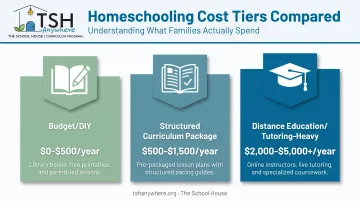
Here's a quick snapshot of the three main cost tiers before we break each one down:
| Approach | Typical Annual Cost (per child, AUD) |
|---|---|
| Budget/DIY | $0 – $500 |
| Structured curriculum package | $500 – $1,500 |
| Distance education / heavy tutoring | $2,000 – $5,000+ |
Price Range 1: Budget/DIY Homeschooling
This approach leans on free state-aligned curriculum outlines, public library books, and secondhand resources picked up from other homeschooling families. Parents design their own learning plan and handle registration and reporting requirements independently.
Best for: Confident parents who don't need a pre-built program and are comfortable creating lesson plans that meet their state's curriculum coverage rules.
Price Range 2: Structured Curriculum Packages
This tier covers a full pre-built curriculum spanning core learning areas, often with registration and reporting support baked in. Providers such as My Homeschool and Simply Homeschool publish subscription pricing in this range, generally landing between $400 and $950 per year depending on the plan and year level.
Some families also look beyond Australian-specific providers for supplementary resources. The School House's AEC curriculum subscription, for example, runs around US$125 a month and includes printables and instructional videos for Pre-K through 8th grade.
It's built for the American curriculum framework, though, so Australian families still need to confirm independently that it meets their state's registration and reporting requirements.
Best for: Parents who want a done-for-you structure without spending hours designing lessons themselves.
Price Range 3: Distance Education / Tutoring-Heavy Approach
This is the closest option to traditional schooling. Queensland's Brisbane School of Distance Education charges a compulsory AUD $1,738.80 fee for its 2026 "By Choice" home-based enrollment, before additional year, subject, and resource fees. Families leaning heavily on private tutoring instead of (or alongside) distance education can push costs even higher.
Best for: Families wanting structured teacher contact and closer alignment to a conventional school experience, or kids needing extra academic support.
Key Factors That Affect the Cost of Homeschooling in Australia
Your final cost depends on the teaching method you pick, how many children you're teaching, and how much infrastructure you already have at home.
Curriculum Type and Teaching Method
DIY, off-the-shelf packages, and formal distance education sit at three very different price points. DIY costs the least because you're assembling free resources yourself. Packaged curricula charge for convenience and structure. Distance education charges for formal enrollment, teacher oversight, and school-style accountability.
Family Size and Learning Resources
Larger families often reuse curriculum across siblings. A workbook or subscription bought for your eldest can frequently carry through to younger kids, dropping the per-child cost from the second child onward.
Basic setup typically includes a computer, printer, reliable internet, and stationery. Many families also add subscription tools:
- Reading Eggs: roughly $150/year, covering up to four children
- Mathletics: around $20/month
- Printing and workbooks: variable, and easy to underestimate over a full school year
Tutoring, Extracurriculars, and Registration
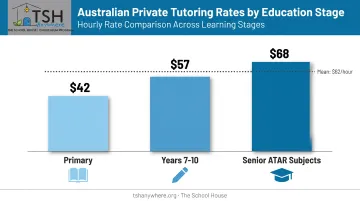
Private tutoring rates vary by subject and year level. Learnmate marketplace data puts primary tutoring around $42/hour, Years 7–10 near $57/hour, and senior ATAR subjects up to $68/hour (overall mean near $62/hour). Heavy tutor use for core subjects can become one of your largest line items.
Registration is free everywhere in Australia, but reporting requirements differ by state. Some jurisdictions want annual progress reports or portfolios; others include periodic home visits. Those rules don't add a direct fee, yet they do raise what you spend on printing, organising, and compiling documentation each year.
Homeschooling vs Public vs Private School — Cost Comparison
According to Futurity's 2026 education cost analysis, 13 years of government schooling in major cities costs an estimated $113,594. That total includes fees, uniforms, devices, and activities.
Catholic schooling runs about $247,174 over the same span. Independent schooling reaches $369,594.
Homeschooling typically runs $0–$5,000+ per child per year, plus first-year setup for a learning space and devices.
| Cost Category | Homeschooling | Public School | Private School |
|---|---|---|---|
| Tuition/fees | $0 – $1,700+ (distance ed) | Low/no tuition, some fees | $10,000 – $30,000+/year |
| Curriculum/resources | $0 – $1,500 | Included | Included |
| Tutoring | Variable | Sometimes needed | Sometimes needed |
| Uniforms | None | $100 – $300/year | $300 – $600/year |
| Technology | $500 – $1,000 setup | Often required | Often required |
On direct dollars, homeschooling wins. The line item that can flip the math is parental income: a parent who cuts hours or leaves work to teach absorbs an opportunity cost that rarely appears in curriculum spreadsheets—and often outweighs every other expense combined.
How to Reduce the Cost of Homeschooling in Australia
You can lower homeschool costs in Australia without dropping quality. A few practical moves make a real difference:
- Start with free state templates. Every state publishes curriculum outlines that already align with registration requirements, giving you a solid foundation before spending a cent.
- Buy secondhand. Homeschool Facebook groups, Facebook Marketplace listings, and local swap meets are full of barely-used curriculum sets and books at a fraction of retail price.
- Reuse across siblings. Curriculum bought for one child rarely needs replacing for the next, especially for consumable-free resources.
- Group up for tutoring and excursions. Local homeschool networks often negotiate discounted group rates for tutors, museum visits, and activity days that cost far more booked individually.
How to Estimate the Right Homeschooling Budget for Your Family
Building a realistic budget starts with a few honest decisions rather than a spreadsheet full of guesses.
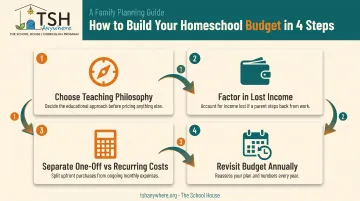
- Pick your teaching philosophy first — structured, eclectic, and unschooling approaches carry very different price tags, and this choice shapes your budget more than any other factor
- Factor lost income into the same plan as curriculum costs if a parent is cutting work hours to teach
- Split one-off setup costs (desk, laptop, printer) from recurring costs (curriculum subscriptions, tutoring) so year-two planning stays realistic
- Revisit the budget every year as needs change; what works at 6 rarely fits the same child at 10
Frequently Asked Questions
How long can you homeschool in Australia?
Families can homeschool from Foundation through Year 12, provided they maintain registration requirements in their state or territory.
Is homeschooling better than public school in Australia?
Neither is universally better. Homeschooling offers individualized pacing and flexibility; public school provides a structured social setting and lower out-of-pocket costs for most families.
Why is homeschooling legal in Australia?
Homeschooling is a legally recognized education option under each state and territory's education act, provided families register and meet basic curriculum coverage requirements.
Is homeschooling cheaper than sending a child to public or private school?
Usually yes versus private school, and roughly comparable to public school once you include resources, activities, and any lost income.
Do homeschooling families get any government funding support in Australia?
There is no direct subsidy for everyday homeschooling costs. Some geographically isolated families may qualify for the Assistance for Isolated Children Scheme, subject to strict eligibility rules and approved study arrangements.
How much does it cost to register for homeschooling in Australia?
Registering to homeschool costs nothing in any Australian state or territory. Families still cover ongoing curriculum, resource, and reporting costs on their own.