Introduction
Every homeschool parent hits the same fork in the road: which math curriculum do I actually pick? Two philosophies dominate the conversation, spiral and mastery, and the one you choose shapes math time for years.
The wrong fit can mean a child who forgets material three months after "finishing" it, or one who feels rushed past concepts before they're ready. Get it right, and math time stops being a daily battle.
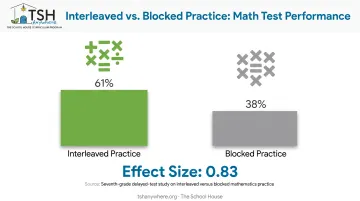
Research on interleaved practice found students scored 61% versus 38% on a delayed test when problems were mixed rather than blocked by type. That sequencing gap sits at the center of the spiral-versus-mastery choice.
This guide breaks down both approaches, compares them side by side, and helps you match the method to how your specific child actually learns.
Key Takeaways
- Spiral math introduces a concept briefly, then circles back so skills stick without long gaps
- Mastery math stays on one topic until your child fully understands it before moving on
- Neither method is universally better; it depends on your child's temperament and your teaching bandwidth
- You can blend both approaches—or switch—as your child's needs change
- Common spiral picks: Saxon, Horizons, Teaching Textbooks; mastery: Math-U-See, Singapore Math
Spiral vs Mastery: Quick Comparison
Here's the side-by-side breakdown parents ask for most often:
| Dimension | Spiral | Mastery |
|---|---|---|
| Learning structure | Introduces a concept, practices briefly, moves on, and circles back multiple times per year | Stays on one topic in depth until the child demonstrates full understanding |
| Review frequency | Built-in daily or weekly review of past concepts | Minimal review once a topic is considered mastered |
| Pacing | New material almost every lesson, in small steps | Varies by child; some topics move fast, others take weeks |
| Best fit for | Kids who need variety or benefit from repeated exposure | Kids who want deep focus and dislike jumping between topics |
| Cost/availability | Widely available (Saxon, Teaching Textbooks) across budgets | Spans budget-friendly (Math Mammoth) to premium (Beast Academy) |
A quick note on classification: some programs blur these lines. Math-U-See and Rod & Staff are mastery-based but still build in systematic review. "Mastery" doesn't mean zero repetition — it means repetition happens after the concept sticks, not before.
What Is Spiral Math Curriculum?
Spiral curriculum is built on a simple premise: kids retain material better when they see it again and again, spaced out over time, rather than absorbing it once and moving on for good.
The logic tracks with what's called the forgetting curve. Skills fade without reinforcement, so a spiral program keeps circling back before a concept fully drops out of memory.
That design also keeps any one skill from becoming a bottleneck. If a child stalls on long division for a week, the lesson still moves forward, then returns to that skill later with fresh practice.
Not all spiral programs cycle the same way:
- Saxon — rotates topics almost every lesson, mixing several skills daily with continuous review
- Math Mammoth — spends a few consecutive lessons on a topic before rotating to the next
- Horizons — labeled spiral by its publisher, cycling review alongside new content
- Teaching Textbooks — vendor-confirmed spiral review built into daily lessons
- Christian Light — continuous, systematic review built directly into each lesson set
Who Spiral Math Works Best For
Spiral suits kids who need frequent, low-stakes exposure rather than a single deep dive. It also fits parents who want built-in review without extra lesson planning.
Research on this scheduling approach is concrete. A randomized controlled trial published in the Journal of Educational Psychology tested seventh graders on material a full month after instruction.
Students who practiced with interleaved, mixed problem sets scored 61%, compared to 38% for students who practiced one problem type at a time (blocked practice). An effect size of 0.83 is a large gap for a scheduling change alone.
What Is Mastery Math Curriculum?
Mastery curriculum flips the sequencing. Instead of moving forward on a schedule, the child stays on a concept—place value, for example—until they can demonstrate solid understanding. Only then does the lesson advance.
This appeals to sequential, detail-oriented learners who get frustrated leaving a topic half-finished. It also protects against what educators call "mile-wide, inch-deep" coverage, where a student technically saw every topic but retained none of them solidly.
Use Cases of Mastery Math
Mastery fits kids who get anxious jumping between unrelated topics, or who need to fully "own" a skill before their confidence lets them move forward.
Common mastery-style programs include:
- Math-U-See: self-paced and manipulative-based, with procedural blocks and layered review worksheets
- Singapore Math: conceptual depth through visual and pictorial models before symbols
- Rod & Staff: one operation taught continuously for several weeks, plus cumulative review
- CTC Math: checks mastery at the lesson level before the student advances
- Beast Academy: built around deep problem-solving rather than memorization
Research supports the depth-first approach. The Education Endowment Foundation's mastery learning review found stronger effects in math and science than in reading—roughly six months of additional progress—and linked about 80% mastery on a concept to stronger long-term success.
An earlier synthesis of elementary classroom studies reported an average effect size of 0.89 for mastery learning in that age group, one of the largest benefits in that body of research.
Spiral vs Mastery: Which Is Better for Your Homeschool?
There's no universal winner here. What matters is matching the method to your child, and to your own bandwidth as the teacher.
Weigh these factors before deciding:
- Your child's attention span and tolerance for repetition
- How anxious or bored they get when material feels unfinished
- Your child's current math confidence level
- How much daily planning time you realistically have
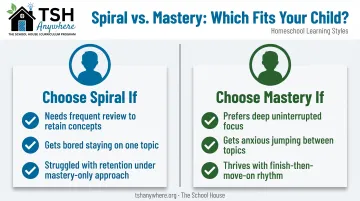
Choose spiral if:
- Your child needs frequent review to retain concepts
- They get bored staying on one topic too long
- They've struggled with retention under a mastery-only approach
Choose mastery if:
- Your child prefers deep, uninterrupted focus
- Jumping between unrelated topics makes them anxious
- They thrive with a "finish this, then move on" rhythm
Hybrid programs like Singapore Math and RightStart borrow from both camps, and switching mid-year is common and not harmful.
Some research-informed models skip the either/or framing entirely. The School House's American Emergent Curriculum, for example, stays developmentally aligned rather than locked to pacing guides. It pairs structured review cycles (its "Cycle + Advanced Assessments" component) with extended, project-based blocks so kids can still go deep on a topic.
Strong curriculum design usually pulls evidence from both sides instead of locking into one tradition out of habit.
Real-World Example: A Homeschool Switch in Action
Picture a common scenario: a second grader on a strict mastery program stalls on multiplication for six straight weeks. She loses confidence, dreads math time, and her parent starts second-guessing the whole curriculum.
The trigger for switching is usually one of these:
- The child fell noticeably behind pace
- Confidence dropped along with motivation
- Lessons started feeling boring or, conversely, overwhelming
There isn't solid published data on how many homeschool families switch math curricula each year, so treat any specific percentage you see elsewhere with skepticism. For most parents, curriculum choice is individual and trial-and-error. Switching approaches is normal—and catching a mismatch early saves time, money, and a lot of frustrated tears at the kitchen table.
Conclusion
Spiral and mastery are two different roads to the same destination: solid math proficiency. Neither is objectively superior. The right choice comes down to how your specific child learns, not which program wins more homeschool forum debates.
Feel free to test, adjust, and blend approaches as your child grows. If you want to see a research-driven curriculum that draws from both review and deep practice, The School House's curriculum samples show that blend in action.
Frequently Asked Questions
What is the best homeschool spiral math curriculum?
It depends on your child and budget. Saxon leads on incremental daily review; Horizons pairs spiral cycles with colorful workbooks; Teaching Textbooks adds video lessons for independent learners.
What is the best online math curriculum for homeschoolers?
Teaching Textbooks leans spiral with self-checking digital lessons. CTC Math checks mastery after each lesson. Khan Academy is explicitly mastery-based, letting kids work a skill until it's solid before advancing.
What is the best mastery-based math curriculum for homeschool?
Math-U-See stands out for hands-on manipulatives and self-paced blocks. Singapore Math is known for conceptual depth through visual models. Beast Academy suits kids who want rigor and challenge.
Can you combine spiral and mastery methods in homeschool math?
Yes, and many families do. A common approach is using a mastery curriculum as the base, then adding spiral-style review worksheets or flashcards to reinforce older concepts.
Which approach is better for a child who struggles with math?
Match the approach to the root cause. Kids who forget material benefit from spiral's frequent review. Kids who feel rushed and confused often do better with mastery's slower, no-pressure pacing.
How do I know if my child needs a different math curriculum approach?
Watch for these signals that your current approach isn't working:
- Ongoing frustration or anxiety during lessons
- Concepts forgotten within a few weeks
- Boredom with material that feels too easy or repetitive