Here's the good news — you don't need to figure it all out at once. A simple checklist breaks the process into five manageable steps: legal requirements, curriculum, readiness skills, routine and supplies, and socialization.
Think of this guide as a printable-style roadmap. Work through each step, check off what applies to your family, and move to the next. By the end, you'll have a clear plan instead of a pile of open browser tabs.
Key Takeaways
- Check your state's homeschool laws first — rules range from none to portfolios and hour logs
- Prioritize reading and math; add science and social studies lightly
- Gauge readiness across language, motor, social, and independence skills
- Keep table time short; balance it with play, read-alouds, and hands-on work
Step 1: Confirm Your State's Homeschool Requirements
Before you buy a single workbook, find out what your state actually requires. Homeschool laws vary enormously, and rules you hear from a friend two states over may not apply to you at all.
Check an official source, not word-of-mouth. HSLDA tracks state-by-state homeschool law and is a far more reliable starting point than a Facebook group.
Requirements swing wildly depending on where you live:
- Texas: No registration, monitoring, or program approval—only a course of study that includes good citizenship.
- Pennsylvania: Paperwork at compulsory age (6 by September 1), plus instructional time, a portfolio, and an annual evaluation.
- New York: After the sixth-birthday cutoff, file a letter of intent, instruction plan, quarterly reports, and yearly assessment.
That's three states, three completely different systems. Yours could resemble any of these, or none of them.
Build a compliance folder from day one. Even in low-regulation states, keeping records protects you and makes transitions easier down the road. Include:
- Notification or intent letters, if required
- An attendance log
- Work samples collected monthly
- Any evaluation or assessment paperwork
A shoebox or a simple digital folder works fine. You don't need a perfect system—just a paper trail if anyone ever asks.
Step 2: Build Your Core Curriculum Checklist
Kindergarten curriculum doesn't need to cover everything under the sun. Reading and math are the priority; everything else can be layered in lightly through books, conversation, and everyday life.
The Institute of Education Sciences backs this up with strong evidence: teaching sound-letter connections and decoding skills in kindergarten builds the foundation for reading comprehension later. Early math benefits from the same intentional approach — number sense and counting matter more right now than worksheets.
Core Subjects to Include
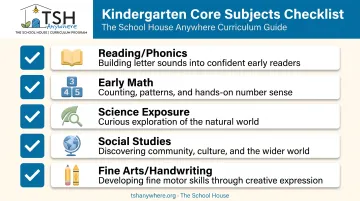
Your checklist should touch five areas:
- Reading/phonics awareness — letter recognition, book handling, listening comprehension
- Early math and number sense — counting, shapes, patterns, one-to-one correspondence
- Science exposure — nature walks, simple experiments, picture books about animals and weather
- Social studies basics — community roles, maps, simple history through stories
- Fine arts and handwriting — drawing, tracing, name-writing practice
Within reading and math specifically, self-assess against these skills:
Reading: recognizes most letters and sounds, holds a book right-side up, listens to a short story and answers a question about it.
Math: counts to 10 or higher reliably, identifies basic shapes, recognizes and continues simple patterns.
Science and social studies still belong on the checklist. Cover them at a kindergarten pace through stories, walks, and conversation rather than formal units.
Choosing an Approach That Fits Your Family
You've got options, and there's no single correct one:
- Boxed/structured curriculum — everything planned out, good for parents who want less prep time
- Play-based/eclectic — mixing resources based on what your child responds to
- Child-led/unschooling — following your child's interests as the primary guide
Many homeschool families describe their approach as eclectic, blending pieces from multiple sources rather than sticking to one program cover to cover.
If budget is tight, you don't need to spend much:
- Your library card covers most read-aloud material for free
- Free printables handle phonics and math practice
- Open-and-go programs (pre-planned lessons you just pick up and teach) cut prep time without full boxed-curriculum pricing
Programs like TSH Anywhere's kindergarten curriculum bundle reading, math, and hands-on projects into one subscription if you'd rather not piece things together yourself. Plenty of families still build a solid kindergarten year from library books and free resources alone.
Step 3: Check Off Developmental Readiness Skills
Academic readiness is only half the picture. Social, emotional, and independence skills matter just as much as knowing letters and numbers, and often more at this age.
Academic & Language Readiness
Run through this "does your child…" list:
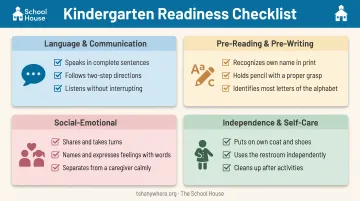
Language/communication:
- Follows two-step directions ("pick up the blocks, then put them away")
- Speaks in complete short sentences
- Retells a simple story in the right order
Pre-reading/pre-writing:
- Identifies some letters by name
- Holds a pencil or crayon with a functional grip
- Prints their own name, even imperfectly
The CDC's developmental milestones for age five include sustaining a back-and-forth conversation, counting to 10, and writing some letters in their own name. These are useful benchmarks, though the CDC is clear that milestone lists don't replace a formal screening if you have real concerns.
Social, Emotional & Independence Readiness
Social-emotional:
- Shares and takes turns most of the time
- Separates from you without prolonged distress
- Names feelings instead of just acting on them
Independence:
- Dresses themselves (mostly)
- Follows a simple daily routine
- Uses the bathroom independently
Checked "not yet" on a few? That's normal, not a red flag. Try these low-pressure fixes instead of drilling the skill directly:
- Turn-taking: Play a simple board game together a few times a week
- Fine motor skills: Playdough, lacing cards, or cutting practice with child-safe scissors
- Emotional vocabulary: Read books that name feelings, then ask how the character felt
Readiness is a snapshot of where your child stands right now, not a pass/fail test.
Step 4: Set Up Your Homeschool Routine & Supplies
Forget an hour-by-hour schedule. Kindergarten homeschooling works better in loose blocks:
- Morning routine — breakfast, getting dressed, a quick check-in about the day
- Table time — focused reading and math practice
- Play/centers — blocks, art, sensory bins, independent exploration
- Afternoon quiet time — read-alouds, rest, or free play
Table time for a five-year-old is naturally brief. Most of the real learning at this age happens through play and read-alouds, not seated instruction, so don't worry if your school day looks shorter than expected.
Your supply checklist doesn't need to be elaborate:
- Pencils and crayons
- Child-safe scissors
- A dedicated book box or basket
- A workspace or small table
- Simple manipulatives — blocks, beads, playdough
That's genuinely it. You don't need a classroom, just a corner that's consistently "school" when you need it to be.
Step 5: Plan for Socialization & Enrichment
Kindergarten homeschoolers still need regular time with other kids and adults outside the family. Turn-taking, cooperation, and peer interaction don't happen by accident at home the way they do in a classroom. You have to plan for them as part of healthy development.
Your socialization checklist:
- Playdates with kids in a similar age range
- Homeschool co-ops for shared classes or activities
- Library storytime for early group-listening practice
- Community classes such as swim, art, or gymnastics
Field trips double as social studies and language practice. Strong kindergarten options include:
- Fire station visits
- Grocery store trips
- Local nature trails
Each outing gets your child talking, asking questions, and observing the world while you check off community concepts on your social studies list.
If you want more structured peer interaction alongside your homeschool routine, community-built models can fill that gap. The School House runs a Montessori-based campus in East Northport, New York, serving learners from Pre-K through middle school.
Families on a hybrid path sometimes use a school like this for part-week community time while keeping the rest of learning at home. It does not have to be an either-or choice.
Frequently Asked Questions
What does a kindergartener need to know before starting homeschool?
Basic readiness matters more than advanced academics. Look for skills like following two-step directions, recognizing some letters and numbers, and handling routines like dressing or using the bathroom independently.
Do I need a formal curriculum for homeschool kindergarten?
No. Formal curriculum is optional at this stage, and many experts favor play-based, read-aloud-heavy approaches over structured workbooks for five-year-olds.
How many hours a day should kindergarten homeschooling take?
There's no official hour requirement. Most families keep focused table time brief and fill the rest of the day with play, read-alouds, and exploration.
What if my child isn't ready for kindergarten yet?
Delaying a year is common and often helpful. It gives kids extra time to build maturity, independence, and confidence before starting formal instruction.
Do all states require homeschool kindergarten registration?
No. Requirements vary widely — some states have none, others require notification or portfolios. Always verify current rules through your state's official homeschool law resource.
What if homeschooling doesn't feel like the right fit for my family?
That's okay, and it's common. Some families explore community-based alternatives like The School House, which offers an affordable, science-based school model as another option.