That freedom only works if the curriculum cooperates. Many traveling families struggle with programs built for a stationary classroom, ones that assume daily Wi-Fi, a fixed desk, and a strict 9-to-3 schedule.
Homeschooling is growing fast enough that curriculum providers are paying attention. According to Johns Hopkins School of Education, registered homeschool participation grew by an average of 4.9% for the 2024-2025 school year alone, more than double the roughly 2% pre-pandemic rate, with 80% of reporting states seeing increases.
This guide covers five curriculum options built to handle life on the move, plus the strategies that make any program travel-ready.
Key Takeaways
- Portability and offline access matter more than brand names or feature-heavy platforms
- Options range from free, self-guided platforms to $12,500/year accredited academies
- Every state has different homeschool reporting rules. Register in a home base before departure
- A flexible weekly rhythm beats a rigid daily schedule for travel-heavy families
Overview of Homeschool Curriculum for Traveling Families
For families on the road, homeschool curriculum has to work in an RV, a hotel room, or a rental abroad, and keep going when the Wi-Fi drops or the itinerary changes.
That usually means choosing among online academies with video lessons, all-in-one printed programs, unit studies built around field trips, and free resources parents piece together themselves. Demand has risen with remote work and digital nomad households that no longer need to stay near an office.
The list below ranks the five strongest options for travel, weighted by flexibility, cost, and how well each one holds up without reliable internet.
Top 5 Best Homeschool Curriculum Options for Traveling Families
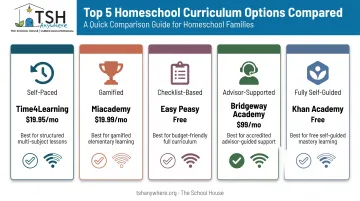
Top 5 Homeschool Curriculum Options for Traveling Families
Each option below was measured against five factors: flexibility, affordability, offline or portable access, accreditation availability, and how well it adapts across multiple grade levels in one household.
Time4Learning
Time4Learning has been a go-to PreK-12 online platform for over a decade, letting families mix and match grade levels subject by subject rather than locking a child into one grade for everything. That matters when a nine-year-old reads at a sixth-grade level but is still working through fourth-grade math.
The fully online, self-paced design fits road life: pause mid-week, skip a travel day, and pick up later without a backlog.
| Category | Details |
|---|---|
| Pricing | $39.95/month for one student, with sibling discounts of 10-25% for additional kids |
| Flexibility | Self-paced lessons and an activity planner that adapt to irregular travel schedules instead of a fixed daily calendar |
| Best For | Elementary through middle school travelers who need structure without a rigid classroom feel |
Miacademy
Miacademy is an accredited K-8 platform (MiaPrep extends it through grade 12) built around gamified, video-based lessons that keep kids engaged without a parent narrating every step.
Parents can block off travel days ahead of time, and the platform redistributes assignments around those gaps. That helps on RV routes through national parks or weeks abroad with patchy service.
| Category | Details |
|---|---|
| Pricing | $1.99 for the first month, then $48/month, or $480 billed annually (about $40/month) |
| Flexibility | Parent-set schedules with the ability to block off travel days ahead of time |
| Best For | Families who want gamified engagement plus accreditation options through MiaPrep |
Easy Peasy All-in-One Homeschool
Easy Peasy is a free, Christian-based curriculum covering every core subject from preschool through 12th grade (high school lives on a sister site). It runs entirely on daily checklists.
For travel, the draw is zero cost and almost no physical materials. Full-time families on a tight budget can cover a full school year without hauling textbooks.
| Category | Details |
|---|---|
| Pricing | Free, supported by voluntary donations |
| Flexibility | Self-guided daily checklists that families complete whenever the schedule allows |
| Best For | Families prioritizing affordability over formal accreditation |
Bridgeway Academy
Bridgeway is a fully accredited K-12 program with both secular and Christian tracks, built around individualized assessments rather than a one-size-fits-all pace.
Every family gets a dedicated academic advisor who builds the plan around an irregular schedule, instead of forcing the family onto a fixed calendar.
| Category | Details |
|---|---|
| Pricing | Full enrollment runs roughly $709/month ($8,500/year) to $1,042/month ($12,500/year), depending on tier |
| Flexibility | Advisor-supported customization built for irregular attendance and non-traditional calendars |
| Best For | Families wanting a fully managed, accredited program while traveling long-term |
Khan Academy
Khan Academy is a free, self-guided library of math, science, humanities, and more through video lessons and practice sets. It is not a full curriculum on its own, but it is one of the strongest travel companions on this list.
Download lessons on the mobile app before off-grid stretches, then finish practice sets when you have service again.
| Category | Details |
|---|---|
| Pricing | 100% free, no subscription |
| Flexibility | Fully self-guided pacing with no fixed schedule at all |
| Best For | Low-bandwidth practice and review alongside a primary curriculum |
How We Chose the Best Curriculum for Traveling Families
Most curriculum reviews rank programs for a family sitting still at a kitchen table. That's the common mistake: picking a platform built for a fixed classroom instead of one designed for changing locations and unpredictable connectivity.
We weighted four factors by how much each one affects a family's ability to keep learning on the road:
- Offline access: can lessons continue without daily internet?
- Self-pacing: can a family skip a travel day and resume without penalty?
- Cost: does the price work alongside fuel, flights, and campground fees?
- Accreditation: does the family need a formal transcript, or is a portfolio enough?
Tips for Making Any Curriculum Work While Traveling
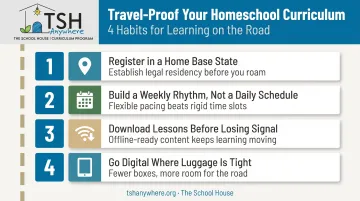
No curriculum survives a poorly planned trip. These four habits matter more than which program you pick.
- Register in a home base state first. Homeschool laws vary widely—from no-notice to high-regulation—and follow where your family is legally registered, not where you're parked. If you'll spend more than a month in another state while its public schools are in session, check whether that state expects compliance too.
- Build a weekly rhythm, not a daily schedule. Assign core subjects like math and reading to driving days when kids are already buckled in. Save hands-on learning—science experiments, museum visits—for exploration days. A weekly rhythm holds up better than a fixed Monday-through-Friday grid.
- Download lessons before you lose signal. National parks, rural highways, and international stays often mean unreliable Wi-Fi. Download videos, offline packets, or printable worksheets in advance, and keep a cellular hotspot as backup for longer off-grid stretches.
- Go digital where luggage is tight. RVs and carry-ons don't have room for a full shelf of textbooks. Favor curriculum that lives on a tablet or laptop, and reserve physical materials for subjects that truly need them—handwriting practice or math manipulatives.
Conclusion
The best curriculum for a traveling family is the one that still works when the itinerary changes and the kids are cranky from six hours in a car seat.
Test-drive any program for a month before committing to a full year. Most platforms, including the five above, offer short trial periods because pacing and format take a few weeks to feel natural.
Families who settle into a home base between travel seasons, or want more structure alongside road time, often need a middle ground between a full boxed curriculum and a loose unit study.
The School House’s AEC-based subscription through TSH Anywhere sits in that space. It offers:
- Pre-K through 8th grade coverage with printable materials
- 400+ training films parents can use with a printer and a screen
- Pricing at $125/month or $1,200/year per child
It isn’t a stand-in for the travel-first options above. It’s a science-based, community-backed option worth considering when the pace of travel slows and you want steadier structure at home.
Frequently Asked Questions
What is the most used homeschool curriculum?
Popularity varies by grade level and religious preference, but broadly used programs include Time4Learning, Abeka, and Easy Peasy. Most families mix and match rather than relying on a single dominant program.
What's the hardest state to homeschool in?
HSLDA currently classifies Massachusetts, New York, Pennsylvania, Rhode Island, and Vermont as high-regulation states, meaning they require notification, testing or evaluation, and sometimes curriculum approval or home visits.
Is homeschool curriculum expensive for traveling families?
Costs range from free (Easy Peasy, Khan Academy) to several hundred dollars a month for fully accredited programs like Bridgeway. Traveling families often lean toward lower-cost digital options to offset fuel, flights, and lodging expenses.
Can homeschooled kids who travel still get into college?
Yes. Colleges widely accept homeschool transcripts, and the University of Arkansas reviews homeschool applicants under the same standards as other freshmen, weighing course records and test scores over accreditation alone.
How many hours a day should a traveling family homeschool?
Research cited by HSLDA found that grades 3-4 students made the same academic progress as public school peers with just 2-3 hours of daily work. Travel days often warrant even lighter loads.
Do I need to notify my state if we travel while homeschooling?
Most families register and report in their home state regardless of where they travel. If you'll stay in another state for more than a month while its schools are in session, confirm whether that state expects separate compliance.