Many parents turning to homeschooling in Massachusetts are looking for flexibility, a break from classroom-based frustrations, or a more personalized, science-informed approach to learning. Others simply want more control over pace and content.
This guide walks through Massachusetts homeschool law, the three main types of homeschool programs families use across the state, and how to match a program to your child's needs.
Key Takeaways
- Massachusetts approves homeschooling at the district level with an annual plan—not a statewide filing
- State law lists 13 required subjects but no hour mandate; most districts expect 900–990 hours
- No grants, vouchers, or tax breaks—Massachusetts homeschool families cover all costs themselves
- Common paths include online curricula, local co-ops, and community-built microschools
- Match your choice to learning style, teaching time, and your district’s approval rules
What Is Homeschooling in Massachusetts?
Homeschooling in Massachusetts means a parent directs a child's education instead of enrolling them in public or private school. It's governed by Massachusetts General Laws Chapter 76, Section 1, which excuses a child from compulsory school attendance if they're "otherwise instructed in a manner approved in advance" by the local superintendent or school committee.
That last phrase matters. Notification alone doesn't authorize homeschooling. Approval does.
Homeschooling also differs from remote or virtual learning. Programs like Commonwealth Virtual Schools are still public school enrollment, just delivered online. Homeschooling is a private, parent-directed alternative entirely outside the public system.
What makes Massachusetts unusual is where the rules live:
- There's no single, uniform statewide homeschool policy
- Each of the state's 351 school districts sets its own review process
- Requirements for curriculum documentation, hours, and evaluation can differ from one town to the next
That means what works for a family in Worcester might need adjustment for a family in Newton.
Why Massachusetts Families Choose Homeschool Programs
Families choose homeschooling for day-to-day flexibility and for deeper control over how their kids learn. The most common drivers include:
- Personalized pacing that moves faster through subjects a child grasps quickly and slower through ones that need more time
- School days built around family travel, work schedules, or extracurriculars
- Ready access to Massachusetts museums, historical sites, and universities for hands-on learning
- Curriculum and values alignment without waiting on a district adoption cycle
Addressing the "Strict State" Reputation
HSLDA classifies Massachusetts as a high-regulation state for homeschooling, largely because of the advance-approval requirement and the option for districts to require testing or evaluation. High regulation mainly means more paperwork and oversight, not harder academics or limits on what you can teach.
A Growing Trend
Homeschooling in Massachusetts isn't shrinking. According to Johns Hopkins Institute for Education Policy's Homeschool Hub, the estimated share of Massachusetts K-12 students being homeschooled rose from 3.14% in 2022–23 to 3.39% in 2023–24 — roughly an 8% relative increase in a single year. That climb points to sustained interest, not a one-year blip.
Massachusetts Homeschool Laws & Requirements
Unlike most states, Massachusetts requires district-level approval of a homeschool plan before instruction legally begins. This applies to children ages 6 through 16.
Notice of Intent & Approval Process
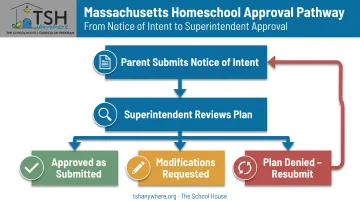
Parents submit a homeschool plan (commonly called a Notice of Intent) to their local superintendent. From there, the district can:
- Approve the plan as submitted
- Request modifications before granting approval
- Deny the plan, requiring resubmission
A typical plan includes:
- Curriculum and materials you'll use
- Planned instructional hours
- Teaching methods
- How you'll evaluate progress
The Massachusetts Department of Elementary and Secondary Education is clear that notice alone isn't enough. The district must actually approve the plan first.
Required Subjects & Instructional Hours
Massachusetts law requires coverage of 13 subjects, drawn from the same statute governing public school curriculum content:
- Language arts: spelling, reading, writing, English grammar
- Social studies: geography, U.S. history and the Constitution, citizenship duties
- Math and arts: math, drawing, music
- Health and character: health, physical education, good behavior
There's no official state-mandated hour count for homeschoolers. Structured learning time rules that apply to public schools don't extend to home education. That said, most districts still expect rough alignment with the public school standard:
| Benchmark | Requirement |
|---|---|
| School days | 180 (public school standard) |
| Elementary hours | 900 (public school standard) |
| Secondary hours | 990 (public school standard) |
Use these as planning benchmarks, not legal mandates — but expect your district to reference them anyway.
Evaluation & Record-Keeping
Standardized testing isn't automatically required statewide, but individual superintendents can ask for it as a condition of plan approval. When testing isn't required, districts commonly accept:
- Periodic progress reports
- Dated work samples
- Portfolios of completed work
Keep thorough records either way. Massachusetts wants proof of educational progress, not a specific format, so attendance logs, work samples, and assessment results all help if your plan is ever questioned.
Financial Assistance & State Funding
Massachusetts offers no grants, vouchers, or tax deductions specifically for homeschooling. Every curriculum purchase, co-op fee, or program subscription comes out of your family's own budget. Unlike some states experimenting with education savings accounts, Massachusetts hasn't extended similar support to home educators.
Types of Homeschool Programs in Massachusetts
Homeschool programs in Massachusetts generally fall into three categories: fully packaged online curricula, peer-led co-ops, and community-built school models. Each suits a different kind of family.
Online Accredited Homeschool Curriculum Programs
These are structured, professionally developed curricula (live or self-paced) that cover Massachusetts's required subjects with built-in tracking tools.
- How it differs: Relies on a pre-built curriculum rather than parent-designed lesson plans
- Best for: Working parents who want structure without building their own curriculum from scratch
- Strengths: Accreditation supports transcripts and college transitions; progress tracking simplifies district reporting
- Limitations: Costs and required parent involvement vary widely; even self-paced formats need supervision to stay on track
Homeschool Co-ops, Support Groups & Associations
Massachusetts has a strong network of parent-led organizations, including:
| Organization | Founded | Focus |
|---|---|---|
| AHEM (Advocates for Home Education in Massachusetts) | — | Getting-started resources, district guidance, community events |
| MHLA (Massachusetts Home Learning Association) | 1987 | District policy support, advocacy |
| MassHOPE | 1988 | Legal-compliance help, conventions, support-group network |
These groups are community-driven, not curriculum-driven. Families still design their own homeschool plan, but gain access to group classes, resource-sharing, and mentorship from experienced homeschoolers who know local district quirks.
- Best for: Families wanting socialization or guidance navigating district-specific requirements
- Strengths: Strong social support, often free or low-cost
- Limitations: Doesn't replace a full curriculum. Parents still handle core academics and paperwork
Community-Built Microschools & Affordable Alternative School Models
This category covers small, in-person, cohort-based programs where families or communities build a shared, low-cost school around a modern, science-based curriculum.
The School House is one example of this replicable model. Its flagship in East Northport, New York, has run as a live proof-of-concept since 2017, backed by a decade of curriculum research and six-plus years of classroom validation. Learners there reportedly test at least twice the national average across subjects, without academic admission screening.
The model was a 2025 Yass Prize finalist. Through TSH Anywhere, that same curriculum framework is available to homeschooling families directly. The school-building approach is also expanding to partner communities, including Bridgeton, Maine (2026) and North Miami, Florida (2027).
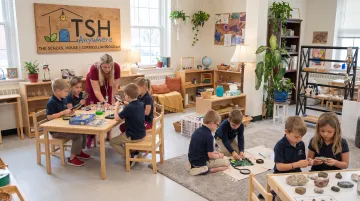
- How it differs: Combines the structure and teacher-led environment of a physical school with the affordability and flexibility homeschooling families value
- Best for: Families who want teacher-led structure without private-school tuition, or parent groups willing to help launch a shared microschool
- Strengths: Professional teacher culture, meaningful cost savings versus traditional private tuition, shared community ownership
- Limitations: Newer model with limited locations today; launching a site takes community coordination
How to Choose the Right Homeschool Program for Your Family
There's no single "best" homeschool program in Massachusetts. The right choice depends on your specific family. Popularity shouldn't drive the decision.
Weigh these factors before committing:
- Your child's needs: academic pace, social requirements, learning style
- Your available time: how much daily teaching and grading you can realistically commit to
- Budget: curriculum subscriptions, co-op fees, or tuition-style microschool costs
- District fit: how easily the program's records satisfy your local plan approval requirements
- Long-term goals: whether the program supports transcripts and diploma issuance if college is on the horizon
Common Mistakes to Avoid
- Underestimating time commitment. A fully independent, self-paced program still requires a parent to teach, supervise, and grade. Don't assume "self-paced" means hands-off.
- Filing too late. Massachusetts requires district approval before instruction starts, so switching programs mid-year without early paperwork can cause real delays.
- Choosing based on familiarity, not fit. A program's marketing or brand recognition doesn't guarantee it matches your child's needs or your district's specific plan requirements.
Frequently Asked Questions
Does Massachusetts pay for homeschooling?
No. Massachusetts offers no grants, vouchers, or tax deductions for homeschooling. Families cover all curriculum and program costs themselves.
What homeschool programs are available in Massachusetts?
Three main categories exist: online accredited curricula, local co-ops and associations like AHEM or MassHOPE, and community-built affordable school models such as The School House.
Is Massachusetts a strict homeschool state?
It's considered high-regulation due to mandatory district approval before instruction starts. That mainly means more paperwork and oversight, not more academic difficulty.
How many hours do I need to homeschool in Massachusetts?
There's no official state hour mandate for homeschoolers. Most districts still expect general alignment with the public school standard of 900–990 hours.
Do I have to notify my school district every year to homeschool?
Most districts expect an annual homeschool plan submission to the superintendent, though exact renewal policies vary by town. Check your district's current requirement each year.
Can homeschoolers in Massachusetts get a diploma recognized by colleges?
Parents typically issue their own homeschool diploma and transcript. Most Massachusetts colleges accept these, though some — like UMass campuses — request additional documentation of your approved curriculum.