Introduction
Homeschooling in Wisconsin isn't a niche choice anymore. Home-based enrollment hit 32,891 students for the 2025-26 school year, up nearly 6% from the year before, according to data reported by Wisconsin Public Radio. Right behind "how do I start?" comes the harder question families struggle with: "what will this cost me?"
Unlike public school (free) or private school (fixed tuition), Wisconsin homeschooling has no set price tag. There's no bill, no invoice, no standard fee schedule. A family's annual spend can land anywhere from nearly free to several thousand dollars per child, depending on curriculum, materials, and activities.
This article breaks down realistic pricing ranges, the factors that push costs up or down, a full budget category checklist, and how Wisconsin's lack of state homeschool funding affects your out-of-pocket budget.
Key Takeaways
- Wisconsin homeschool costs typically range from under $200 to over $2,500 per child annually
- The state offers no ESAs, vouchers, or direct payments for homeschool families
- Curriculum choice, sibling count, extracurriculars, and tech needs drive most of the cost variation
- Libraries, co-ops, and virtual charter resources can cut your budget fast
- Minimal regulations mean you control spending—not the state
How Much Does Homeschooling Cost in Wisconsin? (Pricing Overview)
There's no tuition schedule to reference here. Wisconsin doesn't approve, require, or price out a homeschool curriculum. What you spend depends on what you buy, build yourself, or borrow for free.
New homeschool parents tend to overspend in three predictable ways:
- Buying a pricey all-in-one curriculum before knowing whether a child learns best visually, hands-on, or through reading
- Duplicating materials across siblings when a shared or multi-age curriculum would work fine
- Underestimating recurring costs like printer ink, workbooks, and software renewals
Nationally, the National Home Education Research Institute cites a $600 average annual spend per student across all homeschooling approaches. Wisconsin families land across a much wider range depending on which tier they fall into.
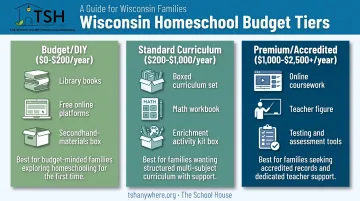
Budget / DIY Homeschooling ($0–$200/year)
This tier relies on:
- Public library books and programs
- Free platforms like Khan Academy and educational YouTube channels
- Secondhand books from resale groups
- Basic supplies you already own or buy at a discount store
Best for: parents comfortable assembling their own curriculum and confident using community resources instead of packaged materials.
Standard Curriculum Package ($200–$1,000/year)
This covers a purchased boxed or online curriculum for core subjects, plus some paid enrichment—math programs, language arts kits, or a subscription that bundles several subjects.
Best for: families who want structure and a clear scope-and-sequence without designing everything themselves.
Premium / Accredited Online Program ($1,000–$2,500+/year)
This tier includes accredited online coursework, dedicated teacher support, co-op or tutoring fees, and testing or assessment tools.
Best for: families targeting college-prep rigor, an official transcript, or built-in accountability from someone other than a parent.
Key Factors That Affect the Cost of Homeschooling in Wisconsin
Wisconsin doesn't mandate a curriculum, testing, or teacher credentials for homeschool parents. Costs vary widely because families spend based on preference, not state requirements.
Curriculum Type and Source
Curriculum choice drives most of the budget swing:
- Free or open-source materials cost nothing beyond the time to assemble them
- Boxed curriculum typically runs a few hundred dollars per subject
- Accredited online programs cost the most, often with tuition-style pricing and teacher access
Number and Ages of Children
Costs multiply with each additional child, but not always in a straight line. A multi-age curriculum or shared read-alouds and science kits can cut the per-child cost once you have two or more kids at different grade levels.
Extracurriculars, Co-ops, and Enrichment
Beyond core academics, many families also budget for:
- Co-op membership dues
- Sports leagues or private lessons
- Music instruction
- Specialized classes (coding, art, foreign language)
These add-ons often become the largest line item after curriculum itself.
Technology and Learning Materials
Devices, printers, home internet, and consumable workbooks add up fast over a nine- or ten-month school year. A single laptop upgrade or printer replacement can spike one year's budget well above the next.
Testing, Portfolios, and Optional Assessments
Wisconsin requires no testing at all. Even so, many families pay for standardized tests like the ITBS or SAT-10, or a portfolio review service, to track progress or prepare for future transcript needs.
Cost Breakdown of Homeschooling in Wisconsin
The "sticker price" of a curriculum box is only one piece of the real annual cost. Most Wisconsin homeschool budgets break down across these categories:
| Category | Frequency | What It Covers |
|---|---|---|
| Curriculum & core books | Recurring (annual) | The biggest cost driver; free to several hundred dollars per subject |
| Supplies & consumables | Recurring | Workbooks, art supplies, science kits, paper and printing |
| Technology & equipment | One-time, with upgrades | Computer/tablet, printer, software subscriptions |
| Extracurricular & co-op fees | Recurring | Membership dues, class fees, sports or music lessons |
| Field trips, memberships & enrichment | Recurring | Museum/zoo memberships, trip costs, learning app subscriptions |
A practical rule: Budget the curriculum line first, then add 20–30% for supplies, tech renewals, and at least one enrichment activity. That buffer is where most families get caught off guard.
Financial Support, Tax Benefits, and Funding for Wisconsin Homeschoolers
Wisconsin does not fund homeschooling directly. The state's private school choice programs (Milwaukee's MPCP, Racine's RPCP, and the statewide WPCP) pay for private school tuition only. The Wisconsin Department of Revenue is explicit that a home-based education program isn't a private school, so none of that funding reaches homeschool families.
Tax-advantaged savings options exist, with clear limits:
- Edvest 529 contributions qualify for a Wisconsin state tax deduction. It is a college savings tool, not a way to cover this year's curriculum purchases.
- Coverdell ESA is a federal option allowing up to $2,000 per beneficiary per year in tax-advantaged savings for qualifying school expenses, including books, supplies, and technology.
- Ordinary Wisconsin homeschool costs are not deductible on state or federal returns, unlike certain classroom teacher expense deductions.
Free and low-cost resources:
- Public library card (books, database access, sometimes free museum passes)
- Museum and zoo discount or free-admission days
- Free virtual charter school materials
- Used-curriculum marketplaces and local co-op swaps
How to Budget for Homeschooling Without Overspending
A little restraint in year one saves real money later. Here's how experienced Wisconsin homeschool families keep costs down:
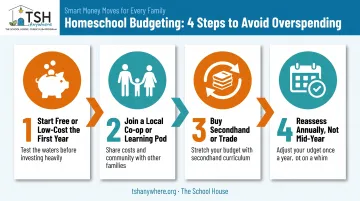
- Start free or low-cost the first year. You don't yet know your child's learning style. Spending big before you do almost always leads to unused materials.
- Join a local co-op or learning pod. Splitting the cost of shared classes, field trips, and even bulk-purchased supplies cuts everyone's individual spend.
- Buy secondhand or trade. Curriculum exchange groups and resale pages regularly offer barely-used materials at a fraction of retail price.
- Reassess annually, not mid-year. Switching curriculum mid-stream is one of the fastest ways to double-spend on the same subject.
When designing, teaching, and budgeting all fall on you, a structured program can still cost far less than private school. TSH Anywhere from The School House delivers the American Emergent Curriculum for $125 a month or $1,200 a year per learner.
That fee includes 400+ educator training films, live weekly teacher support, and progress tracking through Transparent Classroom. It runs as an at-cost program, not a franchise, so pricing stays closer to a subscription than a tuition bill.
Frequently Asked Questions
Does Wisconsin pay for homeschooling?
No. Wisconsin offers no direct payments, ESAs, or vouchers for homeschoolers. The state's private school choice programs only cover tuition at participating private schools, not home-based education.
How many hours are required for homeschooling in Wisconsin?
Wisconsin requires 875 hours of instruction per school year. Families can structure this across a traditional calendar or spread it year-round, as long as the total hours are met.
Is homeschooling cheaper than private school in Wisconsin?
Generally, yes — by a wide margin. Even premium homeschool programs rarely approach average private school tuition, though your final cost still depends on curriculum and enrichment choices.
Are homeschooling expenses tax deductible in Wisconsin?
No. Homeschool expenses don't qualify for Wisconsin's private school tuition subtraction, and there's no equivalent federal deduction for ordinary homeschool purchases.
What is the average cost of homeschooling one child in Wisconsin?
Most families fall somewhere between under $200 (budget/DIY) and $2,500+ (premium accredited programs) per child annually, with $200-$1,000 covering a typical standard curriculum package.
Do Wisconsin homeschoolers need to buy an accredited curriculum?
No. Wisconsin doesn't require or approve any specific curriculum, so families can choose free, informal, or accredited materials based on their budget and academic goals.