Many homeschool parents run into this exact wall. Traditional language arts curricula often demand heavy prep time, extra manipulatives, and lesson plans that assume you have hours to spare each week. A 2015 case study published by the National Home Education Research Institute found that weak time-management support was a recurring struggle for homeschooling parents, one that can leave kids behind on their work.
This guide breaks down what "open-and-go" actually means, what to look for in a strong program, and which language arts curricula genuinely deliver on the promise of less prep and more teaching.
Key Takeaways
- Open-and-go curricula need little to no daily prep—open the guide and teach.
- Programs that integrate grammar, spelling, and writing beat separate-subject stacks.
- Literature-based lessons build stronger, more transferable writing skills than drills alone.
- LLATL, Queen Homeschool, and Pathways cover multiple grades with one teacher’s guide.
- Match cost and format to your family size and budget before you buy.
What Does "Open and Go" Curriculum Mean?
"Open and go" describes exactly what it sounds like: a curriculum you can open and start teaching the same day, without pre-reading chapters, gathering supplies, or writing your own lesson plans. The teacher's guide does the heavy lifting.
Sonlight markets its instructor's guides as "Fully-Planned, No-Prep Lessons": everything the parent needs is already laid out.
Common Sense Press takes the same stance with Learning Language Arts Through Literature. Its open-and-go design puts answers beside the activities in the teacher's book, so parents can guide lessons with almost no prep.
Most true open-and-go programs share a few traits:
- Lessons planned in advance, day by day
- Clear, ready-to-use teacher directions (not always scripted word-for-word, but close)
- Answer keys built directly into the guide
- A self-contained teacher's book and student book, with few extra purchases required
That last point comes with a caveat. LLATL bundles readers for grades 1-2, but families using grades 3-8 need to source four separate novels for the book studies. "Open-and-go" describes how much planning a parent has to do, not necessarily whether every book ships in the box.
This style has caught on fast with larger families and parents juggling multiple grade levels. When you're teaching a first grader and a seventh grader in the same morning, a curriculum that requires zero setup time isn't a luxury. It's what makes homeschooling multiple kids sustainable.
Key Features to Look for in an Open-and-Go Language Arts Curriculum
Not every program labeled "easy" or "simple" actually saves you time. Here's what separates a genuinely low-prep curriculum from one that just looks that way on the shelf.
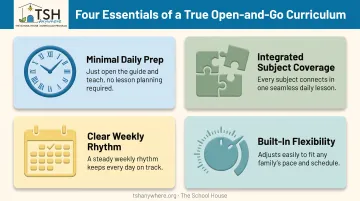
- Minimal daily prep. Open the guide and start teaching within a few minutes, with no supply gathering or night-before reading.
- Integrated subject coverage. Grammar, spelling, vocabulary, composition, and reading work together so you are not juggling five separate curricula.
- Clear weekly rhythm. A predictable four- or five-day structure makes pacing simple. You always know what Tuesday looks like.
- Built-in flexibility. Slow down for a tricky concept or skip ahead when a child has already mastered something, without breaking the system.
Why Literature-Based Instruction Matters
Many open-and-go programs teach grammar and writing through real books and passages instead of isolated worksheet drills. The National Council of Teachers of English has stated, based on decades of research, that teaching grammar in isolation doesn't improve student writing and can actually get in the way of it.
NCTE's more recent guidance backs this up: grammar instruction works best when it's tied directly to a student's own writing, using techniques like sentence combining built from real mentor texts rather than disconnected fill-in-the-blank exercises.
The strongest open-and-go programs reflect this research in how they structure daily lessons. The School House, whose team has spent over a decade studying how children acquire language, treats evidence-based design as standard practice for every subject, including homeschool language arts.
Best Open-and-Go Homeschool Language Arts Curricula to Consider
These five programs show up often in homeschool circles because they cut prep time without skimping on substance.
Learning Language Arts Through Literature (LLATL)
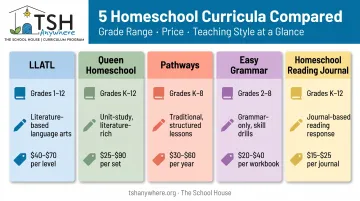
LLATL uses a Charlotte Mason-inspired approach: grammar, spelling, and composition come through real books and passages, not isolated drills. It covers grades 1–8; most levels need only a student activity book and teacher's book. Physical books run roughly $34–$40 at the upper grades; digital versions are about $22–$26. Grades 3–8 also need four novels for book studies, so budget for those.
Queen Homeschool Language Lessons & Spelling
Queen's Language Lessons follows a gentle Charlotte Mason-style rhythm—picture study, narration, copywork, dictation, poetry, and grammar—in 180 daily lessons per volume. It spans PreK through grade 8. The companion Learning to Spell Through Copywork series builds spelling through repeated practice instead of memorized lists. Physical volumes cost about $28.95; eBooks are around $29.95.
Pathways Language Arts (Kendall Hunt Publishing)
Pathways 2.0 bundles spelling, reading, writing, and phonics into one themed, living-book program for grades 1–8. Daily Lesson Guides need no prep beyond opening the guide. Each themed unit is about $60 for a combined print-and-digital, five-year license—one unit, not a full-grade kit—so plan for a full year of units.
Easy Grammar
Easy Grammar is the no-frills, grammar-only option: capitalization, punctuation, sentence structure, and mechanics for grades 1–8 (Easy Grammar Plus and the Ultimate series). It skips reading, spelling, and composition, so families usually pair it with a literature or writing program. Teacher editions run $36.95–$41.95; student workbooks are about $16.95–$17.95.
Homeschool Reading Journal (Not Consumed)
This option skips traditional lessons. Kids choose their own books and spend about 15 minutes a day on guided journal prompts that build comprehension and analysis. It fits grades 2–5 (a middle school version covers 6–8) and costs $19 per journal. Journals are consumable—plan on one per child.
How to Choose the Right Open-and-Go Program for Your Family
The "best" program depends less on rankings and more on how your specific kids learn and how your household actually runs day to day.
Think about learning style first. Some children thrive with literature immersion and narration; others do better with short, structured grammar-only lessons that don't wander into story discussion. If your child gets restless during read-alouds, Easy Grammar's directness may fit better than LLATL's literature-heavy approach.
Factor in family size and grade spread. Before buying, check how each program handles teaching multiple ages:
- LLATL expects one-on-one instruction in early grades, with independent work starting around grade 3
- Queen's printed Language Lessons are consumable, so you'll need one copy per child
- Not Consumed's digital editions can be used across multiple kids with a single purchase
Weigh cost against format. Physical books are easier for young readers to write in, but digital versions are often $10–$15 cheaper per level and can be printed on demand. If you're teaching three kids the same grade, a reproducible teacher edition (like Easy Grammar Plus) can save real money compared to buying individual consumable workbooks.
Making the Most of an Open-and-Go Curriculum
Buying the right program is half the battle. Using it well is the other half.
Give yourself permission to tweak things:
- Skip a repetitive section if your child has clearly mastered it
- Swap in a book your child actually chose instead of an assigned title
- Fold a spelling list into your existing phonics program rather than running two systems side by side
Set a consistent rhythm — four or five set teaching days each week — and stick to it. Open-and-go only saves time if you're not constantly rescheduling around it.
And let go of the pressure to finish every page. These programs are built on spiral review, meaning concepts repeat and build over the year. Mastery matters more than completion. If you're three weeks "behind" by May but your child can confidently identify a subject and predicate, that's a win, not a failure.
Frequently Asked Questions
What does open-and-go curriculum mean?
Open-and-go means little to no prep—you open the teacher's guide and start the lesson immediately. There's no separate lesson planning or gathering of extra materials beforehand.
Is there an open-and-go spelling curriculum available?
Yes. Queen Homeschool's Learning to Spell Through Copywork is a standalone spelling option, and programs like LLATL and Pathways build spelling into their integrated language arts lessons.
What is the best homeschool language arts curriculum?
It depends on your child's learning style and your family's schedule. Literature-based, integrated programs like LLATL often balance ease of use with real academic depth.
How much does an open-and-go language arts curriculum typically cost?
Prices generally run $15 to $40 per level for physical books, with digital versions often a bit cheaper. Bundles that include literature books can offer better value for larger families.
Can open-and-go curriculum work for multiple children at once?
Many programs include independent student workbooks or reproducible pages, so larger families can teach several grade levels at once. Always check the specific program's licensing terms first.
Is open-and-go curriculum too easy or lacking in rigor?
Not necessarily. Most use spiral review and literature immersion to build lasting skills, even when lessons feel short. Families wanting exam-style rigor in the upper grades can add a supplemental grammar workbook.