Most articles on this topic stop at "freedom and flexibility." That's not wrong, but it's incomplete. Florida families who homeschool successfully track something more concrete: what it costs, how much paperwork it demands, and whether their kids are actually progressing.
This article breaks down those practical benefits — the legal simplicity, the real dollar savings, and the day-to-day flexibility that makes homeschooling work for Florida families specifically.
Key Takeaways
- Florida is a low-regulation state with minimal paperwork and no mandated testing
- Homeschooling costs a fraction of private tuition, especially with PEP or Family Empowerment Scholarship funds
- Families control pacing, subjects, and schedules — a clear edge for kids with different learning needs
- Support networks (FLVS, co-ops, FPEA) make starting and sustaining homeschooling far easier than in stricter states
What Is Homeschooling in Florida (Brief Context)
Homeschooling in Florida means a parent or guardian takes direct legal responsibility for a child's education outside a traditional public or private school. No teaching certificate required. No district oversight of daily lessons.
Florida law recognizes three distinct paths to satisfy compulsory attendance:
- Home education program — the standard route under Florida Statute 1002.41, governed by a notice of intent, a portfolio, and an annual evaluation
- Private school enrollment, including church or "umbrella" programs — technically a private-school attendance path, not a home education program
- Certified private tutor — instruction from someone holding a valid Florida teaching certificate, subject to a 180-day term requirement
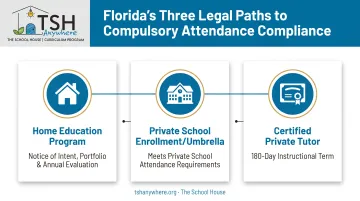
The paths differ in paperwork and oversight, but all three let families design education around their own child.
Key Advantages of Homeschooling in Florida
The benefits below aren't abstract ideals about self-directed learning. They're the specific, trackable outcomes Florida families weigh when deciding whether to homeschool: cost, flexibility, compliance ease, and actual academic progress.
Advantage 1: Minimal Regulation and Legal Simplicity
Florida is one of the least regulated states for homeschooling. There's no mandated instructional hour count, no state-approved curriculum, and no requirement to test through a standardized exam.
Here's what compliance actually looks like:
- File a notice of intent with your district superintendent within 30 days of starting
- Keep a simple portfolio — a log of materials used plus samples of student work, retained for two years
- Complete one annual evaluation, chosen from several parent-selected options (portfolio review, standardized test, or licensed psychologist evaluation, among others)
That's it. No monthly reporting. No district-approved lesson plans.
Why this matters: Lower paperwork means a lower barrier to entry. A parent weighing a mid-year switch out of public school doesn't need months of red tape: just the notice of intent and a plan for the portfolio. Florida's homeschool population, now over 150,000 students, reflects how many families have found this system workable at scale.
This ease matters most for first-time homeschoolers and single-income households already managing a full set of responsibilities. Nobody wants bureaucratic stress stacked on an already disruptive transition.
Advantage 2: Significant Cost Savings, Especially With ESA Support
Homeschooling costs less than private school. That's true even before state financial support enters the picture.
Florida's average private school tuition runs $13,794 for elementary grades and $13,859 across all K-12 grades, according to Education Data Initiative's 2026 analysis. Compare that to structured curriculum subscriptions built specifically for homeschool families — TSH Anywhere's Pre-K through 8th grade program, for instance, runs $1,200 per year per learner ($125/month), and that includes curriculum, printables, over 400 educator training films, and a portfolio-tracking tool called Transparent Classroom.
That's roughly a tenth of the average private tuition figure, before any scholarship funds are applied.
Two Florida programs can push the real out-of-pocket cost even lower:
- Personalized Education Program (PEP) — an education savings account for eligible K-12 students not enrolled full-time in public or private school, covering curriculum, tutoring, and testing
- Family Empowerment Scholarship — funds primarily for participating private schools, with remaining balances usable for instructional materials and other approved expenses
Both allow unspent funds to roll forward year to year, up to a $24,000 cap, which means families can plan multi-year education budgets instead of scrambling for tuition each August. Not every curriculum provider is an approved PEP vendor, so it's worth confirming eligibility directly with Step Up For Students before assuming a purchase qualifies.
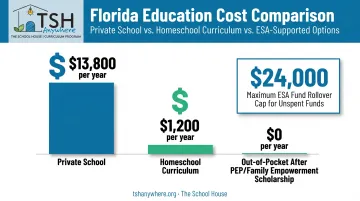
That gap is where options like TSH Anywhere fit: structured, research-based curriculum at a fraction of private-school tuition, without the same hit to the household budget.
Where this matters most: working-class and single-income families who want private-school-caliber instruction without the private-school price tag.
Advantage 3: Built-In Flexibility for Academic and Family Needs
Florida law places zero restrictions on homeschool schedules, subjects, or pacing. In practice, this means:
- Accelerating through subjects a child already grasps
- Slowing down where a child needs more repetition
- Building lessons around field trips, family travel, or work schedules
- Adjusting daily structure for kids who focus better at 7 a.m. than 1 p.m.
Why this matters academically: According to NHERI's 2026 research summary, homeschooled students typically score 15 to 25 percentile points above public school students on standardized achievement tests. That figure draws on multiple peer-reviewed studies from 2010 to 2026. It isn't proof homeschooling causes better outcomes on its own, but it does suggest the flexibility isn't costing families academic ground.
Florida also permits eligible secondary home-education students to enroll in dual enrollment courses at no cost (no registration fees, no lab fees) provided they demonstrate college-level readiness through an articulation agreement with the postsecondary institution.
This flexibility carries the most weight for families juggling multiple children at different learning levels, kids with special learning needs, gifted learners who need faster pacing, and older students chasing early college credit.
What Happens When Homeschooling Isn't Properly Planned
Florida's low-regulation environment is a benefit, but it can also lull new homeschoolers into skipping steps that matter. Common mistakes include:
- Missing the 30-day notice of intent deadline creates avoidable compliance headaches with the district
- Underestimating the time commitment leads to inconsistent instruction and rushed lesson planning
- Skipping curriculum planning altogether creates gaps in core subjects that surface years later
- Isolating from the broader homeschool community cuts off access to co-ops, field trips, and extracurriculars
- Ignoring available ESA funding like PEP or Family Empowerment Scholarship leaves real money unclaimed
If an annual evaluation shows a student isn't progressing at a rate commensurate with their ability, the superintendent issues a written notice. The family then has one year to provide remedial instruction before re-evaluation. Early planning avoids that headache entirely.
How to Get the Most Value from Homeschooling in Florida
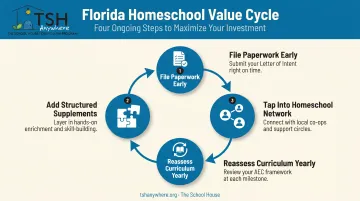
Homeschooling works best as an ongoing system, not a one-time setup you configure in August and forget about.
- File paperwork early and keep portfolios current. Don't wait until evaluation season to assemble a year's worth of work samples.
- Tap into Florida's homeschool network. Groups like FPEA offer local support chapters, an annual convention, and a guide many new families rely on.
- Reassess curriculum every year. What worked for a second grader may not fit a fourth grader; adjust rather than force a bad match.
- Add structured, affordable supplements when you want classroom-style rhythm without private-school tuition.
Many families want a defined academic calendar, portfolio tracking, and live educator support without hiring a tutor or paying full private tuition. Programs like TSH Anywhere fill that gap with 8-week sessions, weekly live educator support, and a secular curriculum focused on civics and entrepreneurship.
The School House is also building a Florida presence through community events in Vero Beach and a planned North Miami location in 2027.
Conclusion
Florida's homeschooling advantage comes down to three things working together: minimal regulatory burden, real financial support through PEP and Family Empowerment Scholarship funds, and the freedom to build an education around a specific child rather than a fixed system.
These advantages compound. A family that files paperwork early, taps into ESA funding, and stays connected to the broader homeschool community will see a bigger payoff five years in than a family that treats homeschooling as a one-time decision made in a panic.
Homeschooling is a practice you refine every year. With lighter rules, real ESA support, and room to adapt, Florida makes that ongoing work easier than most states.
Frequently Asked Questions
Does Florida pay parents for homeschooling?
No. Florida doesn't issue direct payments to homeschooling parents. Programs like the Personalized Education Program (PEP) and the Family Empowerment Scholarship provide education savings account (ESA) funds for curriculum, tutoring, and other approved expenses.
How many hours are required for homeschooling in Florida?
Standard home education programs under Florida's statute have no mandated hour or day count. Only the certified private tutor path requires 180 days, mirroring the public school calendar.
Is Florida a good state for homeschooling?
Yes. The Home School Legal Defense Association (HSLDA) classifies Florida as a low-regulation state, with support from Florida Virtual School (FLVS), the Florida Parent-Educators Association (FPEA), and statewide ESA scholarships.
How much does it cost to homeschool in Florida?
National homeschool spending estimates run around $600 per student annually, compared to Florida's average private school tuition of roughly $13,800. ESA funding can reduce out-of-pocket costs further.
What are the basic legal requirements for homeschooling in Florida?
Three things: a notice of intent filed within 30 days, a portfolio of work samples (kept for two years), and one annual evaluation chosen from several parent-selected options.
Can homeschooled students in Florida participate in public school sports or clubs?
Yes. Florida law allows homeschoolers to participate in extracurricular activities at their zoned public school, provided they meet the same eligibility and performance standards as enrolled students.