You're not alone. Poetry is quietly the most skipped subject in homeschool language arts. Many parents feel they lack the expertise to explain meter, form, or hidden meaning, so they either rush through a unit or avoid it entirely.
Here's the good news: you don't need a literature degree to teach poetry well. This post covers what a strong poetry homeschool curriculum actually needs, a simple framework called the Six S's, age-by-age strategies, and daily habits so easy you'll wonder why you waited this long.
Key Takeaways
- A balanced poetry curriculum combines reading, analyzing, and writing — not just one of the three
- The Six S's framework (Speaker, Subject, Situation, Structure, Sound, Sense) makes analysis simple at any age
- Short, consistent habits like a daily poem read-aloud beat occasional, lengthy lessons
- Matching poems to your child's interests matters more than sticking to "classic" titles
- Memorization builds confidence but isn't required for a poetry unit to succeed
Why Poetry Deserves a Place in Your Homeschool
Poetry does more heavy lifting than most parents realize. Its rhythm and repetition build phonological awareness, the skill that underlies early reading.
A longitudinal study of 92 children from first through third grade found that kids who developed more natural reading intonation later showed stronger fluency and comprehension.
Poetry is uniquely suited to building that skill because it's short, rhythmic, and made for reading aloud. As the International Literacy Association notes in its research on poetry and reading instruction, rhyme and rhythm support phonics, and repeated oral reading of melodic poems strengthens fluency and prosody.
Poetry offers an emotional benefit too. It condenses complex feelings into a handful of words, which makes it a quiet teacher of empathy. Charlotte Mason captured this when she wrote that "the best poetry is very full of moral impulse, not offered with intent" — meaning good poems shape character without ever lecturing.
Poetry doesn't have to mean rigid dissection. Playful, low-pressure exposure works better than academic autopsy:
- Read a poem aloud just for the sound of it
- Skip the "what does this symbolize" questions most days
- Let kids react with a drawing, a giggle, or silence
Poetry doesn't need to be boring. It only becomes boring when it's treated like a puzzle to be solved instead of language to be enjoyed.
What Makes a Good Poetry Homeschool Curriculum?
A strong poetry curriculum rests on three legs: reading and reciting poems, analyzing structure and meaning, and writing original verse. Skip any one leg and the table wobbles. A program that's all analysis feels like a chore. One that's all reading with no writing never lets kids try the craft themselves.
It Should Grow With Your Child
The best curricula are age-progressive:
- Early years: nursery rhymes, playful verse, read-alouds
- Middle grades: single-poet studies, light structural analysis
- High school: formal forms like sonnets, free verse, and literary movements
It Should Connect to Other Subjects
Multi-sensory pairings help reluctant learners connect emotionally with poems that might otherwise feel distant. Many homeschool literature courses pair classic poems with film: a poem about ambition alongside Citizen Kane, or a poem about resilience next to Chariots of Fire. The pairing gives abstract language a concrete anchor.
It Should Stay Light on Prep and True to Research
Poetry works best as a short, consistent habit, not an occasional big production. If your curriculum demands 45 minutes of lesson planning before you can read a single poem, it will get skipped. The strongest programs let you open a book and go.
Solid design also draws on current literacy research rather than outdated rote-memorization models. The School House takes that path in language arts: hands-on, discussion-driven lessons instead of rigid worksheets. The same idea fits poetry well. Lead with engagement, then bring in terminology.
Match the format to your goal:
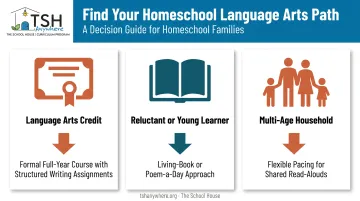
- Language arts credit: Choose a formal, full-year course with structured writing assignments.
- Younger or reluctant learner: Prefer a living-book or poem-a-day approach over a textbook.
- Multi-age household: Look for flexible pacing so siblings can share read-alouds and branch into different writing tasks.
The Six S's of Poetry: A Simple Framework for Analysis
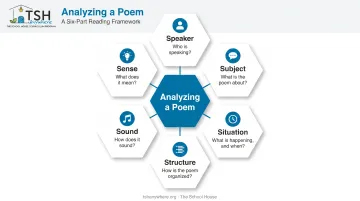
If meter and symbolism make your palms sweat, the Six S's give you a low-stress way to break down any poem without a literature degree. It's a memorable framework: Speaker, Subject, Situation, Structure, Sound, and Sense.
| Element | What to Ask |
|---|---|
| Speaker | Who is "talking" in this poem, and is it the poet or a persona? |
| Subject | What is this poem actually about? |
| Situation | What's happening: the setting, moment, or circumstance? |
| Structure | How are lines and stanzas arranged, and why? |
| Sound | What rhyme, rhythm, or repeated sounds shape the poem's music? |
| Sense | What's the overall takeaway once you combine the other five? |
Speaker: Separating Voice From Poet
Ask, "Who is saying this?" A poem written in first person isn't always the poet's own voice. Emily Dickinson often wrote from personas far removed from her own life. Teaching kids to spot this distinction early prevents lazy assumptions later.
Subject and Situation: The What and the Why Now
Subject is the topic: love, loss, a thunderstorm. Situation is the surrounding context—is the speaker remembering something, watching something happen, or imagining a future moment? These two questions ground kids before they hunt for deeper meaning.
Structure: What Form Reveals
Stanza breaks, line length, and form aren't decorative. A poem written in short, choppy lines might mimic breathlessness or urgency. A tightly rhymed sonnet might mirror order and control. Ask what the shape of the poem does to how it feels to read.
Sound: The Poem's Music
Rhyme, rhythm, meter, alliteration, and assonance are the tools that make a poem sound like a poem rather than a sentence chopped into lines. You don't need to name every device. Just ask, "What do you notice about how this sounds when read aloud?"
Sense: What the Poem Is Really Saying
Sense is the synthesis step. Once you've covered the other five, ask: "So what is this poem really saying?" That question asks for real interpretation, and kids answer it with far more confidence after the groundwork is in place.
Teaching Poetry by Age and Grade Level
Age-appropriate expectations matter more in poetry than almost any other subject. National literacy standards move students from simply recognizing rhythm in early grades toward analyzing sonnet form and word choice by high school. Here's how that plays out in a homeschool setting.
Elementary (Grades K-5)
Keep it playful. Prioritize memorization and illustration over formal analysis:
- Read nursery rhymes and playful verse daily
- Keep a decorated poetry folder for favorites
- Have kids draw pictures inspired by a poem
- Hold a weekly family recitation, even if it's just two lines
Middle School (Grades 6-8)
Middle school is the right time to move from pure play into light craft talk—speaker, imagery, sound, and sense—without full formal analysis. Pair single-poet studies with short biographies: three or four Langston Hughes poems alongside a page about his life, for example. Start basic writing exercises too:
- Acrostic poems using a favorite word or name
- Haiku, which teaches economy of language
- Free verse, which removes the pressure of rhyme
These build confidence before formal instruction arrives.
If You Continue Past 8th Grade
Families who keep poetry going in the high school years can shift into formal study of poetic forms and literary movements, with structured writing that still supports a language arts credit. Tie poems to other subjects—war poetry with a history unit, or a classic poem with a film from the same era—so the work stays connected rather than isolated analysis.
Simple, Low-Prep Ways to Bring Poetry to Life
You don't need elaborate lesson plans. A few small habits do more than a semester of worksheets.
Try these low-prep habits:
- Poem-a-day: Read one poem aloud each morning. No formal teaching—two minutes builds familiarity with poetic language over time.
- Weekly memorization: Pick one short poem, recite it on a set day, and file it in a poetry folder. Watching that folder grow is its own reward.
- Optional enrichment: Poetry teatime (poems over cookies and tea) or pairing verses with art and music. Treat it as a bonus, never a requirement.
The goal is consistency, not spectacle.
Common Mistakes That Turn Kids Off Poetry
A few habits reliably drain the joy out of poetry, even with good intentions.
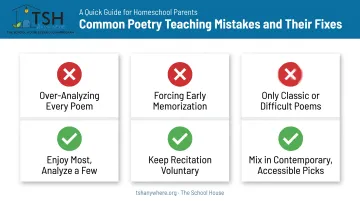
- Over-analyzing every poem. Turning every reading into a device scavenger hunt leaves students uninspired rather than curious. Reserve deep analysis for a select few poems and let the rest simply be enjoyed.
- Forcing memorization or recitation too early. Pushing performance before a child feels ready creates anxiety instead of appreciation. Let recitation stay voluntary and low-stakes until confidence builds.
- Choosing only "classic" or difficult poems. Sticking rigidly to canon titles without considering a child's interests or reading level disengages reluctant readers, especially older students. Mix in accessible, contemporary poems alongside the classics.
As the National Council of Teachers of English has written on poetry engagement, giving students time to simply enjoy, discuss, or creatively respond to a poem matters more than checking off analytical boxes.
Frequently Asked Questions
What is a good poetry curriculum for homeschooling?
A good curriculum balances reading, analysis, and writing rather than focusing on just one. It can range from a casual living-book or poem-a-day approach to a formal full-credit course. Choose based on your child's age and goals.
What are the six S's of poetry?
The Six S's are Speaker, Subject, Situation, Structure, Sound, and Sense — a simple framework for breaking down any poem without feeling overwhelmed.
At what age should I start teaching poetry to my child?
Informal exposure—nursery rhymes and read-alouds—can start in toddlerhood. Save formal analysis, such as the Six S's, for around middle school.
Do I need to teach poetry every day?
Not formally, but a short daily habit like reading one poem aloud is more effective than infrequent, lengthy lessons. Two minutes a day beats a 45-minute unit once a month.
How can I teach poetry if I don't understand it myself?
Simple frameworks like the Six S's and casual read-aloud routines let you learn alongside your child. You don't need expert knowledge — just curiosity and consistency.
Is poetry memorization necessary for homeschoolers?
No, it's not mandatory. It offers real benefits for public speaking, confidence, and retention, but it works best introduced gradually and without pressure.