These platforms matter because the homeschool math gap is real. Kids who fall behind on fractions in third grade often struggle with algebra five years later, and a workbook alone rarely catches that early enough. Adaptive, self-paced programs are built to spot those gaps immediately and build the STEM-ready skills colleges and careers now expect.
This guide compares the top online homeschool math programs for 2026, breaks down what actually separates a mastery-based platform from a spiral one, and clears up the curriculum jargon that makes shopping for math programs so confusing.
TL;DR
- Adaptive, self-paced platforms close common homeschool math gaps and build STEM-ready skills early
- Options range from free (Khan Academy) to premium adaptive tools like ALEKS and CTCMath
- The right fit hinges on grade level, learning style, budget, and mastery vs. spiral design
- Math is cumulative — switching programs mid-year usually creates more gaps than it solves
Overview of Online Homeschool Math Programs in 2026
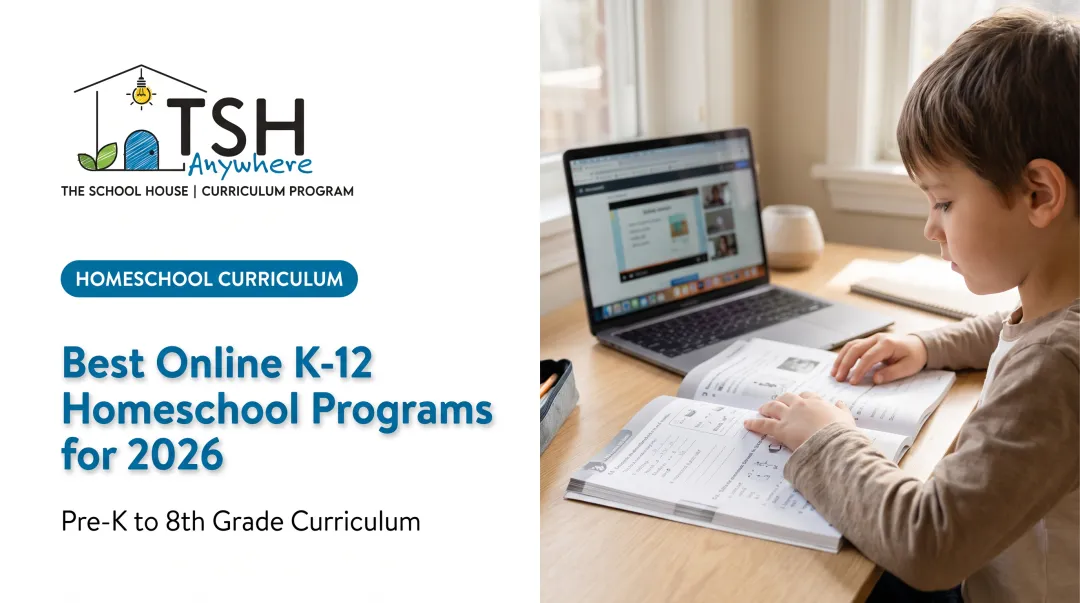
Online homeschool math programs replace static textbooks with video lessons, adaptive practice sets, and automated grading. Instead of a parent checking an answer key by hand, the platform adjusts difficulty in real time and flags exactly which skills need more work.
That shift matters more than it might seem. A National Home Education Research Institute review found that 15 of 24 academic-achievement studies, 62%, showed homeschooled students outperforming institutionally schooled peers, though the review notes causation hasn't been proven and results vary by study.
Math is harder to isolate, but the pattern holds: structured, well-chosen instruction tends to beat guesswork. Flashy animations and gamified badges are easy to market, but they don't guarantee a child retains the concept.
Judge instructional design by proven pedagogy, not interface polish—the same standard The School House uses in its science-based curriculum for homeschool families.
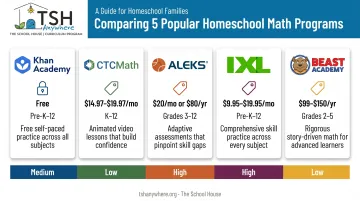
The list below ranks the top online homeschool math programs available to U.S. families in 2026, based on grade coverage, adaptivity, cost, and how parents and students actually rate the experience.
Best Online Homeschool Math Programs for 2026
Every program here was evaluated on four criteria:
- How well it adapts to the learner
- How many grade levels it spans
- What it costs a real family
- How parents and students rate it after using it week to week
Khan Academy
Khan Academy is the free, nonprofit platform most homeschool parents try first. Its math catalog runs from Pre-K through AP Calculus, multivariable calculus, and even linear algebra, with video lessons for nearly every topic in between.
What makes it stand out is the price-to-coverage ratio: no other platform on this list spans this many grade levels at zero cost. The video explanations are strong, and Khanmigo, its AI tutor, adds guided help for $4 a month or $44 a year if a family wants extra support.
| Category | Details |
|---|---|
| Cost | Free (Khanmigo AI tutor add-on: $4/month or $44/year) |
| Grade Levels | Pre-K through Calculus |
| Best For | Budget-conscious families wanting broad, self-directed coverage |
CTCMath
CTCMath is a subscription video curriculum spanning K-12, built around short, sequential lessons and printable worksheets rather than Common Core scope and sequence.
Each lesson ends with an adaptive quiz that raises difficulty as a student answers correctly. Mastery is marked by earning four stars on the hardest question set.
Parents consistently mention two things: the discounted homeschool pricing and how little day-to-day involvement it requires. It's a traditional, video-led sequence, and a solid fit for families who want structure without teaching the lesson themselves.
| Category | Details |
|---|---|
| Cost | $39.90/month or $257/year (1 student); $59.90/month or $397/year (multiple students) |
| Grade Levels | K-12 |
| Best For | Families wanting a traditional, video-led sequence with minimal parent involvement |
ALEKS
ALEKS is the AI-driven adaptive platform widely used in college-prep and dual-enrollment math tracks.
It opens with an Initial Knowledge Check that maps exactly what a student knows, then builds a personalized path using what McGraw Hill calls Knowledge Space Theory. It retests periodically to confirm earlier topics actually stuck.
The homeschool version covers grades 3-12, wider than many parents expect. It's rigorous, and the analytics are detailed, making it a strong choice for older students prepping for algebra-heavy coursework or standardized tests.
| Category | Details |
|---|---|
| Cost | $19.95/month, $49.95/3 months, $99.95/6 months, or $179.95/year |
| Grade Levels | 3-12 |
| Best For | Students needing rigorous, adaptive practice aligned with college readiness |
IXL
IXL is less a full curriculum and more a skill-practice engine, spanning Pre-K through Calculus and tracking progress at the level of individual skills rather than broad topics. Every question ties to a specific standard, so a parent can see precisely which fraction sub-skill is shaky.
That granularity is what parents like most. It's useful as a diagnostic tool, whether IXL serves as the main curriculum or a supplement to something else entirely.
| Category | Details |
|---|---|
| Cost | $9.95/month or $79/year (1 child); +$4/month per additional child; bundles start at $15.95/month |
| Grade Levels | Pre-K through Calculus |
| Best For | Supplementing another curriculum or targeting specific skill gaps |
Beast Academy
Beast Academy teaches math through comic-style storytelling, following a cast of monster characters through challenging problem sets. It's built for ages 6-13, with five levels that roughly track grades 1 through 5. Levels 4-5 also cover a fair amount of middle-grade content.
It's available online, in print, or both, and either format can stand alone as a full curriculum. For a kid who finds standard workbooks boring, this is often the program that keeps them working through harder problems.
| Category | Details |
|---|---|
| Cost | $15.99/month or $99.99/year (1 student); +$10.99/month per sibling; books bundle $160 |
| Grade Levels | Grades 1-5 (ages 6-13) |
| Best For | Young learners who need an engaging, story-driven approach to stay motivated |
Mastery vs. Spiral vs. Common Core: What These Terms Mean for Your Choice
Curriculum descriptions throw around terms that sound interchangeable but aren't. Getting these right can save a family from switching programs three times in one year.
Mastery Learning vs. Spiral Learning
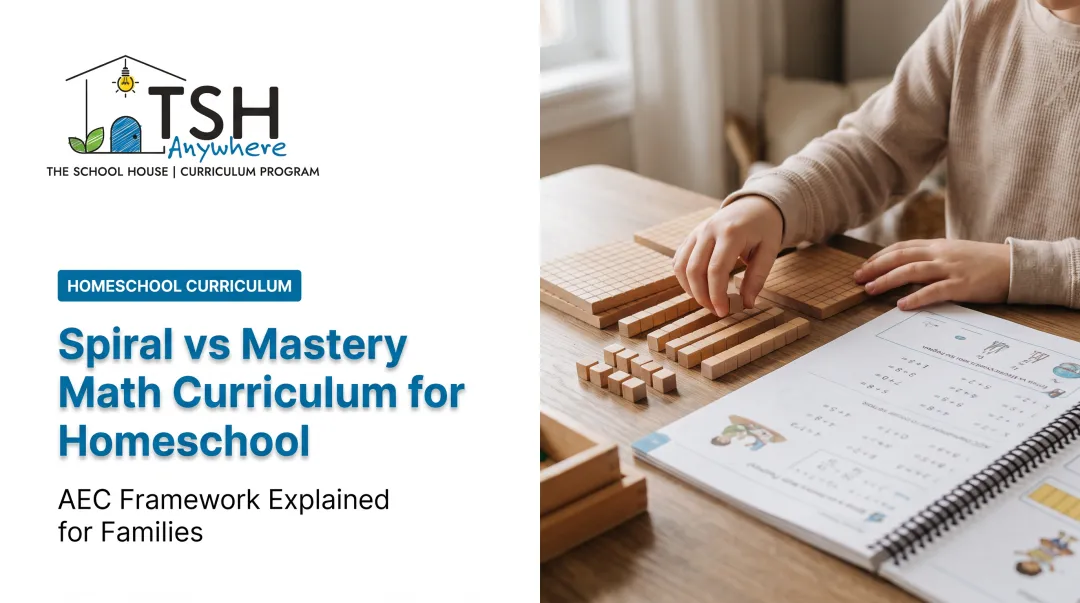
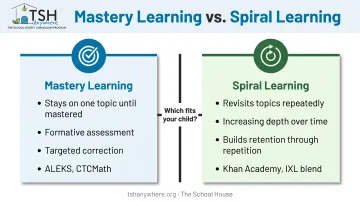
Mastery learning means a student stays on one topic, such as long division, until they've truly nailed it, then moves forward. ASCD describes the model as units followed by formative assessment, targeted correction for anything unmet, and enrichment for students who mastered the material the first time.
ALEKS and CTCMath both lean heavily on this approach.
Spiral learning takes the opposite path: topics get revisited repeatedly over the year, each time at slightly greater depth. EBSCO traces this model back to Jerome Bruner, whose framework connects each return to a concept with what's been learned since.
Most platforms, including Khan Academy and IXL, blend both. They place mastery checkpoints inside a spiraling sequence because pure mastery can leave retention gaps, and pure spiral can feel repetitive without ever going deep.
Conceptual vs. Procedural Teaching
Some kids need to see why a formula works before they'll trust it. Others just want the steps.
Match the program's style to how your child learns:
- Visual models and manipulatives suit conceptual learners (Beast Academy)
- Worked examples and repetition suit procedural learners (CTCMath)
Why Common Core Alignment Matters
Common Core alignment matters if a child might transition into a traditional school or sit for state standardized tests. It keeps vocabulary and sequencing consistent across systems. Khan Academy and IXL both align their content to Common Core and state standards. CTCMath, by contrast, follows its own sequential structure rather than Common Core.
One practical rule: don't switch programs mid-year. Math is cumulative. A gap in October compounds by February, and jumping platforms usually means re-teaching what the new program assumes a student already knows.
How We Chose the Best Programs
Most curriculum regret comes from the same mistake: picking a program because it was cheap, pretty, or recommended by a friend whose kid learns nothing like yours does. None of those factors are wrong — they're just incomplete.
Here's what we weighted instead:
- Grade-range coverage: does the platform span where your child is now and where they're headed next year?
- Adaptivity: does it adjust to what the student already knows, or does everyone get the same worksheet?
- Cost transparency: is pricing published clearly, or buried behind a "contact sales" form?
- Parent-reported outcomes: what do real homeschool parents say after a full semester, not just a free trial week?
- Progress tracking: can a parent see skill-level data, or only a completion percentage?
No program on this list is objectively "the best." A platform that's perfect for a self-directed 12-year-old might be a poor match for a 7-year-old who needs more structure and encouragement.
Fit for the individual learner, and for how much bandwidth the parent actually has to teach, outweighs brand reputation every time.
Conclusion
The right online math program is the one that matches your child's pace, learning style, and your family's actual bandwidth, not whatever's trending in homeschool groups this month.
Test the free trials. Read the scope and sequence before buying a year-long subscription. And once you pick something, give it a real semester before deciding it's not working. Half-finished curricula rarely show what a program can actually do.
Whether you're building a full at-home math routine or exploring community-based schooling options, families deserve access to affordable, science-backed education. That's the same principle behind The School House's work to make quality curriculum accessible to families nationwide.
Frequently Asked Questions
What is the best free online math curriculum for homeschooling?
Khan Academy is the top free option, offering a full Pre-K through Calculus curriculum with videos, practice problems, and an AI tutor. There's no paywall on the core math content.
What age or grade level should my child start using an online math program?
Most platforms, including IXL and CTCMath, start as early as kindergarten. Regardless of your child's age, take a placement test first to find the right starting point.
Is an online math program enough on its own, or do I need a textbook too?
Programs like ALEKS and CTCMath are designed as stand-alone curricula. Some parents still add printed worksheets for kinesthetic learners who benefit from writing things out by hand.
How do I know if my child needs a mastery-based or spiral-based program?
Kids who like going deep on one topic before moving on tend to thrive with mastery-based platforms like ALEKS. Kids who need frequent, varied review do better with spiral-style programs that revisit skills often.
Is IXL or Khan Academy better for homeschool math?
Khan Academy wins on instruction quality and free, full-curriculum coverage. IXL wins on targeted skill practice and detailed, skill-by-skill progress reports parents can use to spot gaps fast.
How much do online homeschool math programs typically cost?
Costs range from free (Khan Academy) to roughly $10-$20 a month for IXL, Beast Academy, and ALEKS. CTCMath runs higher, starting around $40 a month for one student.