Introduction
A secular science homeschool curriculum teaches evidence-based content—evolution, an ancient universe, and the scientific method—without religious framing such as creationism or intelligent design. For families who struggle to find materials that match the scientific consensus taught in public schools, that distinction matters more every year.
Homeschooling itself keeps expanding. According to Johns Hopkins University's Homeschool Research Lab, average state-reported homeschool enrollment grew 4.9% in the 2024-25 school year, and 36% of reporting states hit record highs. Secular families make up a meaningful slice of that growth, and their science curriculum choices have shifted sharply in just the past three years.
This article breaks down the trends, market drivers, and curriculum signals shaping secular science homeschooling heading into 2026—so you can choose with clarity.
Key Takeaways
- AI tools can personalize science pacing without replacing hands-on learning
- Lab kits and subscription boxes still lead for screen-free, tactile instruction
- NGSS-aligned content supports public-school rigor and transcript credibility
- Microschools and co-ops make structured science more affordable and social
- Video platforms fill gaps but rarely replace real experimentation
Top Trends Shaping Secular Science Homeschool Curriculum in 2026
Five trends stand out as more families move away from religious curriculum options and toward research-backed, standards-aligned science instruction.
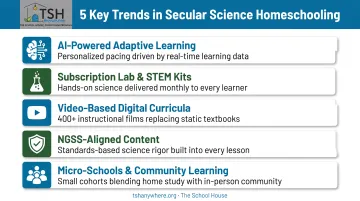
AI-Powered & Adaptive Science Learning Tools
Adaptive platforms adjust difficulty in real time based on how a student performs, similar to how Khan Academy or IXL reroute a math lesson when a student struggles. Science-specific tools are catching up fast.
Many families now layer an AI diagnostic tool on top of a hands-on curriculum like Real Science Odyssey or BFSU. The software flags specific knowledge gaps, then parents fill those gaps with targeted mini-lessons instead of reteaching an entire unit.
That approach cuts parent lesson-planning time. RAND's fall 2023 teacher survey found 18% of K-12 teachers already used AI for teaching, with another 15% having tried it at least once. Homeschool parents are following a similar curve, adopting these tools as companions rather than replacements for structured curricula.
Subscription-Based Hands-On Lab & STEM Kits
Monthly "lab-in-a-box" subscriptions deliver pre-measured materials so kids run real experiments without a parent sourcing chemicals or hardware. MEL Science-style kits start around $29.90 per month, while build-your-own kits like CrunchLabs run closer to $329.40 annually.
Secular homeschool communities have leaned into this format specifically because it's tactile and screen-free. Parents get convenience; kids get concept retention through actual experimentation rather than passive reading.
A peer-reviewed meta-analysis of inquiry-based science teaching found a 0.50 mean effect size on learning outcomes—one of the stronger effects in K-12 science research. Hands-on experimentation consistently beats lecture-only instruction.
Video-Based & Interactive Digital Science Curricula
Video-first platforms like Mystery Science and Generation Genius have moved from supplemental resource to core curriculum for many secular families. Generation Genius alone reports reach into more than 30,000 schools, and homeschool adoption has grown alongside that.
Built-in quiz tools, similar to Kahoot-style checks, give parents an instant read on comprehension without designing their own assessments. Families like the format for two reasons:
- Strong engagement for visual and auditory learners who struggle with textbook-only formats
- Near-zero prep time, since the video does the heavy lifting
The tradeoff: video-based learning works best paired with a hands-on component, not as a standalone substitute for lab work.
Demand for NGSS-Aligned, Evidence-Based Content
As secular homeschooling scales, credibility starts to matter for co-op placement, transcripts, and college applications. Parents increasingly cross-reference a curriculum's scope-and-sequence document against their state's standards before buying anything.
44 states plus the District of Columbia have adopted NGSS or closely related standards, according to NGSS's own state-adoption data. Generation Genius markets itself as covering 100% of NGSS content, which is a publisher claim worth independently verifying but a useful starting filter.
That standards focus has a practical payoff. According to NHERI's review of Cogan's research, homeschooled students have historically moved into college coursework more successfully than many conventionally schooled peers. Aligned science credits give families clearer documentation for transcripts and admissions.
Rise of Micro-Schools, Pods & Community-Based Science Learning
Hybrid models, small in-person micro-schools and co-ops, are pooling families together around structured, shared science curricula. This cuts individual costs and solves the isolation problem that pure at-home learning can create.
The School House in East Northport, New York, shows how a shared, science-based model can work in practice. Founded in 2017, it pairs a decade of curriculum research with more than six years of live classroom testing behind its American Emergent Curriculum (AEC):
- Learners reportedly test at least twice the national average across all subjects, with no academic admission screen
- Communities can replicate the model for roughly a third of typical school-building costs
- Partner sites are slated for Bridgeton, Maine (2026), North Miami, Florida (2027), and South Africa (2027)
A replicable group model like this gives co-ops a ready template instead of building structured science instruction from scratch.
Micro-schools broadly are scaling fast. RAND estimates between 750,000 and 2.1 million students now use a microschool as their main education provider, with a median monthly fee near $650.
Rising private-school costs—$32,251 on average at NAIS member day schools in 2024-25—make that fee look increasingly reasonable by comparison.
What's Driving These Secular Science Curriculum Trends
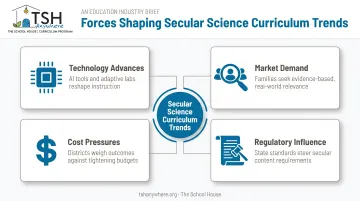
Technology, parent demand, cost pressure, and regulation sit behind all five trends above.
- Technology advances: Better AI and video production lowered the cost of high-quality digital science content. Tools that once needed a publisher's budget now reach smaller companies and families.
- Market demand: A growing secular homeschool population wants unbiased, critical-thinking instruction, not content shaped by a particular worldview.
- Cost pressures: Subscription kits and microschool models offer lab access and structured teaching for a fraction of the roughly $32,000 average private-school tuition noted above.
- Regulatory influence: States like New York require an Individualized Home Instruction Plan listing materials for every subject, which steers parents toward documented, standards-referenced programs.
How These Trends Are Impacting Homeschool Families
These shifts change not just what gets taught, but how homeschool days actually run and where the family budget goes.
Curriculum Planning Impact
Fewer families rely on a single boxed curriculum now. Instead, they blend two or three resources:
- A video platform for concept introduction
- A hands-on kit for application
- A workbook for reinforcement
It takes more upfront research to piece together, but the fit tends to be better for the individual kid.
Spending & Investment Impact
Budgets are shifting away from static textbooks toward subscriptions and kits. NHERI reports average homeschool spending around $600 per student annually across all subjects, though families investing heavily in science kits or AI tools often exceed that on science alone.
Integrated subscription models fit this pattern. TSH Anywhere's $125-per-month or $1,200-per-year curriculum, for example, bundles access in one plan instead of piecemeal textbook purchases.
Community & Social Impact
More families are joining co-ops, pods, or hybrid micro-schools specifically to split lab costs and give kids peer collaboration during experiments. A shared lab kit budget across six families stretches a lot further than six individual subscriptions, and kids get lab partners instead of solo experimentation.
Future Signals for Secular Science Homeschool Curriculum
Watch for these shifts as 2026 unfolds:
- AI tutors go standard. Expect AI diagnostic and tutoring tools to become a default companion to hands-on curricula rather than a novelty families try once and drop.
- Micro-schools blur the lines further. The gap between "homeschool" and "small private school" keeps narrowing, making affordable, structured group science instruction common across more communities.
- Standards alignment gets formal recognition. More states and co-ops will likely start recognizing NGSS-aligned homeschool science coursework for transcripts and dual enrollment credit, not just for personal peace of mind.
Conclusion
Secular science homeschooling in 2026 is being reshaped by five forces at once: AI personalization, hands-on subscription kits, video-based learning, NGSS alignment demands, and community-based micro-school models. The strongest setups pull from more than one of these at a time.
Families who adapt early build more sustainable science education for their kids. That usually means blending resources instead of locking into one boxed curriculum, or exploring a hybrid micro-school model. Whether learning happens at the kitchen table or through a community-based program, quality science instruction can stay affordable, rigorous, and free from religious framing.
Frequently Asked Questions
What is the best secular science curriculum for homeschooling?
It depends on age and learning style. Real Science Odyssey and BFSU suit elementary hands-on learners, Generation Genius fits visual learners, and Khan Academy works well for older students.
Is Apologia science secular?
No. Apologia describes its curriculum as "Creation-based with a Biblical worldview" and integrates biblical creationism throughout, so it is not secular—even though it often appears in general science curriculum searches.
What makes a science curriculum "secular"?
A secular curriculum presents scientific consensus—evolution, an ancient universe, and standard methodology—without religious interpretation. It does not include intelligent design or young-earth creationism.
Is Mystery Science a secular curriculum?
Yes. Mystery Science is non-religious and video-based, and secular homeschoolers commonly use it as a K–5 supplement or core resource.
Can I combine multiple secular science curricula in one homeschool year?
Yes. Many families blend a hands-on kit, a video platform, and a workbook so different learning styles are covered in the same year.
Are secular science curricula aligned with Next Generation Science Standards (NGSS)?
Some are, some aren't. Generation Genius explicitly claims full NGSS alignment, while other secular options don't align at all. Check the scope-and-sequence documentation before purchasing anything.