A dedicated Christmas homeschool curriculum solves that tension. Instead of choosing between holiday magic and meaningful learning, you fold them into one seasonal rhythm.
The term covers more ground than you might expect. It can mean a 25-day Advent devotional read at breakfast, or a full Charlotte Mason-style unit study with baking, handcrafts, and notebooking pages for every child in the house. This guide walks through why these curricula work, how to pick one that fits your family, six solid options by format, and practical ways to weave it all into a busy December without losing your mind.
Key Takeaways
- Blend faith, history, art, and life skills into one theme—don’t add another subject
- Match the program to your child’s age, your faith approach, and real December prep time
- Use any curriculum as a flexible menu, not a checklist, amid holiday gatherings
- Most programs run 3–4 weeks (~25 days)—start as late as the week after Thanksgiving
Why Add a Christmas Curriculum to Your Homeschool
A themed study lets you intentionally pause or lighten regular subjects while keeping your kids engaged during a month when focus is already scattered. Rather than fighting December's natural distraction, you work with it.
Holiday unit studies also solve a logistics problem. Instead of juggling five separate lesson plans, one theme carries history, geography, art, literature, and reading at once. You plan once and cover more.
If your family observes the season’s religious traditions, you can fold in carol history, service projects, or readings that match your values—so meaning doesn’t get buried under gift lists and commercial noise.
The Life School Angle
Many curricula pair academics with real skills kids will actually use:
- Baking recipes tied to a specific country or era being studied
- Budgeting for handmade gifts
- Letter writing to family or pen pals
- Hosting guests and managing a shared meal
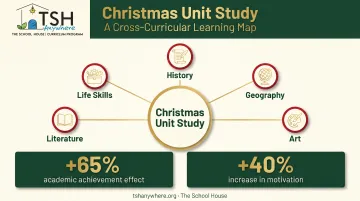
That hands-on blend is backed by research. A 2023 meta-analysis of 66 project-based-learning studies found a strong academic-achievement effect (0.650) and a meaningful boost to student motivation (0.401) when learning is organized around a hands-on theme rather than isolated subject drills.
Organizations rethinking American education use the same idea. The School House, for example, builds its American Emergent Curriculum around thematic integration—science, writing, reading, math, civics, and art intersecting in one arc—rather than subject silos.
A Christmas unit study runs on that logic for a single season: one holiday theme, many subjects, and skills kids practice in real life.
How to Choose the Right Christmas Homeschool Curriculum
Not every family needs the same thing in December. Work through these five factors before you buy anything.
Age and grade range. Check whether the curriculum offers multi-level guides so siblings can study together. The First Christmas from Gather 'Round, for example, runs leveled Student Notebooks from Pre-Reader through high school, letting one teacher's guide serve the whole family at once.
Faith-based vs. secular content. Decide if you want an overtly Scripture-and-carol-centered study, or something gentler on doctrine. Even nature-inspired options like Unearthing Wonder still carry a Christian framework, so if you want a fully secular study, plan on a DIY mix of library books and open-ended projects.
Format and time commitment. Compare:
- Daily devotionals (20-25 days, 15-30 minutes each)
- Multi-week unit studies (3-4 weeks, can replace or supplement regular school)
- Single read-aloud chapter books requiring no daily planning at all
Prep and materials needed. Digital downloads you print yourself cost less but take printer ink and time. Ready-made printed packs cost more but arrive ready to open. Some studies are craft- and baking-heavy; others need nothing but a book and a couch.
Learning style fit. Match the format to how your kids actually learn: hands-on crafts and baking, notebooking and writing, or immersive read-aloud storytelling.
Whatever you choose, favor material with solid historical grounding and clear learning goals over fluff dressed up in festive graphics. If you cannot tell what research or design work sits behind the lessons, you are probably paying for the cover.
Top Christmas Homeschool Curriculum Picks by Format
This list spans Advent devotionals, unit studies, hymn studies, and read-alouds, so you can find an entry point that matches your season, whether you have three weeks of energy or three days.
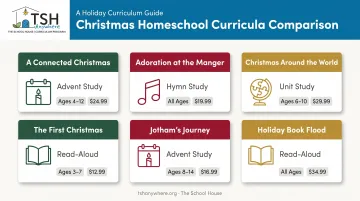
A Connected Christmas (Treehouse Schoolhouse)
A three-week Christian Advent study built for the whole family, connecting kids to the Nativity through carols, poetry, art, baking, and handcrafts. It's recommended for K-3 and grades 4-8, with adaptations down to preschool and up through middle school. Narration notebooks help kids record what they're learning as they go.
Pricing runs around $25.60 on sale (regular $32), with both digital and hard-copy options at Treehouse Schoolhouse.
Adoration at the Manger (Not Consumed)
A 25-day hymn study tracing the Scripture and history behind classics like "O Come, All Ye Faithful" and "Joy to the World." Levels run from Primary (ages 4-7) through Youth (13+) and a Parent Guide, at about 15 minutes daily. It's a strong pick for families who connect best through music.
Priced at $15 for either the digital or printed version.
Christmas Around the World (Brighter Day Press)
A four-week guide for ages 5-12 exploring Christmas traditions in Germany, Sweden, Great Britain, and Mexico through Scripture, cultural traditions, picture books, and crafts. This is the pick for families wanting a geography-and-culture angle without dropping the faith content. Available as a $19 digital guide or $30 printed (which includes the digital copy) at Brighter Day Press.
The First Christmas (Gather 'Round Homeschool)
A leveled study with notebooking pages from Pre-K through high school, covering the Nativity story alongside crafts and baking. Families can run the full 2-3 week schedule or compress it into a 12-day Advent version. Digital bundles run around $18; printed books around $20, both through Gather 'Round Homeschool.
Jotham's Journey (Arnold Ytreeide)
An adventure-driven Advent read-aloud following a ten-year-old boy's journey to Bethlehem, meant to be read a few minutes daily starting the fourth Sunday before Christmas. It's a favorite for families who love narrative-driven learning over worksheets — but preview it first.
The publisher's own excerpt includes a jackal attack and other intense moments, so sensitive kids may need a gentler pick. Paperback runs $18.99 through Kregel Publications.
Holiday Book Flood (The Peaceful Press)
A 25-day, low-prep Advent guide pairing classic picture books with simple daily activities for kids of all ages. Supply lists are intentionally minimal, making this the go-to for families who want connection without a craft closet full of supplies. Digital PDF runs $19, with a printed edition also available at The Peaceful Press.
Tips for Fitting a Holiday Curriculum Into Your Homeschool Rhythm
Buying the curriculum is the easy part. Actually running it during a month full of travel and gatherings takes a little strategy.
- Start with buffer time. Begin the last week of November instead of December 1st, so missed days from travel don't derail a 25-day schedule.
- Pause overlapping subjects. Set aside regular history if it covers similar ground for the month. Keep math and grammar going so you aren't restarting from scratch in January.
- Treat it as a flexible menu. Pick the readings, crafts, or traditions that matter most to your family and skip the rest—guilt-free.
One homeschool blog, Little School of Smiths, documents exactly this approach for their own December: math and language arts continue as usual, while history, science, and geography pause until the new year. Not every family needs this split, but many find it a workable December pattern.
Hands-On Ways to Bring the Curriculum to Life
The best Christmas studies leave behind something kids can touch again next year, not just a completed worksheet.
- Build keepsakes kids can revisit—narration notebooks, ornament crafts, and paper garlands they can compare year over year as handwriting and drawing change
- Tie baking to the lesson—stollen for a Germany week, buñuelos for Mexico—so the recipe is the study
- Host a community learning day with another homeschool family for a joint reading, caroling walk, or shared craft; kids remember the people and the making
None of this requires a big budget. One afternoon of baking and reading together often sticks with a five-year-old longer than a perfectly executed 30-page unit study.
Frequently Asked Questions
What age is best to start a Christmas homeschool curriculum?
Most curricula are designed for Pre-K through middle school (roughly ages 3–14), with adjustable depth. Preschoolers can join simplified crafts and read-alouds while older kids handle notebooking and discussion questions from the same guide.
Do I need to pause my regular homeschool curriculum during Christmas studies?
Most families lighten or pause overlapping subjects like history while keeping core skills like math and reading going. It's a common practice, not a strict rule, so adjust based on what your kids need.
Are there free Christmas homeschool curriculum options?
Yes. You can build a free version using library picture books, a printable Advent calendar such as Not Consumed's free reading plan, and simple Scripture readings. Paid guides just offer more structure and less prep work.
What's the difference between an Advent study and a Christmas unit study?
An Advent study is typically a daily, calendar-based countdown to December 25th. A unit study is broader, exploring a theme like history or geography across multiple subjects over several weeks. Many products blend both formats.
Can Christmas curriculum be used by families who don't homeschool?
Yes. Most of these resources work well as after-school or weekend activities too, since they're built for flexible, low-pressure use during holiday break rather than a strict classroom schedule.
How long should a Christmas homeschool unit study last?
Most run 3-4 weeks or about 25 days, though some, like The First Christmas, offer a compressed 12-day version. You can always shorten any guide further by starting later or picking select activities.