Relaxed homeschool kindergarten starts from a different place. It keeps the core academics that matter, reading, writing, and math, while letting play, curiosity, and real life carry everything else. This isn't a lesser version of school-at-home. It's a philosophy grounded in how young children actually learn, supported by research from groups like the American Academy of Pediatrics.
This guide covers what relaxed homeschooling actually looks like, which subjects deserve daily attention, how much table time your five-year-old really needs, and how to pick a curriculum without overthinking it.
Key Takeaways
- Pair core academics (reading, writing, math) with child-led exploration for everything else
- Most kindergartners only need 30-60 minutes of structured learning per day
- Play and nature time aren't breaks from school; they build the same skills worksheets try to teach
- No curriculum is "the" right one—fit matters more than brand name
What Is Relaxed Homeschool Kindergarten?
According to HSLDA, the homeschool advocacy and legal organization, an eclectic education mixes philosophies and keeps or drops elements based on what works for your specific child. That's different from "school-at-home," which recreates a classroom's textbooks, grade levels, and bell-schedule feel. Relaxed homeschooling is eclectic homeschooling applied gently to kindergarten age.
Where It Fits on the Spectrum
| Method | Core Feature | Fit for Kindergarten |
|---|---|---|
| School-at-home | Textbooks, grade-level pacing, classroom routine | Often overwhelming for a 5-year-old |
| Classical | Memorization, Socratic discussion, structured stages | Only the early "Grammar Stage" applies here |
| Charlotte Mason | Living books, nature study, short varied lessons | A close cousin of relaxed homeschooling |
| Eclectic/Relaxed | Mix-and-match, basics only, interest drives the rest | Built for a short attention span |
| Unschooling | Fully child-directed, no set curriculum | More hands-off than most relaxed families prefer |
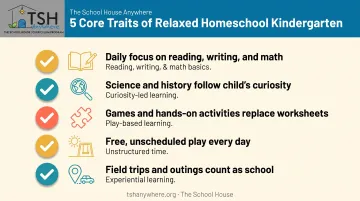
A relaxed kindergarten approach usually shares a few defining traits:
- Daily focus stays on reading, writing, and math; nothing else is mandatory
- Science and history follow whatever the child is curious about that week
- Games and hands-on activities replace most worksheets
- Free play gets real, unscheduled time every single day
- Field trips and social outings count as legitimate "school"
The Research Behind It
The American Academy of Pediatrics' report on play ties play directly to executive function, language development, early math skills, and social growth in children ages 4 to 6, the full kindergarten age range.
Relaxed homeschooling is a philosophy for how you teach, not a boxed product. You can pair it with any curriculum brand, workbook, or box set. The relaxed part is how you use the materials, not which ones you buy.
Core Subjects to Cover in a Relaxed Kindergarten Curriculum
Most relaxed homeschoolers still show up daily for three subjects: reading, handwriting, and math. Everything else can wait for curiosity to lead the way.
Reading & Phonics
Look for multisensory, scripted, open-and-go phonics programs. You should be able to read the teacher's script straight off the page without hours of prep. Pair the lesson with tactile add-ons:
- Letter magnets for spelling out simple words on the fridge
- Textured or sandpaper letters for tracing sounds with a finger
- Simple decodable readers instead of leveled chapter books
Handwriting
Kindergarten handwriting doesn't need a stack of worksheets. Hands-on practice builds the same fine motor skills with far less resistance:
- Tracing letters in a tray of salt, sand, or shaving cream
- Rolling play dough into letter shapes
- Practicing on a chalkboard or whiteboard instead of paper
- Building shapes from sticks and curves before writing them freehand
Math
Skip the worksheet stacks here too. Build number sense through games and hands-on practice with manipulative-based, low-writing math programs:
- Counting bears, base-ten blocks, or dice games for quantity and place value
- Calendar time for patterns, days of the week, and simple addition
- Real-life math: measuring ingredients, counting change, sorting laundry by color
Across all three subjects, keep each lesson to 10–20 minutes. According to the CDC’s 5-year milestones, many children this age can pay attention for about 5–10 minutes during a non-screen activity like story time or a craft. That’s not a hard ceiling, but it’s a useful gauge for how long to expect a five-year-old to sit still.
Structuring Your Day: How Long Should a 5-Year-Old Homeschool?
For homeschool kindergarten, 30 to 60 minutes of structured academic time a day is typical — total, not per subject. Split it into two or three short chunks rather than one long sitting.
Why a School Day Doesn't Translate 1:1
A public-school kindergarten day looks long on paper, but most of it isn't direct instruction. A 2021 study of kindergarten classrooms in one large urban district found students spent an average of 85 minutes on literacy and 57 minutes on math daily. Roughly 2.5 hours went to transitions, lining up, and other noninstructional activities.
One-on-one homeschooling skips almost all of that overhead. Those combined 142 minutes of school instruction don't need to become your homeschool target.
A Sample Weekly Rhythm
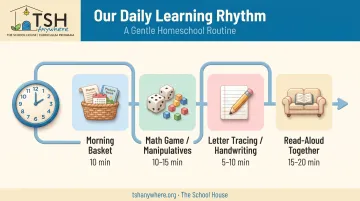
A simple relaxed rhythm might look like this:
- Morning basket: a poem, calendar time, and a picture book (10 minutes)
- Math game or manipulative practice (10-15 minutes)
- Letter tracing or handwriting practice (5-10 minutes)
- Read-aloud time together on the couch (15-20 minutes)
Many relaxed families run this rhythm 3-4 days a week instead of five, leaving room for field trips, rest days, or simply catching up.
Loop Schedules for the Extras
Science, art, and nature study don't need a fixed daily slot. A loop schedule lists these activities in rotation and picks up wherever it left off last time. Monday's science experiment might not happen until Wednesday, and that's fine. Nothing gets skipped forever; it just moves at the pace the week allows.
Signs You're Doing Too Much or Too Little
- Too much: daily meltdowns, resistance before lessons start, exhaustion by lunchtime
- Too little: constant boredom complaints, no daily rhythm, a child asking to "do school"
If you're landing near 30–60 minutes with short chunks and a flexible loop, you're in a healthy range for a five-year-old.
Interest-Led Learning: Science, History & Play
Science, history, and play rarely need a formal curriculum at kindergarten age. A library card and a little curiosity go further than an expensive textbook set.
Easy ways to follow your child's lead:
- Nature walks with a simple field guide or bug-catching kit
- Hands-on science kits (volcanoes, magnets, water play)
- Museum, zoo, or nature-center visits tied to current interests
- Multi-day deep dives into one fascination at a time
If a child announces she wants to know everything about Egypt after watching a mummy documentary, that curiosity is the lesson plan. Follow it with library books, a craft, and maybe a museum trip, and she'll retain more than a scripted unit could offer.
Unstructured outdoor play deserves the same respect as a reading lesson. For a five-year-old, that play often is the learning: problem-solving, negotiating with playmates, building physical stamina, and resetting a brain that's been asked to focus.
Choosing Curriculum & Getting Started
The "best" kindergarten curriculum is the one that fits your child's pace and your own teaching style, not the one with the most reviews or the fanciest branding.
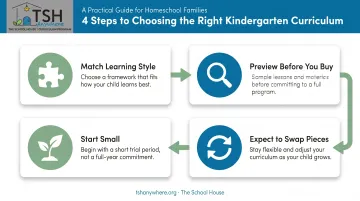
A few practical starting points:
- Match learning style. A wiggly kid may need manipulatives over worksheets; a bookish one may love read-alouds.
- Preview before you buy. Most publishers offer sample pages or flip-through videos—use them before you spend.
- Start small. Pick one or two subjects the first week, then add the rest once a rhythm sticks.
- Expect to swap pieces. Drop what isn't working—no guilt required.
If you want a research-backed option beyond typical homeschool catalogs, look at how The School House on Long Island, NY built its program: a decade of curriculum research and six-plus years of classroom testing, with learners reportedly testing at least twice above the national average.
It runs as a fuller framework rather than a pure pick-and-mix kit, but it’s a clear example of affordable, science-based design you can study even if you only borrow pieces for your kitchen-table setup.
Before you lock a full-year plan, check your state's homeschool rules. Notification, testing, and recordkeeping requirements vary widely—confirm what your state asks for so your relaxed setup still stays compliant.
Frequently Asked Questions
What is relaxed homeschooling?
It's a flexible, eclectic method that covers core basics like reading, writing, and math while letting interests and real-life experience guide everything else. It's a philosophy, not a specific curriculum brand.
How long should a 5-year-old homeschool?
Around 30-60 minutes of structured academic time daily is typical for kindergarten. The rest of the day is filled with play, reading together, and informal, hands-on learning.
Is relaxed homeschooling legal in every state?
Homeschooling is legal in all 50 states, but requirements around notification, testing, and recordkeeping vary widely. Check your state's specific rules or consider an umbrella school for guidance.
Does my kindergartner need to know how to read by the end of the year?
No. Reading readiness varies widely; some children read at 4 or 5, while most don't read fluently until 6 or 7. It's a range, not a strict kindergarten requirement.
What curriculum is best for relaxed homeschool kindergarten?
There's no single best option. The right pick depends on your child's pace, attention span, and your own comfort level with teaching, not a brand's reputation.
Can I switch from relaxed to a more structured homeschool method later?
Yes. Homeschool methods commonly evolve as children grow, their learning needs shift, and family circumstances change. Many families blend or switch approaches multiple times over the years.