That's the disconnect many parents run into. Preschool math doesn't come with worksheets or grades, so it's hard to know which skills actually matter or whether a child is developing on schedule. Is counting to 20 impressive, or is naming shapes more important right now?
This guide breaks down the core math domains preschoolers need, what typical progress looks like between ages 3 and 5, and simple ways to build these skills through everyday routines rather than drills.
Key Takeaways
- Preschool math centers on five areas: number sense, geometry/spatial sense, measurement, patterns, and sorting/classifying
- From about 36–60 months, skills follow a predictable path (Head Start Early Learning Outcomes Framework)
- Everyday play and conversation build these skills more reliably than flashcards or worksheets
- Strong curricula weave math into daily activities—not a separate "math time"
The 5 Core Math Domains and Objectives Every Preschooler Should Master
Major frameworks don't agree on everything, but they land on similar ground when it comes to preschool math. The NAEYC's joint position statement with NCTM identifies five key content areas: number and operations, geometry, measurement, algebra (including patterns), and data analysis.
Head Start's framework groups these slightly differently but covers the same territory.
That overlap is useful. It means parents don't need to chase a dozen competing checklists : just these five areas.
Number Sense & Counting
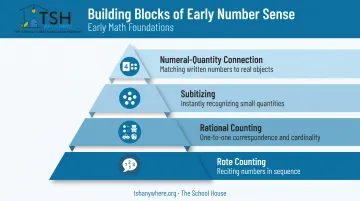
Counting looks simple from the outside, but it's actually two separate skills layered together.
Rote counting is reciting numbers in order ("one, two, three, four") without necessarily understanding what the numbers represent. Rational counting is different. It means assigning one number to each object and understanding that the last number said tells you the total.
Here's the distinction in action: a child counting five crackers one by one is using one-to-one correspondence. When she can then answer "how many crackers do you have?" with "five" without recounting, she's demonstrated cardinality, the core of rational counting.
Two more milestones matter here:
- Subitizing: instantly recognizing a small quantity (like three dots) without counting
- Numeral-quantity connection: knowing that the written symbol "5" represents five actual objects
Shapes & Spatial Sense (Early Geometry)
Shape recognition starts concrete and gets more analytical over time. A three-year-old names a circle and square by their overall look. By kindergarten readiness, that same child describes shapes by their sides and angles, and can combine smaller shapes to build new ones (two triangles making a square, for instance).
Spatial vocabulary develops alongside this. Words like in front of, behind, up, and down give children the language to describe position and direction. Puzzles and block play build these skills hands-on. Every time a child rotates a puzzle piece to make it fit, she's practicing spatial reasoning.
Measurement & Comparing Attributes
Before children measure with rulers, they measure with comparisons. "Your tower is taller than mine." "This bag is heavier."
Preschoolers typically compare using non-standard units first (snap cubes, footsteps, or handfuls) before moving to standard units like inches. This progression matters because it builds the underlying concept (that measurement means comparing against a consistent unit) before the abstraction of a ruler gets introduced.
Comparative vocabulary (taller, shorter, heavier, lighter) usually develops in tandem with these hands-on comparisons, not before them.
Patterns & Early Algebraic Thinking
Patterns are an early form of algebraic thinking, even though no one calls it that at age three. The typical progression looks like this:
- Recognizing a simple pattern, like red-blue-red-blue
- Duplicating it with a second set of materials
- Extending it by adding the next correct item
- Creating an original pattern independently, using objects, sounds, or movement
By kindergarten age, many children can identify the "core unit" of a pattern (the smallest repeating chunk) and fill in a missing piece.
Sorting, Classifying & Early Data Skills
Sorting starts with one attribute: all the red blocks together, regardless of shape. Over time, children begin classifying by more than one attribute at once : red squares in one pile, blue circles in another.
Simple graphing builds on this. Sorting a snack mix into groups and then counting which group has the most is a preschooler's first taste of data representation, no spreadsheet required.
Age-by-Age Math Milestones: What to Expect at 3, 4, and 5
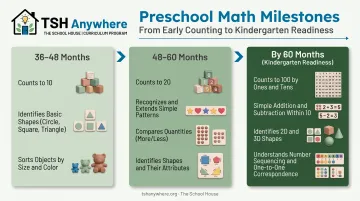
These milestones, drawn primarily from the Head Start Early Learning Outcomes Framework, describe a developmental progression, not a checklist a child must complete on schedule.
36 to 48 Months (Around Age 3)
- Counts to 10 with support, though not always accurately
- Begins one-to-one correspondence when counting small groups
- Names a circle and square; sometimes a triangle
- Compares up to five objects by size, using words like "bigger" or "smaller"
- Recognizes and duplicates simple AB patterns (red-blue-red-blue)
48 to 60 Months (Around Age 4)
- Quickly recognizes small quantities without counting (subitizing)
- Independently creates and extends repeating patterns
- Compares shapes by attributes like number of sides, not just overall look
- Understands that written numerals represent quantities and recognizes some through 10
By 60 Months (Kindergarten Readiness)
- Counts to 20 or more by ones
- Solves simple addition and subtraction using fingers or objects
- Measures using a consistently repeated unit, such as snap cubes
- Matches sets of objects to written numerals 0 through 5
These are general guideposts, not deadlines. A child who's counting confidently but still mixing up shape names isn't behind. They're just developing unevenly, which is completely normal.
Simple Ways to Support Math Objectives at Home
You don't need flashcards or a curriculum to build these skills. Everyday routines already contain most of the math preschoolers need.
Embed counting and measuring into chores:
- Count plates and forks together while setting the table
- Measure ingredients while baking ("we need two cups of flour")
- Sort laundry by color, then by owner
Model math vocabulary during play, without turning it into a lesson:
- "You have more blocks than your sister right now."
- "This box is heavier than that one — want to check?"
- "Your tower is taller than the book. Can we line them up?"
Try low-cost pattern and sorting games using items already in the house:
- Line up socks in repeating color patterns
- Sort buttons by size, then by color
- Arrange snacks (crackers, grapes) into groups and count which pile is bigger
Keep numbers, shapes, and comparisons in everyday talk. That steady exposure builds the skills that matter more than any formal drill.
How The School House Builds These Math Objectives into Everyday Learning
Founder Mimosa Jones Tunney built The School House's American Emergent Curriculum after research showed most American schools weren't designed around how children actually learn. That research shaped an approach where math isn't taught in isolated blocks—it's woven into hands-on, thematic learning throughout the day.
At the Primary level (Pre-K through Kindergarten), foundational numeracy is built on manipulatives and sensory-based learning, not worksheet-heavy instruction. In practice, that can look like:
- Counting and sorting during practical life activities
- Comparing quantity and size in cooking or outdoor play
- Spotting patterns through music, art, and movement
- Exploring shapes and space with hands-on materials
The curriculum stays intentionally screen-minimal, since young children retain far more from hands-on activity than from screens.
The same model aims to keep developmentally grounded early education affordable for working families—not only those who can pay premium private tuition. Families can see how it works through the curriculum and film samples available via TSH Anywhere.
Common Mistakes to Avoid When Teaching Preschool Math
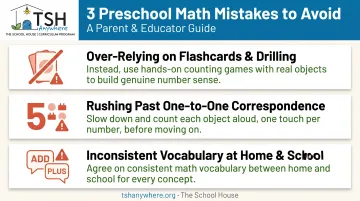
A few common habits work against early math development:
- Over-relying on flashcards and drilling. Early math isn't about memorizing isolated facts, as the NAEYC notes. Concrete manipulatives such as blocks, buttons, and counters build understanding in a way repetition alone doesn't.
- Rushing past one-to-one correspondence. A child who hasn't mastered matching one number to one object often struggles later with abstract numerals. Skipping ahead to "recognize the number 7" before that foundation is set creates confusion, not acceleration.
- Using inconsistent vocabulary at home and school. If one setting says "bigger" and another says "taller," young children struggle to connect the concepts. Keeping comparative language consistent across environments reduces that friction.
Frequently Asked Questions
What are some good math learning objectives for preschoolers?
The five core areas are number sense and counting, geometry and spatial sense, measurement, patterns, and sorting/classifying. Focus on simple, age-appropriate milestones in each area rather than rushing formal drills.
At what age should a child start learning math skills?
Math learning begins informally through play and everyday language as early as toddlerhood. Structured objectives are typically tracked starting around 36 months.
How can I tell if my preschooler is behind in math?
Development varies widely, and one-off gaps aren't cause for concern. A consistent lack of progress with counting or shape recognition by ages 4 to 5 is worth discussing with a teacher.
What is the difference between rote counting and rational counting?
Rote counting means reciting numbers in order without necessarily understanding quantity. Rational counting means assigning one number per object and knowing the last number stated is the total.
How much time should preschoolers spend on math activities each day?
Short, frequent bursts — around 10 to 15 minutes woven into daily routines — work better than long structured sessions. Consistency matters more than duration.
Is it normal for a preschooler to not know all their numbers yet?
Yes. Numeral recognition typically develops gradually through age 5. Regular exposure through play matters more than early memorization of every number.