But here's a question worth asking: what if the answer isn't a newer curriculum, but an older one?
Long before "STEM" existed as a buzzword, history's most influential scientific minds were shaped by a very different kind of education — one built on language, logic, and disciplined observation rather than content checklists. This guide breaks down what a classical science curriculum actually is, how it moves through the grammar, logic, and rhetoric stages, and how The School House builds these same principles into an affordable, replicable school model any community can use.
Key Takeaways
- Classical science curriculum trains curiosity and clear thinking, not test-driven memorization
- Learning follows the trivium: grammar (wonder), logic (analysis), rhetoric (application)
- A four-year rotation cycles through biology, earth science, chemistry, and physics with growing depth
- Strong programs blend hands-on labs, living books, notebooking, and science fair projects
- The School House packages this science-based approach into a school model any community can replicate
What Is a Classical Science Curriculum?
Classical education prioritizes teaching students how to think and learn over simply covering as much content as possible. It's built on the trivium — grammar, logic, and rhetoric — a framework popularized in modern homeschooling by Dorothy Sayers' 1948 essay The Lost Tools of Learning. Sayers argued that schools were teaching subjects without ever teaching students how to reason, argue, or express an idea clearly — the actual "tools" learning depends on.
Applied to science, that means:
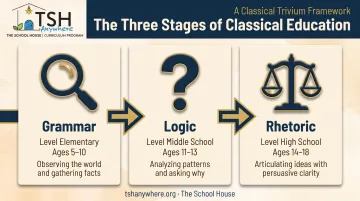
- Grammar stage: gather facts through observation and stories
- Logic stage: ask why those facts connect
- Rhetoric stage: apply and defend conclusions through evidence
A Different Kind of Scientific Foundation
Many pioneering scientists came up through classical schooling rather than a dedicated "science track." Isaac Newton, for instance, attended Grantham grammar school, where he built a firm command of Latin before later encountering Aristotle and Descartes at Cambridge. His path ran through language and philosophy before it ran through mathematics.
That history doesn't prove classical schooling causes scientific genius. It does show that the habits of mind behind discovery — close reading, careful reasoning, clear expression — can be built before a student ever opens a chemistry textbook.
The same approach works in formal classrooms, not only at home — the gap The School House is built to fill.
The Three Stages of Classical Science Education
Classical science education isn't a single method: it shifts as students grow.
Grammar Stage (Elementary Years)
Young learners don't need dense textbooks. They need wonder.
- Living books and science encyclopedias replace fact-cramped chapters
- Nature walks build the habit of close observation
- Simple observation journals capture what students notice, in their own words
- Hands-on demonstrations (think baking soda volcanoes, magnet sorting) plant the seeds of curiosity
At this stage, the goal isn't mastery. It's collecting raw material: facts, images, and questions that later stages will sharpen into real understanding.
Logic Stage (Middle School Years)
Around fifth or sixth grade, kids stop just wanting to know facts. They want to know why.
- Structured experiments with formal lab reports
- Vocabulary-building tied to specific disciplines (cellular structures, chemical bonds)
- Labeled diagrams that force precision
- Scientist biographies that connect discoveries to real people and real historical moments
- A first formal science fair project — often the first real taste of the full scientific method
Rhetoric Stage (High School Years)
By high school, students move from analysis to argument.
- Full lab-based coursework in biology, chemistry, and physics
- Research papers where students defend a conclusion using evidence, not opinion
- History and philosophy of science to sharpen critical thinking before college
- Oral defenses and presentations that require clear, evidence-based argument
Each stage builds directly on the last. Grammar gives raw material, logic organizes it, and rhetoric applies it through argument and evidence.
Why Classical Science Curriculum Builds Sharper Thinkers
The core skills classical science develops—curiosity, careful observation, disciplined written expression—are the actual mechanics of scientific reasoning, not soft extras.
"Cram, test, and dump" memorization doesn't build understanding. It builds short-term recall that evaporates by summer. Having students summarize material in their own words, the notebooking habit baked into classical education, forces a level of comprehension that multiple-choice review sheets simply can't match.
There's research behind this. A 2012 meta-analysis of 37 experimental studies on inquiry-based science teaching found an overall mean effect size of 0.50, with teacher-guided inquiry outperforming purely student-led approaches by roughly 0.40. Guided investigation, not passive content delivery, drives real learning gains.
A few other habits classical science reinforces:
- Hands-on lab notebooks build problem-solving skills that transfer across subjects, not just isolated facts for one unit
- Scientist biographies and history show students that science is a human, evolving pursuit — not a fixed list of answers to memorize
- Written argument forces students to organize evidence logically before they ever reach a conclusion
None of this is flashy. It's slower, and it asks more of both student and teacher. But it produces thinkers who can reason through unfamiliar problems — which is the actual point of studying science in the first place.
Essential Components of a Strong Classical Science Curriculum
Not every program calling itself "classical" delivers the same rigor. A few components separate the strong ones from the watered-down ones.
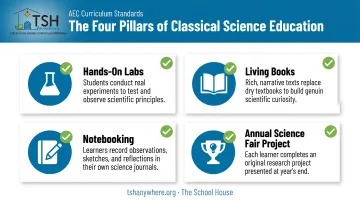
Hands-on experiments, not just screens. Physical labs matter because they put students in direct contact with the material world: mixing, measuring, and observing outcomes in real time. Virtual simulations have their place, but they work best as a supplement, not a replacement, at every stage of classical science.
Living books over fragmented textbooks. Narrative-driven science books and encyclopedias build knowledge that sticks through story and context, not isolated bullet points.
Notebooking. Recording observations, new vocabulary, and conclusions in a student's own handwriting and words reinforces retention far better than highlighting a textbook.
The science fair project. Done once a year, it gives students a full run-through of the scientific method: question, hypothesis, experiment, data, and conclusion. That annual cycle turns the project into a rite of passage, not a chore.
A quick checklist for evaluating any program:
- Does it include real, hands-on labs at every stage?
- Are living books used instead of dense textbooks alone?
- Is there a consistent notebooking or written-summary habit?
- Is there an annual science fair or equivalent project?
If a curriculum is missing more than one of these, it's likely leaning too hard on content coverage and too light on actual scientific thinking.
Classical Science vs. Traditional Science Standards
The biggest structural difference between classical science and a typical scope-and-sequence program comes down to timing and repetition.
How the two approaches schedule science:
- Classical: Revisits biology, earth science/astronomy, chemistry, and physics in a rotating cycle, adding depth each time students return.
- Conventional: Front-loads biology and often delays chemistry and physics until high school.
That delay has real consequences. National data on U.S. high school graduates found that only 15% of twelfth graders took physics, while 45% earned no science credit at all in their senior year, according to the National Center for Education Statistics' 2018 report on high school course-taking. Chemistry and physics simply aren't guaranteed exposure points in many conventional pathways.
Classical students, meanwhile, typically encounter chemistry and physics concepts more than once before high school even starts — giving them a running start when advanced coursework arrives.
A common worry is that skipping heavy test-prep drills leaves classical students behind on standardized tests. In practice, the reverse is often true. Years of lab reports and research papers build analytical reasoning and writing that transfer directly to test performance and college-level science — without drill-and-kill review packets.
How The School House Brings Classical, Science-Based Learning to Every Community
The challenge with classical education has always been access. Building a rich, living-books-and-labs science program from scratch takes time, money, and expertise most working families and school districts simply don't have room for.
The School House was founded in 2017 to close that gap, combining a modern, research-backed curriculum with classical teaching instincts inside a school model that's affordable to build and run.
A few things that make this replicable rather than aspirational:
- Communities can build a School House location for roughly a third of the cost of a traditional school build
- The minimum physical footprint is small: a modest building or section of a building with outdoor space, workable in all 50 states
- Partners get full launch support: The School House handles curriculum, staffing, training, and launch, so districts and developers don't need in-house education expertise
- Families access the same curriculum directly through a homeschool subscription, delivered through 400+ educator training films and printable materials
This isn't a private-school-only model. It's built for public districts, private operators, and land developers alike. That breadth matters because rigorous science instruction shouldn't be reserved for families who already have the time and resources to build it themselves.
None of this works without teachers who buy into curiosity-driven instruction. The School House's educator culture leans on live weekly training sessions, an evidence-based curriculum updated annually, and a "learn by doing" philosophy that keeps screens in a supporting role rather than the main event.
The flagship location on Long Island has run this model for more than six years, with learners consistently testing at least twice above national averages. Those results show the classical instincts behind this approach hold up in practice.
Frequently Asked Questions
What is the best classical homeschool science curriculum?
There's no single "best" option. It depends on your student's stage and whether your family prefers textbook-based or living-book approaches. Look for hands-on labs, notebooking, and a four-year rotation regardless of brand.
What are the three stages of classical education?
The three stages are grammar, logic, and rhetoric. Grammar (elementary) focuses on facts and wonder; logic (middle school) on asking why; rhetoric (high school) on application and argument.
What is the four-year science cycle in classical education?
Most classical programs rotate through biology, earth science/astronomy, chemistry, and physics over four years, repeating the cycle with more depth as students advance through each stage.
Is classical science curriculum enough to prepare students for college-level science?
Yes, in most cases. Repeated exposure to each science discipline, combined with strong lab and writing skills, typically leaves classically educated students well prepared for college coursework.
Can classical science curriculum be used in a traditional school setting, not just homeschool?
Absolutely. Classical science principles apply just as well in formal classrooms: the same four-year rotation, stage-based depth, labs, and notebooking work in brick-and-mortar settings, not only at home.
Do classical science programs require expensive lab equipment?
Not usually. Many experiments run on basic household or classroom materials, though community lab days or co-ops can help supplement more advanced equipment when needed.