Many parents and teachers freeze up here, though. How do you ask a child who's still sounding out words to "reflect" on their learning? It feels like a skill for kids who can already read and write fluently, not for a first grader still learning to hold a pencil correctly.
Here's the good news: self-assessment for young learners doesn't look like writing at all. Metacognitive and self-regulation strategies are linked to an average of eight additional months of academic progress across early years, primary, and secondary students alike, according to the Education Endowment Foundation.
This guide covers what self-assessment actually looks like for elementary students, why it matters this early, and how to walk a young child through writing one, step by step.
Key Takeaways
- Young learners self-assess best through visuals, verbal prompts, and short checklists, not long written reflections
- Starting early builds metacognition and ownership; those habits compound into a growth mindset over the school years
- Success depends on adult modeling, simplified criteria, and frequent low-stakes practice
- Self-assessment supports teacher and parent evaluation; it never replaces it
What Is Self-Assessment for Elementary Students?
Self-assessment is the practice of a student evaluating their own work, effort, or understanding instead of waiting entirely on an adult's judgment. For a second grader, that might mean checking whether their sentence starts with a capital letter. For a fifth grader, it might mean rating how well they explained their reasoning on a math problem.
At the elementary level, this looks nothing like the self-assessment older students do. There's no five-paragraph reflection or detailed rubric scoring here.
Elementary self-assessment relies on:
- Visuals (faces, colors, thumbs)
- Verbal prompts guided by a teacher or parent
- Short, specific checklists with two or three items
- Simple sentence frames instead of open-ended writing
Why This Connects to Critical Thinking
Self-evaluation sits near the top of the revised Bloom's Taxonomy, in the "Evaluate" category, which involves making judgments based on criteria and standards. The framework's knowledge dimension also includes metacognitive knowledge, meaning awareness of how your own learning works.
That placement matters: self-assessment is genuine higher-order thinking, scaled to fit a seven-year-old's capabilities.
A Necessary Caution
Young children don't always judge their own performance accurately. Kids in the preschool and early elementary range frequently overestimate how well they did on a task, sometimes significantly, and that tendency doesn't disappear after a single round of feedback.
This is exactly why self-assessment should complement, not replace, adult evaluation. A teacher or parent still needs to check in, gently correct skewed self-ratings, and keep the process anchored in reality.
Why Self-Assessment Matters for Elementary Students
When a child checks their own work against a clear expectation, something shifts. They stop being a passive recipient of a grade and start seeing themselves as someone with real input into their own progress. That shift toward self-efficacy tends to show up in motivation, too.
The Research Behind It
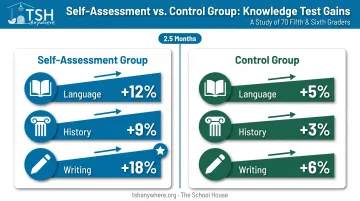
A study assigning 70 fifth and sixth graders to experimental and control groups found that students using rubric-supported self-assessment across Language, History, and Writing over 2.5 months showed a positive effect on knowledge-test performance, with the strongest gains appearing in Writing.
That's a meaningful data point for elementary educators. It suggests self-assessment isn't just a feel-good classroom ritual; it's tied to measurable outcomes when paired with clear, simplified criteria.
Where This Shows Up in Practice
Schools built around a science-based curriculum tend to build self-assessment into daily work rather than treat it as a bonus activity. The School House, which developed the American Emergent Curriculum (AEC), includes "Cycle + Advanced Assessments" and executive functioning among its core pillars—both depend on a child's growing ability to self-monitor and self-regulate.
In that model, assessment is not only something that happens to a student at the end of a unit. It shows up in small, repeatable habits:
- Students check work against a simple rubric before turning it in
- They name one strength and one next step in their own words
- Teachers use those reflections to guide the next lesson, not just to assign a score
Woven through instruction from the earliest grades, those habits turn progress into something students can see and direct.
Examples of Self-Assessment for Elementary Students
The right tool depends entirely on the child's age and the task. Here's what actually works in real classrooms and homeschool settings.
| Tool | How It Works | Best For |
|---|---|---|
| Visual rating scales | Thumbs up/down, traffic lights, or smiley faces to show understanding | Pre-K through 2nd grade |
| Task-specific checklists | "Did I use a capital letter? Did I write three sentences?" | K through 3rd grade |
| Reflection journals | Sentence starters like "Today I learned..." or "I am proud of..." | 2nd grade and up |
| Goal-tracking charts | Visual progress markers toward a specific skill over time | 2nd through 5th grade |
| Simplified rubrics | Two or three criteria a child can realistically judge | 1st grade and up |
| Student-led conferences | Kids present their own work to parents or teachers | K through 5th grade |
Two of these tools show how simple self-assessment can look day to day.
Student-led conferences work even in kindergarten. A child can pull work from reading, writing, math, and art, then explain what they learned and where they still need practice. A teacher or parent guides the conversation the whole way. That's self-assessment in action, no writing required.
Goal-tracking charts work especially well for reading fluency. A second grader who marks a bar graph after each reading log entry starts noticing their own growth without writing a single reflective sentence.
How Elementary Students Can Write a Self-Assessment: Step-by-Step
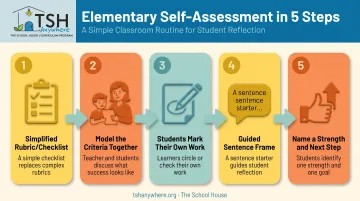
Guide elementary students through self-assessment one small step at a time. A blank page and a vague prompt to "reflect" rarely works for young writers.
Start with a simplified rubric or checklist. Break the task into two or three clear, age-appropriate criteria. A first grader checking a sentence needs "capital letter, ending punctuation, makes sense," not a ten-point rubric.
Model the criteria together first. Walk through an example piece of work as a class or one-on-one before asking a child to judge their own. Show them what success actually looks like.
Have students mark their own work. Circling a capital letter or underlining a topic sentence gives the child a concrete, hands-on way to check against each criterion.
Use a guided sentence frame. Something like "My sentence has a capital letter because ___" gives structure without requiring independent composition skills.
Ask for one strength and one next step. Framing the reflection as "something I did well" plus "something to improve" keeps the process positive rather than punitive.
A child who only names what went wrong starts to dread self-assessment. Pairing the critique with a genuine strength keeps the habit sustainable over months and years—not a one-time exercise.
Tips for Parents and Teachers to Support Self-Assessment
Getting a child comfortable with self-assessment takes consistent modeling, not a single lesson.
- Think out loud. Narrate your own reflection process on a task ("I checked my grocery list and realized I forgot the eggs") so kids hear what honest self-evaluation actually sounds like.
- Keep it consistent. Use the same language and tools at home and school. A child shouldn't have to relearn the process because a checklist looks different in each setting.
- Resist the urge to correct immediately. Let a child practice reflecting honestly, even if their first attempts are inaccurate. Offer gentle adjustments only after they've finished their own reflection.
- Build it into daily routines. Fold reflection into everyday lessons instead of saving it for report-card season. When home and school treat self-assessment as a habit, kids stop treating it like a special event.
For families who want reflection prompts already woven into daily lessons, curriculum samples from The School House show how that structure looks in practice.
Frequently Asked Questions
What is self-assessment for elementary students?
Self-assessment is the practice of young learners evaluating their own work or understanding with simple, guided tools like checklists or visual scales, rather than relying only on adult grading. It builds early metacognitive skills.
What are examples of self-assessment for elementary students?
Common examples include thumbs up/down or traffic light scales, task-specific checklists, sentence-starter reflection journals, and goal-tracking charts. Older elementary students can also use simplified rubrics or portfolio conferences.
How do elementary students write a self-assessment?
They start with a simplified two- or three-item checklist, mark their work against each criterion, then finish a guided sentence frame that names one strength and one improvement goal.
At what age can children start self-assessing their own work?
Even kindergarten and first-grade students can begin with visual and verbal tools like faces or thumbs. Complexity increases naturally as students move into second grade and beyond.
How is self-assessment different from grading?
Self-assessment focuses on a student's own reflection and growth against clear criteria. Grading is an adult's external evaluation of final performance, and the two serve different purposes.
How often should self-assessment be used in the elementary classroom?
Short, frequent moments work better than occasional long exercises. Aim for a quick check-in after key lessons or assignments rather than a single big reflection at the end of a unit.