Introduction
Picture the little red schoolhouse: one teacher, one room, and kids from age 5 to 14 learning side by side. It sounds like a museum exhibit. It's actually making a comeback.
Homeschool participation grew by an average of 4.9% across reporting states in 2024-25, with more than a third of states hitting record enrollment, according to Johns Hopkins' Homeschool Hub. Co-ops, hybrid schools, and microschools are stepping up to meet that demand—often with kids of different ages in the same room.
Here's the problem: most curricula are built for one grade, one age, one pace. Families and communities teaching multiple ages together end up patching systems never designed for their classroom.
This guide breaks down what a one-room schoolhouse curriculum actually is, its core components, how to structure a school day around it, and how to choose or build the right model for your family or community.
Key Takeaways
- Pair grouped "content" subjects with individualized "skill" subjects to make multi-age learning practical
- Replace rigid, grade-segregated instruction with cooperative learning and peer mentoring
- Homeschool co-ops, hybrid schools, and microschools are leading the one-room revival
- Choose curriculum based on cost, flexibility, and your community's needs
What Is a One-Room Schoolhouse Curriculum?
The one-room schoolhouse was standard practice across rural America from the early 1800s through the mid-1900s. One teacher managed students in grades 1 through 8, sometimes ranging from age 5 to 20, in a single space. Some classrooms held 35 to 40 pupils; others crammed in 50 or 60, according to historical accounts documented by the U.S. State Department.
Why the Model Worked
Critics pointed to crowded rooms and heavy reliance on rote recitation. But the underlying structure held up. Younger students recited lessons with the teacher while older students worked independently and often helped struggling classmates.
That grouping strategy, students of different ages learning together by design rather than by accident, is what education researchers now call multigrade or multi-age instruction. A widely cited 1995 research synthesis published in Review of Educational Research found no adverse cognitive, achievement, or noncognitive effects from this kind of grouping. The historic model held up under scrutiny, not just nostalgia.
How This Differs From a Boxed Curriculum
A single-grade curriculum assumes every learner is the same age, at the same stage, moving at the same pace. A one-room schoolhouse curriculum assumes the opposite. Core skills like reading, writing, and arithmetic are taught through cooperative, differentiated instruction rather than isolated grade tracks.
Force a boxed, grade-specific program into a multi-age room and you end up adapting every lesson. A curriculum designed for mixed ages removes that extra layer of work.
The Modern Revival
Homeschool co-ops, hybrid schools, and microschools have picked up where the historic model left off — small groups, mixed ages, one lead educator. Communities are returning to this format because it's affordable, replicable, and built around how children actually learn together.
The School House applies the same multi-age approach in its American Emergent Curriculum (AEC). AEC covers Pre-K through 8th grade for multi-need classrooms and is built so any community, public or private, can replicate it at a fraction of typical school costs.
Key Components and Subjects Covered in a One-Room Schoolhouse Curriculum
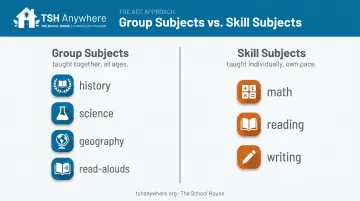
The backbone of most one-room schoolhouse models is a simple split: group subjects taught together, and skill subjects taught individually.
- Group subjects: history, science, geography, and read-alouds — content that all ages can absorb at once, pitched at different levels of depth
- Skill subjects: math, reading, and writing — areas where each child progresses at their own pace, regardless of age
Multi-Level Teaching Techniques
One lesson, several grade levels. That's the goal, and it's achievable with the right tools:
- Manipulatives let a 6-year-old and a 10-year-old explore the same math concept at different depths
- Oral recitation allows younger students to absorb vocabulary and ideas above their current level just by listening
- Shared read-alouds unify the room around one story while comprehension questions flex by age
Programs like The School House's AEC take a related path: instead of splitting content and skill blocks, they weave reading, writing, math, science, civics, and art into single interconnected lessons. Same schoolhouse principle, different structure: one lesson, multiple entry points.
Peer Mentoring in Action
Older students reinforce their own mastery by teaching younger ones. This isn't just convenient. Research from the Education Endowment Foundation's peer tutoring review, based on 145 studies, estimates roughly six additional months of academic progress for students involved in structured peer tutoring.
Thematic Units and Differentiated Assessment
Literature-based or thematic units pull the room onto one shared topic while still flexing by age. For example, a month on ancient Egypt can cover history, art, geography, and reading together.
Two practices keep that model honest:
- Thematic units give every age the same theme, with depth and output matched to each child
- Differentiated assessment tracks individual mastery even when the lesson itself happened as a group
How to Structure Daily Learning for Multiple Ages
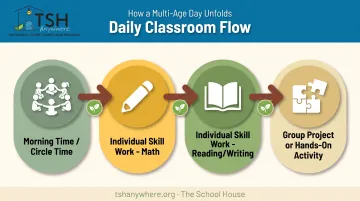
Most successful multi-age classrooms start the day together before splitting into leveled skill work.
Morning Time or Circle Time
This is the shared block where all ages gather for content subjects such as read-alouds, history, science, and geography before breaking into individual skill work. It sets the tone for the day and gives every child a common starting point.
Block Scheduling With Built-In Breaks
Block scheduling assigns fixed time increments to each subject, with breaks woven in to keep focus intact across different attention spans. A simple sample day might look like this:
| Time | Activity |
|---|---|
| 8:30-9:15 | Morning Time (group read-aloud, history, or science) |
| 9:15-9:30 | Break |
| 9:30-10:15 | Individual skill work (math, rotating by level) |
| 10:15-10:30 | Break |
| 10:30-11:15 | Individual skill work (reading/writing, rotating by level) |
| 11:15-12:00 | Project or hands-on activity (all ages together) |
The Educator's Role: Circulate, Don't Lecture
In a single-grade classroom, the teacher lectures to everyone at once. In a multi-age room, the parent or lead educator circulates: checking in with one student's math problem, then another's writing draft, then pulling a small group together for a quick lesson.
Routine matters more than rigidity here. A predictable daily rhythm (same order of activities, even if start times shift slightly) helps students transition between group and independent work without constant redirection. Aim for a rhythm everyone in the room can count on, not a strict timetable.
Benefits and Challenges of the One-Room Schoolhouse Model
The Upside
- Younger students absorb above-level lessons by observation; older students reinforce mastery by revisiting earlier concepts
- Multi-age classrooms build patience, service, and collaboration in ways grade-segregated rooms rarely match
- Flexible pacing means no child waits for an entire grade-level cohort to catch up
Schools built on this philosophy back it up with outcomes. At The School House's flagship location, enrolled learners consistently test at least twice above the national average. That result comes from years of live classroom validation layered on a decade of curriculum research.
The Real Challenges
Those academic and social gains come with operational tradeoffs.
- Balancing individual attention with group management takes planning, usually through independent work systems paired with peer mentoring
- State rules on homeschool law, accreditation, and nonpublic school registration vary widely
- Formalizing a one-room model into a hybrid school or microschool means navigating that patchwork with your state education department
Choosing or Building the Right Curriculum for Your One-Room Schoolhouse
Not every curriculum labeled "flexible" actually flexes. Before committing, pressure-test a few things.
Is It Built for Multi-Age, or Just Adapted?
A curriculum designed from the ground up for mixed ages will already separate group content from individual skill progression. A boxed, single-grade program retrofitted for a multi-age room usually means extra prep work every week — modifying worksheets, adjusting pacing guides, and improvising group activities that weren't part of the original design.
Affordability and Replicability
This matters even more for co-ops and communities building a shared school model. The National Microschooling Center's 2025 sector survey of 800 operating and prelaunch microschools found that 74% charge no more than $10,000 annually, and 65% offer sliding scales or discounts to keep the model accessible.
The School House fits this accessible range. Its AEC subscription runs $125 per month or $1,200 per year, per learner, and includes:
- 400+ educator training films
- Printable materials
- Progress tracking through Transparent Classroom
- Live weekly support sessions
For communities ready to go further, its school-building partnership program helps entrepreneurs, land developers, and districts open an AEC-based microschool or hybrid school for a fraction of typical construction and startup costs.
Support Systems for Long-Term Sustainability
A curriculum is only as strong as the support behind it. Look for:
- Ongoing tutor or educator training, not just a one-time onboarding
- A community of practitioners to troubleshoot with
- Annual curriculum updates so materials don't go stale
- Clear guidance on legal formation, zoning, and compliance if you're formalizing into a school
Frequently Asked Questions
What is the hardest homeschool curriculum?
"Hardest" depends on the child and family. Literature-heavy classical programs and advanced STEM-focused curricula are often cited as the most rigorous, and they require more parental involvement and planning time.
What is the most used homeschool curriculum?
No single program owns a clear majority—rankings shift by year and source. Families most often choose among all-in-one boxed programs, literature-based programs, and online accredited platforms.
What age groups can be taught together in a one-room schoolhouse curriculum?
Most models group children roughly from Pre-K through 8th grade. Families and co-ops sometimes extend that range further using tiered, independent skill work for older or younger learners.
Is the one-room schoolhouse model suitable for children with different learning needs or abilities?
Yes. The model's built-in differentiation makes it well suited to mixed-ability groups, including neurodivergent learners, especially when paired with adaptable materials and flexible pacing.
How much does it cost to start a one-room schoolhouse or microschool?
Costs vary widely between informal co-ops and formal hybrid schools. Replicable models such as The School House's partnership program are built so communities can open a school for about a third of typical startup costs.
Can a one-room schoolhouse curriculum work for a single family with only one or two children?
Yes. The core technique, shared group time plus individualized skill work, scales down easily and works well regardless of family size.