Introduction
Choosing a secular homeschool math curriculum shouldn't feel like detective work, but for a lot of families, it does. Scripture references buried in word problems. Doctrine woven into teacher notes. Even the phrase "secular homeschool curriculum" can turn a simple math search into a frustrating scavenger hunt.
The good news: math is one of the more straightforward subjects to teach without any faith-based framing, and 2026 brings a strong lineup of options.
This guide breaks down what "secular" means for a math program. It ranks the five most vetted picks for the year and shows how to match a curriculum to your child's learning style, not just its marketing.
TL;DR
- Secular = belief-neutral — no scripture or religious claims treated as fact in lessons
- Match your child on two axes: mastery vs. spiral and conceptual vs. procedural
- 2026's top picks span workbooks, hands-on kits, and online video platforms for every budget
- Decide on cost, parent time, and switch-flexibility before locking in a full year
Overview of Secular Homeschool Math Curriculum in 2026
A secular math curriculum teaches concepts and problem-solving without endorsing, referencing, or treating any religious doctrine as fact. That's it. No hidden bar for "how secular is secular enough," just a clean absence of faith-based content in the lessons, examples, and teacher instructions.
Demand for these programs keeps climbing alongside homeschooling itself. Average homeschool enrollment grew 4.9% in the 2024-25 school year across reporting states, according to Johns Hopkins University's Institute for Education Policy — more than double the pre-pandemic growth rate. That's a lot of new families entering the curriculum search at once.
Why Math Is Often the Easier Search
Many secular homeschool parents report that math is simpler to vet than history or science, where worldview tends to creep into narrative content. There's no hard data confirming this pattern nationally, but it lines up with what shows up repeatedly in homeschool forums and curriculum reviews.
That said, "secular" doesn't mean "interchangeable." Rigor, pacing, and teaching philosophy vary enormously between programs, which is exactly why the decision framework below matters before you look at any specific brand.
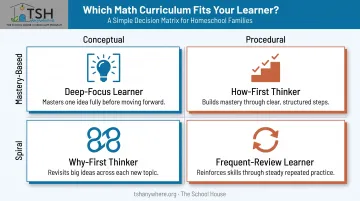
Mastery vs. Spiral, Conceptual vs. Procedural: The Key Decision Framework
Before comparing specific programs, two axes separate them: how content is sequenced, and what the lessons prioritize.
Mastery-Based vs. Spiral Learning
Mastery-based programs dig deep into one topic, typically requiring around 80% proficiency before a student moves forward, with built-in support if they're not there yet. Spiral programs revisit topics repeatedly across the year, layering in complexity each time.
- Mastery tends to suit kids who get frustrated jumping between topics before they feel solid
- Spiral tends to suit kids who need frequent review to retain earlier skills
- Neither is inherently superior: the difference is pacing preference, not rigor
Conceptual vs. Procedural Instruction
Conceptual programs teach the "why" behind a method; procedural programs teach the "how" to execute it efficiently. The National Council of Teachers of Mathematics notes that conceptual understanding should precede and coincide with procedural instruction, not replace it.
Parents often fold a third factor into this choice: learning style. The popular idea that visual, auditory, or kinesthetic learners each need a matched curriculum style doesn't hold up well under scrutiny. The Education Endowment Foundation rates learning-style-matching evidence as extremely weak and warns against restricting a child to one modality. Treat learning style as a preference, not a rigid diagnosis.
With that framework in mind, here's how the five most-reviewed secular options for 2026 actually stack up.
Top 5 Secular Homeschool Math Curricula for 2026
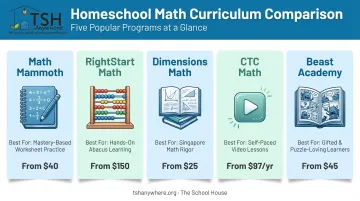
Every program below was selected for genuinely secular content, real instructional rigor, flexibility across learning preferences, and a consistent track record among secular homeschool communities. Every program below was selected for genuinely secular content, real instructional rigor, flexibility across learning preferences, and a consistent track record among secular homeschool communities. Together they cover the main formats families actually use: workbooks, hands-on lessons, mastery textbooks, online video, and gifted-level challenge material.
Math Mammoth
Math Mammoth is a budget-friendly, workbook-based program covering grades K-8, built for gap-free, largely independent learning. Free supplemental videos cover most grades, and each worktext explains concepts clearly enough that many students work through lessons with minimal parent involvement.
Its strong conceptual number-sense foundation does most of the teaching in print, so busy parents spend less time prepping lessons. That combination is a big reason it shows up so often in secular homeschool recommendation threads.
| Format | Digital or print workbooks, self-paced |
| Best For | Independent learners, budget-conscious families |
| Pricing | $245.50 for the full K-8 digital bundle; individual grade downloads around $42.50 |
RightStart Math
RightStart is a hands-on, conceptual program for grades K-7 (Levels A-H), built around manipulatives, games, and the Cotter Abacus rather than worksheets alone. Early levels are strongly parent-directed, with the teacher guiding one-on-one lessons.
The program prioritizes true number sense over rote memorization, which is a real asset for kinesthetic and auditory learners. That depth does mean a higher time and cost investment than workbook-only options.
| Format | Manipulative kit + lesson guide, parent-taught |
| Best For | Kinesthetic and auditory learners, conceptual thinkers |
| Pricing | $99.25 for the Level A book bundle, plus $219.75 for the reusable RS2 manipulative set (roughly $319 for a first purchase) |
Singapore Math (Dimensions Math)
Dimensions Math is the current full-color edition of Singapore's internationally known method, covering PK-8. It's mastery-oriented, developing topics through concrete, pictorial, and then abstract representations, with heavy emphasis on mental math and multi-step problem solving.
Families choose it for decades of strong international results and a problem-solving focus that suits math-minded or advanced students who want depth over breadth.
| Format | Textbook + workbook, mastery-based |
| Best For | Math-minded and advanced learners |
| Pricing | Grade sets range from $137.50 (Kindergarten) to $190.40 (Grades 7-8) |
CTC Math
CTC Math is a fully online, video-based program for K-12, built around short tutorials students can pause and replay, with automatic grading and a parent dashboard tracking scores, time, and areas needing review.
Among these five, it is the most hands-off option: short replayable lessons, auto-grading, and a clear parent dashboard help when you are juggling multiple kids or have limited teaching bandwidth. A free trial lets you test the fit before buying.
| Format | Online video lessons, self-paced |
| Best For | Independent learners, families wanting minimal parent-led instruction |
| Pricing | $39.90/month or $257/year for a single membership; $59.90/month or $397/year for family access |
Beast Academy
Beast Academy is a comic-book-style, mastery-based program for advanced learners, currently structured as Levels 1-5 for ages 6-13 rather than a strict grade sequence. Illustrated guides pair with practice books full of puzzles and layered problem sets.
Where it shines is making genuinely challenging problem-solving fun — a rare mix for gifted or highly engaged kids who check out of standard drill-and-practice formats.
| Format | Comic-style guide + practice book, online option available |
| Best For | Gifted, advanced, or highly engaged math learners |
| Pricing | Online subscription starts at $100/year; print Level 5 set plus one year online runs around $120 |
How We Chose the Best Secular Math Curriculum
The most common mistake homeschool parents make is picking a curriculum based on Instagram aesthetics or forum hype, without checking whether it actually fits their child's pace or their own available teaching time.
We weighed five factors:
- Verified secular content: no religious framing in lessons, instructions, or word problems
- Instructional rigor: real conceptual depth beyond worksheets and busywork
- Learning-style versatility: works across different pacing and processing needs
- Cost transparency: clear, current pricing with no hidden add-ons
- Consistent community feedback: sustained positive reviews from secular homeschool groups, not just launch buzz
No single program works for every child. Build in the flexibility to supplement with a workbook, switch formats mid-year, or pull in outside practice if something isn't clicking after a few months. That flexibility matters more than brand loyalty.
Conclusion
The best secular math curriculum for 2026 matches how your child actually learns and how much teaching time you realistically have. Popularity is a weak stand-in for fit.
Request or print a sample lesson before you buy the full package, and reassess fit every year rather than locking in long-term out of habit. Kids change; curricula should flex with them.
If full-time homeschooling starts to feel like more than your family can sustain, other evidence-based models exist. The School House integrates math with reading, writing, and science in a curriculum built on a decade of research and years of classroom testing. It gives families a community-based path to a science-backed approach without going it entirely alone.
Frequently Asked Questions
What is the most popular secular homeschool math curriculum?
Math Mammoth, Singapore Math, and Beast Academy show up most consistently in secular homeschool community reviews. Popularity here reflects strong word-of-mouth and flexibility, not a formal market ranking.
What is the best secular homeschool math curriculum?
There's no single "best" — it depends on whether your child does better with mastery vs. spiral pacing, and conceptual vs. procedural instruction. Match the program to the learner, not a review score.
Is there an online secular homeschool math curriculum I can use?
Yes. CTC Math, Khan Academy, and Beast Academy Online all offer fully secular, self-paced video instruction across a range of grade levels, with Khan Academy free of charge.
What is the difference between mastery-based and spiral math curriculum?
Mastery focuses deeply on one topic until proficiency before advancing. Spiral revisits topics repeatedly across the year with increasing complexity, favoring continuous review over deep single-topic focus.
Is Common Core-aligned math curriculum okay for secular homeschoolers?
Yes. Common Core is a set of academic standards, not a religious or secular stance, so a Common Core-aligned program can be entirely secular in content and framing.
How much does secular homeschool math curriculum typically cost?
Costs range from free (Khan Academy) to a few hundred dollars per year for workbook or online subscription programs. Always check current pricing directly with the publisher before budgeting.