But the circle times that actually work for kids aren't accidental. Behind the songs and the calendar chart sits a specific developmental goal the teacher chose before the children ever sat down.
Many classrooms skip that step. Circle time runs on autopilot — same songs, same questions, no stated learning target. Research on Head Start classrooms found that challenging behavior was most likely during activities with little opportunity for active participation, a pattern that shows up whenever circle time runs on habit instead of purpose.
This guide breaks down the developmental objectives that make circle time worth the ten minutes it takes, how those objectives shift for 3-, 4-, and 5-year-olds, and how to turn a single objective into an activity plan you can run tomorrow.
Key Takeaways
- One primary objective per session beats trying to hit five goals at once
- Match objectives and session length to age; a 3-year-old's circle time is not a mini 5-year-old session
- Active participation (movement, choice, response) drives retention far more than passive listening
- Watching participation and behavior tells you whether an objective actually landed
The Core Developmental Objectives of Circle Time for Preschoolers
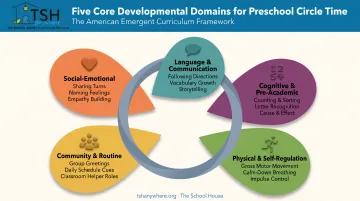
Quality circle time runs on a handful of overlapping developmental domains, not a single lesson topic. Most sessions touch more than one domain; what separates purposeful circle time from filler is naming one primary objective before you start and letting everything else support it.
Social-Emotional Objectives
Circle time is one of the few daily moments where preschoolers practice being part of a group on purpose. Objectives here include:
- Turn-taking: waiting to speak, passing an object, sharing attention
- Expressing feelings: naming emotions instead of acting them out
- Building belonging: learning names, routines, and group rituals
Guidance from NAEYC on preschool group time recommends giving a short gathering one clear purpose — welcoming children, reviewing a classroom rule — rather than requiring an extended sit-still-and-listen format. That single-purpose approach teaches more social skill than a long, unfocused sit does.
Language & Communication Objectives
New vocabulary, active listening, and expressive language through songs and call-and-response stories lay the groundwork for later literacy. Kids who hear and reuse a new word in a low-stakes group setting retain it faster than kids who hear it once alone.
Common objectives:
- Introduce two or three theme-tied words
- Practice active listening (follow along, answer a story question)
- Build expressive language with echo songs and fill-in-the-blank rhymes
Cognitive & Pre-Academic Objectives
Number sense, letter recognition, patterns, and sorting map to concrete kindergarten-readiness benchmarks, not busywork.
Head Start's Early Learning Outcomes Framework ties a simple counting activity (one touch per number word) to Goal P-MATH 3: understanding the relationship between numbers and quantities. By age five, that benchmark expects one-to-one counting to at least ten.
Typical cognitive targets:
- One-to-one counting and early number sense
- Letter and sound recognition in short group games
- Pattern copy-and-extend and basic sorting
Physical & Self-Regulation Objectives
Gross motor movement and impulse control are part of the learning, not a break from it. A jumping-jack warm-up or freeze-dance segment resets attention before the sit-and-listen portion starts.
Low-participation circle time also tracks with more disruptive behavior. Movement objectives give kids something to do with their hands and bodies instead of asking them only to sit still.
Physical and regulation targets:
- Whole-body warm-ups that wake attention
- Freeze or stop-when-signaled games for impulse control
- Simple hand motions tied to songs or stories
Community & Routine Objectives
Belonging, classroom expectations, and transition skills round out the list. Kids learn what circle time is for: where to sit, when it's their turn, how the group signals it's time to move on.
A curriculum built with intention maps every circle time session to one or more of these five categories instead of leaving it to chance. At The School House, circle time is never a placeholder between activities; each session is tied to a specific developmental goal before it starts.
Age-Appropriate Circle Time Objectives for 3, 4, and 5-Year-Olds
Objectives have to scale with attention span, not curriculum ambition. Sustained-attention research with preschoolers shows 3-year-olds make noticeably more errors than 4- and 5-year-olds on the same tasks, with performance improving steadily each year.
That doesn't translate into a clean "age times two minutes" formula, but it does justify shorter, simpler sessions for younger groups.
3-Year-Olds: Following, Imitating, Recognizing
- Following one-step directions ("touch your nose")
- Imitating a movement or sound
- Recognizing peers and names
Keep it brief — 5 to 10 minutes is realistic before attention drops off.
4-Year-Olds: Answering, Waiting, Grasping One Concept
- Answering simple questions about a story or theme
- Waiting for a turn without prompting
- Grasping one, maybe two, concepts per session (a new word plus a number)
Sessions can stretch to about 10 to 15 minutes.
5-Year-Olds: Discussion, Early Literacy, Multi-Step Instructions
- Participating in structured discussion, not just yes/no answers
- Practicing early literacy or numeracy tasks (letter sounds, counting past 10)
- Following multi-step instructions
This group can typically sustain 15 to 20 minutes when movement is mixed in with content.
| Age | Primary Objective Focus | Ideal Duration | Example Skill |
|---|---|---|---|
| 3 years | Following directions, imitation, peer recognition | 5-10 minutes | Touches nose on request |
| 4 years | Question-answering, turn-taking, 1-2 concepts | 10-15 minutes | Waits for a turn without a reminder |
| 5 years | Discussion, early literacy/numeracy, multi-step tasks | 15-20 minutes | Counts objects one-to-one past 10 |
Turning Objectives Into Action: A Sample Circle Time Activity Plan
Picking an objective is step one. Building a session that reinforces that objective at every stage—not just naming it once—is the harder part.
The Planning Process
- Pick one objective — emotional vocabulary, counting, turn-taking, whatever the group needs this week
- Choose a theme to wrap around it (weather, farm animals, colors)
- Structure the session in stages: welcome/warm-up, teach the concept, active practice, closing
- Reinforce the objective at every stage, not just in the middle
Objective-to-Activity Mapping
| Objective | Activity |
|---|---|
| Emotional vocabulary | Feelings check-in using face cards |
| Counting/number sense | Estimation jar with countable objects |
| Turn-taking | Passing a "talking object" during share time |
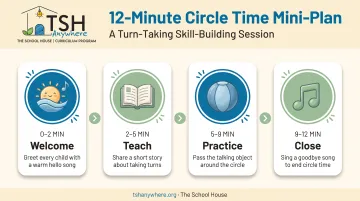
Sample 12-Minute Mini-Plan: Turn-Taking Objective
- 0-2 min — Welcome: Hello song while passing a soft ball around the circle
- 2-5 min — Teach: Short story about sharing; ask who's "next" at each page
- 5-9 min — Practice: Talking-object share time — each child holds the object only while speaking
- 9-12 min — Close: Movement game passing a clap around the circle, then a transition song
Every segment ties back to the same skill: waiting, then taking a turn.
That same discipline applies beyond turn-taking. Build a physical element into every segment, regardless of the primary objective. Even a counting-focused session benefits from clapping out numbers: movement helps sustain attention across every objective type, not just physical ones.
Strong circle time rarely comes from mid-session improvisation. When a curriculum pre-maps objectives to activities, teachers spend prep on delivery—not inventing the learning goal on the rug. The School House builds that planning into its school model so circle time stays intentional without eating individual prep time.
How to Know If Circle Time Is Meeting Its Objectives
You don't need a formal assessment to tell whether a session worked. A few observational markers do the job:
- Participation, not just presence — kids responding, answering, moving, rather than quietly waiting for it to end
- Retention across sessions — a child using last week's vocabulary word or counting further than before
- Calmer transitions — less resistance when circle time ends and the next activity starts
The Weekly Check
Try a simple habit: at the end of each session, ask which objective the group actually achieved, not which one you planned for. If there's a gap, adjust next week's plan instead of repeating the same approach.
Persistent disengagement or behavior problems are usually a sign the objective or its pacing needs adjusting, not a cue to add rewards or consequences. A child who wanders off during a 15-minute sit-and-listen segment probably needs a shorter session, not a sticker chart.
Common Mistakes That Undermine Circle Time Objectives
Three patterns most often weaken circle time objectives:
- Trying to cover too many objectives in one session. Packing in counting, new vocabulary, a feelings check-in, and a letter game splits the teacher's focus and the children's attention. Pick one primary objective and let the rest support it.
- Keeping the same objective-activity pairing too long. The same feelings check-in every day stops teaching once kids have mastered it. Rotate in new "add-in" skills when a core skill is solid, or the routine goes stale.
- Running circle time as pure routine, with no stated learning goal. This sits behind the Head Start findings noted earlier: low-participation activities were where challenging behavior showed up most. A clear, active objective gives kids something to do besides act out.
Frequently Asked Questions
What are the learning objectives and purpose of circle time in preschool?
Circle time targets social-emotional, language, cognitive, physical, and community objectives at once, using a short, structured group session. The goal is building toward school readiness one small skill at a time.
What are some ideas for a circle time activity plan for preschoolers?
Structure it in four stages: welcome, teach the concept, active practice, and close, all tied to one objective. See the sample turn-taking mini-plan above for a stage-by-stage example.
What are some good goals and objectives for preschoolers?
Concrete examples include naming feelings, counting within a set range, taking turns without prompting, and following two-step directions. Which goals fit best depends on the child's age band.
How long should preschool circle time last?
Shorter sessions suit 3-year-olds, around 5 to 10 minutes, while 5-year-olds can typically sustain 15 to 20 minutes with a mix of movement and content. Watch participation, not the clock, to know when to wrap up.
How do teachers know if circle time objectives are being achieved?
Look for active participation, retention of vocabulary or concepts across sessions, and calmer behavior at transitions. Persistent disengagement usually means the objective or pacing needs adjusting.
Do circle time objectives change throughout the school year?
Core objectives, like turn-taking or basic listening, usually stay consistent all year. "Add-in" objectives rotate in as earlier skills are mastered, keeping sessions fresh without abandoning the fundamentals.