That gap between "let them be kids" and "don't let them forget everything" has a name: the summer slide. It's real, but it's also manageable — and it doesn't require turning your living room into a classroom.
This guide breaks down what the research actually says about summer learning loss, whether workbooks genuinely help, and how to pick one that your child won't fight you on every morning.
Key Takeaways
- Summer learning loss is real but uneven: math usually slips more than reading.
- Short daily practice wins: 10–20 minutes most days beats one long weekly session.
- Workbooks are a low-cost tool, best paired with reading and outdoor time—not a full fix alone.
- Grade-level fit beats flashy covers—match what your child just finished and what's next.
What Is the "Summer Slide" and Why Should Parents Care?
The "summer slide" refers to the academic skills kids lose when they go weeks without practicing what they learned during the school year. Reading and math take the biggest hit, largely because both depend on frequent, repeated use to stay sharp. Skip a few weeks of decoding practice or multiplication facts, and that fluency fades instead of holding steady.
A 2024 study published in Educational Evaluation and Policy Analysis tracked roughly 2.7 million K-7 students across nearly 13,000 U.S. public schools. It found average summer declines of 1 to 3 MAP RIT points per summer month, with math typically showing steeper losses than reading. That's not a catastrophic drop for any single summer. But it adds up.
The Cumulative Effect
Repeated losses matter more than any single summer. A widely cited 2007 study of the Baltimore Beginning School Study found that summer setbacks over four elementary summers accounted for roughly two-thirds of the ninth-grade achievement gap between high- and low-income students.
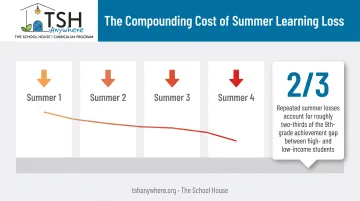
The researchers noted this figure came from a local sample and shouldn't be treated as a universal law. Still, the underlying pattern holds across other research: repeated summer losses compound.
The good news? Summer slide isn't a foregone conclusion. Even modest, consistent practice can offset most of that loss. That's the case for a well-designed workbook: a simple way to keep skills warm, not a cure-all.
Are Summer Learning Workbooks Worth It?
Yes — when they're used consistently and kept short. A workbook won't replace a full curriculum, and it shouldn't try to. But as a tool for maintaining what your child already knows, it's one of the most practical options available to families.
Here's what workbooks actually do well:
- Keep reading and math skills active without daily lesson planning
- Smooth the transition into the next grade by previewing upcoming concepts
- Give parents a ready-made structure, which matters when you're juggling summer camp drop-offs and everything else
The "It Feels Like More School" Concern
This is the most common pushback, and it's a fair one. Nobody wants summer to feel like a fifth quarter of the school year.
Research on learning generally favors short, distributed sessions over long, infrequent ones, a pattern that shows up consistently in classroom studies on spaced practice. Ten to twenty minutes a day, most days of the week, is enough to maintain skills without eating into pool time or bike rides.
Workbooks vs. Tutoring: A Cost Comparison
Private tutoring typically runs $20 to $30 or more per hour depending on your market, and structured summer school programs can cost several hundred dollars for a few weeks. A workbook, by comparison, is usually a one-time purchase in the $10-$20 range.
That's not an apples-to-apples trade. A tutor diagnoses specific gaps and adjusts in real time; a workbook can't do that. For kids who need significant remediation, a workbook should supplement, not replace, more targeted support. For maintenance-level practice, though, it's hard to beat the value.
What to Look for in the Best Summer Learning Workbooks
Not every workbook on the shelf is worth the money. Before buying one, check for these features:
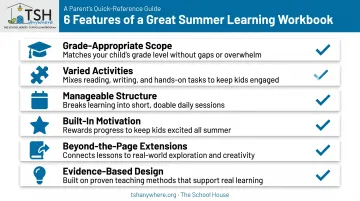
- Grade-appropriate scope: Reviews the grade just finished and gently previews the year ahead, ideally tied to recognized standards
- Varied activities: Mixes puzzles, mazes, coloring, and practice pages so kids stay engaged
- Manageable structure: Organized by weeks and days, with sessions around 15–20 minutes
- Built-in motivation: Progress trackers, stickers, or simple rewards that make kids want to open the book
- Beyond-the-page extensions: Bonus reading lists or outdoor challenges that pair practice with real-world exploration
- Evidence-based design: Created by educators or researchers who understand child development—not generic worksheet packs
Don’t Trust “Aligned” Labels Blindly
A "Common Core aligned" sticker is not an official endorsement. The Council of Chief State School Officers, which helped develop the standards, does not certify individual products.
If a workbook claims alignment, spot-check a few pages against your state's grade-level standards instead of taking the label at face value.
Choosing the Right Workbook by Grade Level
The "right" workbook changes a lot depending on where your child is developmentally. Here's a quick breakdown.
Preschool to Kindergarten
At this stage, skip anything that looks like a worksheet packet from a much older grade. Prioritize:
- Letter and number recognition
- Fine motor skill practice (tracing, cutting, coloring within lines)
- Following simple, multi-step instructions
Keep sessions playful. This age group learns through hands-on interaction, not independent seat work.
1st to 2nd Grade Transition
Strong options for rising 1st and 2nd graders lean heavily on:
- Phonics: blending sounds, decoding short words
- Reading comprehension: short passages with simple recall questions
- Math fact fluency: addition and subtraction within 20
These building blocks support everything else in early elementary. Keep practice steady over the summer rather than dialing it down.
3rd to 5th Grade
By this range, kids are ready for more complexity. Look for workbooks that introduce:
- Multiplication and division fluency
- Longer reading passages with multi-paragraph structure
- Early writing composition: opinion pieces, short narratives, simple explanatory writing
Aim for steady practice that builds reading and writing stamina, not giant packets that burn kids out.
6th to 8th Grade
Older students need workbooks that keep skills sharp without feeling like remediation:
- Pre-algebra readiness and multi-step problem solving
- Analytical reading with evidence-based responses
- Structured writing: short essays, arguments, and clear explanations
Short, consistent sessions beat marathon packets at this age.
Simple Tips to Make Summer Workbooks Actually Work
Buying the right workbook is half the battle. Getting your kid to actually use it is the other half.
- Build a short, consistent routine. Use the same time each day (mornings work best, before screens and plans take over) so workbook time becomes a habit instead of a negotiation.
- Set a simple goal with a real incentive. Finish the book, or a set number of pages, and follow it with a family outing or small reward.
- Blend it with real-world learning. Pair workbook time with a library summer reading program, an outdoor scavenger hunt, or dinner-table trivia. It doesn't need to feel separate from summer. It can just be part of it.
The School House's Science-Based Approach to Learning — And What It Means for Summer
The School House was founded in 2017 by Mimosa Jones Tunney, around one question: why haven't schools built curriculum around what science shows about how children learn?
That question shaped the American Emergent Curriculum (AEC), a framework that links subjects instead of teaching them in isolated blocks:
- Reading
- Math
- Science
- Civics
- Hands-on projects
A decade of research and more than six years of classroom testing back the AEC at The School House's flagship campus in East Northport, New York. Learners there consistently test at least twice above the national average, without academic admissions criteria.
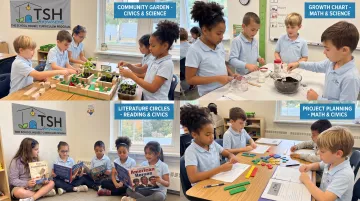
The same principle applies whether you're choosing a full-time curriculum or a summer workbook: children learn best through engaging, evidence-based methods, not repetitive drills. That's the standard worth holding any learning resource to, workbooks included.
If you want that same rigor for full-time learning, TSH Anywhere's homeschool curriculum delivers the identical AEC framework used at the flagship school, for families anywhere in the country.
Entrepreneurs, developers, and districts interested in an affordable, science-based school can explore The School House's replicable school-building model.
Frequently Asked Questions
What are the best workbooks for summer learning?
Match the workbook to your child's grade level, look for varied activities, and favor a short daily structure. Use the checklist above instead of hunting for one "top" product.
Are summer workbooks worth it?
Yes, when used consistently in short sessions. They're a cost-effective way to prevent learning loss, but they work best alongside outdoor play and reading, not instead of them.
What are some good summer workbooks for 1st grade students?
Look for workbooks focused on phonics, reading comprehension, and basic addition and subtraction fluency. Those skills carry the load for the rest of 1st and 2nd grade.
How many days a week should kids do summer workbooks?
Most days of the week, in short 10-20 minute sessions. Frequent, brief practice holds up better than a single long session once a week.
Do summer workbooks really prevent the summer slide?
Yes—when practice is short, consistent, and paired with reading and real-world activities. A workbook alone, used sporadically, won't do much.
What age should kids start using summer workbooks?
Simple, activity-based workbooks can start in preschool or pre-K. Formats then scale up through elementary school as skills grow.