Introduction
Every homeschool parent hits the same wall eventually. The math program that worked beautifully falls apart the moment you try to use it for history. The child who loved living books last year suddenly wants worksheets and a plan to check off. Many families struggle to find one boxed curriculum that fits every subject, every learning style, and every season of life.
In 2021–22, an estimated 3.135 million U.S. school-age children were homeschooled — about 5.56% of the school-age population — according to the National Home Education Research Institute. With that many families building their own path, it's no surprise so many land on eclectic homeschooling: mixing methods and materials instead of forcing everyone into one rigid system.
This guide covers:
- What eclectic homeschooling actually means
- Real benefits and trade-offs
- A step-by-step process for building your own mix
- Where to find resources that fit
Key Takeaways
- Blend methods and materials freely instead of locking into one purchased program
- Match resources to each child's learning style, interests, and your family's current needs
- Plan for more upfront research and ongoing tweaks than a boxed curriculum requires
- Budget flexibly, from free tools like Khan Academy to premium paid programs
What Is the Eclectic Curriculum Model?
Eclectic homeschooling means selectively pulling elements from Classical education, Charlotte Mason, unit studies, traditional textbooks, and even unschooling, then combining them into one program built around your child. According to HSLDA, it's defined by keeping what works for your family and dropping what doesn't, regardless of which philosophy it came from originally.
Unlike Classical education or Charlotte Mason, eclectic homeschooling has no required textbooks, no founding theorist, and no set schedule. It does not sit alongside those methods as a fixed system. It is the selection process parents use to combine them.
Most families don't set out to be eclectic. They pick one method first, discover parts of it clash with a child's personality or their own teaching style, and adjust. A few years in, they realize they've built something entirely their own.
Eclectic vs. Relaxed Homeschooling
Parents often use these terms interchangeably, but they're not quite the same:
- Relaxed homeschoolers typically stay within one philosophy, often Charlotte Mason or Montessori, and simply loosen the pace or structure
- Eclectic homeschoolers freely combine materials and methods from several philosophies at once, regardless of pace
Think of relaxed as a dial on one system. Eclectic is building with parts pulled from several systems at once.
A Sample Subject-by-Subject Breakdown
Here's what an eclectic approach might look like for a third grader:
| Subject | Approach Used |
|---|---|
| Reading | Charlotte Mason living books |
| Math | Traditional sequential textbook program |
| Science | Unit studies built around seasonal themes |
| History | Living books plus documentaries |
| Writing | Structured, incremental workbook |
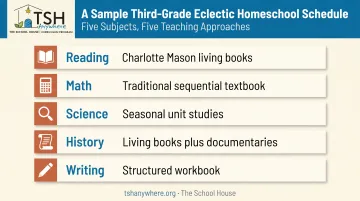
No two eclectic families look identical. That's the entire point of the approach.
Benefits of an Eclectic Homeschool Approach
Personalization That Fits Each Child
Every kid learns differently, even in the same house. An eclectic approach lets you pair a hands-on child with unit studies and manipulatives, while a bookish sibling dives into literature-based history at the same table, same year, without either one being forced into the wrong format.
Flexibility Across Life's Seasons
Life doesn't stay still, and your curriculum shouldn't have to either. A new baby, a move, or a parent picking up part-time work can all change how much bandwidth you have. Eclectic homeschooling flexes with you:
- Swap a heavy writing curriculum for audiobooks during a newborn's first months
- Lean on independent online math during a busy season
- Add hands-on unit studies back in when you have more time and energy
Budget Control
You decide where to spend and where to save.
- Use free platforms for math practice and put paid programs only where you need more structure
- Match spend to each subject instead of buying one full-grade bundle
- Benchmark costs against HSLDA's 2024 survey of more than 4,000 families, which put the average annual cost for an elementary student at $1,295
Real-World Skill Building
Because eclectic learning often pulls from unit studies and project-based work, kids practice connecting ideas across subjects rather than memorizing isolated facts. A unit on the solar system might fold in measuring distances, writing a report, and building a scale model, all in the same week.
Freedom to Blend Values and Worldview
Some families want faith-based read-alouds. Others want a fully secular approach. Eclectic homeschooling doesn't require a single worldview baked into every resource — you set the ratio, subject by subject, based on what matters to your family.
Common Challenges of Eclectic Homeschooling
Time-Intensive Planning
There's no pre-packaged scope and sequence handed to you. You're the curriculum director, researcher, and tester rolled into one. Expect to spend real hours reading reviews, ordering samples, and adjusting mid-year when something isn't clicking for a particular child.
The Fear of "Gaps"
Almost every eclectic homeschooling parent worries about missing something along the way. It's a fair concern, but occasional gaps happen in every educational model, including traditional schools. Regular check-ins with informal assessments, work samples, or a portfolio catch most issues early. Reteaching a missed concept is far simpler than starting over.
Overwhelm, Especially for New Homeschoolers
Building an eclectic curriculum from scratch is a heavy lift, particularly in your first year. If you like the idea of customizing to your child but don't want to research and assemble every piece yourself, a structured program built by someone else can bridge that gap.
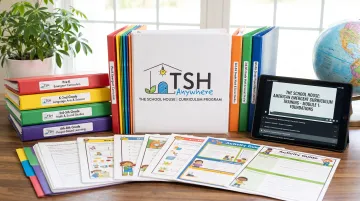
That's where a program like The School House's American Emergent Curriculum (AEC) fits in. It's a Pre-K through 8th grade framework built on a decade of pedagogical research and more than six years of live classroom testing.
What you get through the AEC subscription on TSH Anywhere:
- 8-week sessions already sequenced for you
- 400+ educator training films
- Printable materials ready to use
Families and small groups use it for hands-on, integrated learning without designing every lesson from scratch—useful when the DIY side of eclectic homeschooling feels heavier than you want to carry alone.
How to Build Your Own Eclectic Homeschool Curriculum
Step 1: Research Your State's Homeschool Laws
Check your state's reporting, testing, and subject requirements before you buy any resources. Rules vary widely:
- Some states require portfolios or standardized testing
- Others ask for little beyond a notice of intent
Step 2: Set Goals for Each Child
Decide what "success" looks like this year, for each learner separately. That might mean mastering multiplication, reading independently, or developing a genuine love of nature study. Write it down; you'll use it later to evaluate what's actually working.
Step 3: Observe Learning Styles Through Trial Periods
Try a few resource types for a couple of weeks each:
- A workbook
- A living book
- A hands-on kit
Watch what holds attention and what causes tears. A short trial tells you more than any learning-style quiz ever will.
Step 4: Anchor Core Subjects, Then Layer Flexible Ones
Math and language arts benefit from a consistent, sequential resource since each new skill builds on the last one. Once that's locked in, layer science, history, and electives with unit studies, field trips, or hands-on projects that can flex year to year.
Step 5: Build a Weekly Rhythm
Blend structured lesson time with open exploration:
- Mornings for anchored math and language arts, when focus is highest
- Afternoons for unit studies, co-ops, or virtual labs
- One flex day each week for field trips, catch-up, or rabbit holes
Step 6: Schedule Regular Check-Ins
Set a recurring date—monthly works for most families—to review what's working. Track progress with:
- A simple portfolio
- Saved work samples
- Informal narration
Swap out a resource the moment it stops working for your child.
Categories of Resources for Eclectic Homeschoolers
Most eclectic curricula draw from three resource categories, mixed in whatever ratio suits the family.
Core Subject Publishers
Structured, sequential programs for math or language arts, where skills build step by step. Families often use these as the backbone, then layer flexible resources around them.
Flexible and Free Platforms
Self-paced online tools like Khan Academy offer free Pre-K through 8th grade math practice that adjusts to each child's mastery level. Families use them as budget-friendly supplements or full replacements for paid math curricula.
Enrichment and Hands-On Resources
Unit study kits, literature-based book lists, virtual science labs, and documentaries add real-world context to structured learning. This is where families add depth around a child's interests, whether that's dinosaurs, space, or a specific historical era.
| Category | Best For | Example |
|---|---|---|
| Core subject publishers | Sequential skill-building | Math or grammar programs |
| Flexible/free platforms | Budget-conscious supplementing | Khan Academy |
| Enrichment resources | Real-world context and depth | Unit study kits, documentaries |
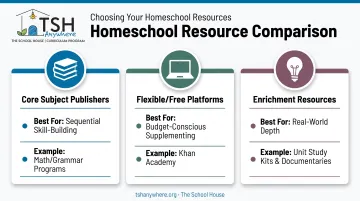
Mixing all three — one anchored core program, one free platform, and rotating enrichment — is one of the most common and effective combinations.
Frequently Asked Questions
What is the eclectic curriculum model?
It's a custom blend of elements from multiple homeschool philosophies — Classical, Charlotte Mason, unit studies, and more — rather than one fixed, purchasable program. Parents select what fits each child instead of following a single method's rules.
How is eclectic homeschooling different from unschooling?
Unschooling skips structured curriculum entirely, following the child's interests without set lessons or schedules. Eclectic homeschooling mixes structured elements, like a sequential math program, with unstructured ones, like interest-led projects.
Can I mix secular and religious materials in an eclectic approach?
Yes. Combining materials regardless of worldview to match your family's values is one of the defining strengths of eclectic homeschooling. There's no rule requiring consistency across every resource.
Is eclectic homeschooling more expensive than a boxed curriculum?
It varies widely. Free resources can offset premium materials elsewhere, so an eclectic approach can be as affordable or as costly as you choose to make it.
How do I know if eclectic homeschooling is right for my family?
It tends to fit families who value flexibility, have kids with different learning needs, or haven't found one curriculum that covers everything they want. If you're already tweaking a boxed program, you may already be eclectic.
What if the eclectic approach feels too overwhelming to manage on my own?
Start with just one or two anchored subjects and add flexible pieces slowly. Structured, community-based alternatives like The School House's AEC also exist for families who want a built-in framework with less DIY planning.