Introduction
Virginia is one of the most homeschool-friendly states in the country. Its legal framework is clear enough to navigate without a law degree, yet flexible enough to fit almost any family's rhythm. Four separate statutes give parents legitimate pathways to teach at home, each with its own paperwork and deadlines.
Families often turn to homeschooling when classroom pacing doesn't fit, a child needs deeper work on gaps or interests, or the local options feel too narrow. At home, parents can set the pace, personalize instruction, and choose from a wider menu of curriculum options than existed even five years ago.
Enrollment reflects that shift. Virginia reported 66,117 homeschooled students for the 2025-2026 school year, a 5.34% jump from the prior year and nearly 50% higher than 2019-2020, according to HEAV's analysis of state data.
This guide covers Virginia's legal requirements, the main types of homeschool programs available, and how to match a program to your child and your family's actual capacity.
Key Takeaways
- Virginia recognizes homeschooling under four statutes, each with distinct filing and documentation rules
- Program options include mastery-based curricula, online schools, textbook programs, and co-ops
- Homeschoolers get no direct state funding; limited tax-credit scholarships cover some private-school paths
- Match your program to your child's learning style, your schedule, and the structure your family needs
Virginia Homeschool Laws & Requirements
Virginia is a "moderate regulation" state. Parents must file specific paperwork and submit annual progress evidence, but they keep broad freedom in choosing curriculum and teaching methods.
There's no state-approved textbook list and no required daily schedule—only a handful of deadlines to track.
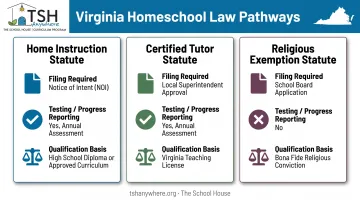
The Home Instruction Statute
This is the most common route Virginia families use, governed by Code of Virginia § 22.1-254.1. It requires:
- A Notice of Intent (NOI) filed with the division superintendent by August 15
- A basic list of subjects to be studied (no state-mandated curriculum)
- Evidence of academic progress submitted by August 1 the following year
Parents must satisfy one of four qualification options before filing:
- Hold a high school diploma
- Meet Board-prescribed teacher qualifications
- Provide a program of study or curriculum, including correspondence or distance learning
- Show evidence of the ability to provide an adequate education for the child
Notice that a teaching license is only one of four paths, not a requirement. Most families qualify through options one or three.
The Certified Tutor Statute
Under this route, a Virginia-certified tutor—a person with a current state teaching license, approved by the division superintendent—can instruct a child at home or elsewhere. Once the license is verified, the superintendent cannot deny approval.
No annual testing and no progress reporting are required on this pathway.
The Religious Exemption Statute
Families with sincere religious objections to school attendance can request an exemption from the local school board. Those convictions must rest on bona fide religious training or belief—not political, philosophical, or purely personal moral views.
If approved, the family is excused from filing, testing, and progress reporting. Immunization compliance still applies.
Notice of Intent, Testing & Attendance
Home Instruction families must provide 180 instructional days or 990 instructional hours per year, averaging roughly 5.5 hours daily. There's no mandated subject list beyond what's listed on the NOI, and no requirement for a fixed daily schedule.
Progress evidence, due by August 1, can take one of four forms:
| Evaluation Option | What It Requires |
|---|---|
| Standardized test | Composite score at or above the 4th stanine, or equivalent ACT/SAT/PSAT score |
| Evaluator letter | Written evaluation from a licensed teacher or someone with a relevant master's degree |
| Transcript/report card | From a community college, college, or accredited distance-learning program |
| Alternative assessment | Any other evaluation the superintendent deems adequate |
Types of Homeschool Programs in Virginia
"Homeschooling" isn't one method. Virginia families choose from several structurally different program types, and the right one depends heavily on your child's needs and your own availability as the primary educator.
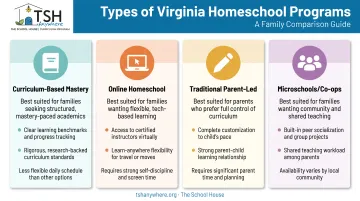
Curriculum-Based Mastery Programs
These are full-year, mastery-based programs families follow at their own pace, often with minimal screen time and optional educator support built in. The School House Anywhere's American Emergent Curriculum (AEC) is one example. It's structured in 8-week sessions that weave reading, writing, math, science, civics, and entrepreneurship together thematically rather than as isolated subjects.
AEC subscribers get a 400+ film educator training library, custom printables, and Transparent Classroom for portfolio and progress tracking. Live weekly Q&As and office hours with curriculum staff come with the subscription; physical materials boxes are an optional add-on.
- Best suited for: Families wanting academic rigor without heavy screen time, especially those with mixed-age or multiple children
- Key strengths: Hands-on projects, transparent progress tracking, and a lighter prep burden than building an eclectic curriculum from scratch
- Limitations: Requires steady parent commitment to pacing and may need supplementing for niche electives
Online Homeschool Programs
These function like a virtual school at home: video lessons, automated quizzes, and computer-graded assignments handle most of the instruction.
- Best suited for: Working parents needing a predictable schedule, and older elementary or middle school students comfortable learning independently on screens
- Key strengths: Minimal parent teaching required, structured pacing set by the platform
- Limitations: Heavy daily screen time, and little room for hands-on or interest-led exploration
Traditional Parent-Led Curriculum Programs
This is the classic model: textbooks, workbooks, and lesson plans with the parent delivering direct instruction. It's essentially a scaled-down version of a traditional classroom, run at your kitchen table.
- Best suited for: Parents who want clear academic benchmarks and children who thrive on predictable routines
- Key strengths: Comprehensive subject coverage with straightforward progress markers
- Limitations: Can feel rigid, and all planning and grading responsibility sits with the parent
Microschools, Co-ops & Hybrid Programs
Microschools are small, tuition-based programs, typically serving around 15 students and built for personalized, multi-age learning. Co-ops are looser: groups of homeschool families meeting once or twice weekly to split teaching duties, often at a church or community center. Hybrid programs mix days at home with part-week attendance at a school or learning center.
- Best suited for: Families prioritizing social interaction and shared teaching responsibility
- Key strengths: Built-in community, and reduced isolation for both kids and parents
- Limitations: Availability varies widely by region, and parents must still independently file their Notice of Intent (NOI) and submit evaluations under state law
How to Choose the Right Homeschool Program in Virginia
The right program is the one that fits your child's learning style and your family's real capacity day to day. Weigh these factors before committing:
- Parent availability and involvement level: Do you want to be the hands-on instructor, or oversee a more independent, self-paced program?
- Child's learning style and screen tolerance: Some kids thrive on video-based instruction; others need physical materials and human interaction to stay engaged.
- Budget: Curriculum subscriptions, physical materials, and tuition-based hybrid programs vary widely in cost.
- Long-term goals: Factor in high school transcript needs and, if relevant, NCAA eligibility documentation later on.
Families wanting structured academics without heavy screens or religious framing often find that a mastery-based option, like the AEC model, bridges the gap between full independence and a fully online school. It keeps the parent as the lead teacher while providing the training films, printables, and pacing structure that eclectic homeschooling usually lacks.
Costs, Funding & Homeschooling Trends in Virginia
Homeschooling in Virginia is largely self-funded. Most families budget for curriculum, supplies, activities, and any paid evidence of progress their chosen option requires.
Virginia does not offer direct state funding, vouchers, or tax breaks specifically for homeschooling. The closest option, the Education Improvement Scholarships Tax Credits Program, supports eligible students at approved private schools—not homeschool curriculum purchases. Income limits generally run up to 300% of federal poverty guidelines (400% with an IEP), and extra eligibility rules can apply.
Accreditation is optional under Virginia law and is not required under any of the four home-instruction statutes. Providers may pursue it to strengthen transcripts for college applications, but it is not a legal requirement to homeschool.
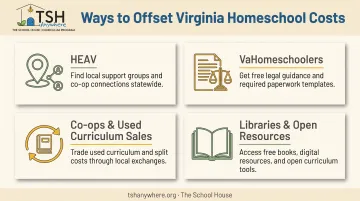
To offset costs without formal funding:
- HEAV (Home Educators Association of Virginia) — local support-group finder and statewide co-op directory
- VaHomeschoolers — law guidance, curriculum resources, and an evaluator directory, largely free
- Co-ops and used curriculum sales — shared classes and secondhand materials lower annual spend
- Libraries and open resources — many core subjects can start with free public materials
HEAV and VaHomeschoolers are worth bookmarking early; much of what they offer replaces services families would otherwise pay for.
Home instruction has stayed elevated since the pandemic as more Virginia families prioritize flexibility and customized pacing—and co-ops, evaluators, and curriculum options have grown with that demand.
Conclusion
Virginia's homeschool laws give families enough structure to stay compliant and enough freedom to customize how kids learn. Whether you file under the Home Instruction Statute, use a certified tutor, or qualify for a religious exemption, the paperwork is manageable once you know the deadlines.
The harder decision is picking a program that fits. A curriculum-based mastery model, an online school, a textbook-driven approach, or a co-op can each work well. The right fit depends on how much structure your child needs and how much time you can realistically give.
Get the legal filings right, then choose a program your family can stick with past the first semester—one built to hold engagement over the full year.
Frequently Asked Questions
Does Virginia give money for homeschooling?
No. Virginia doesn't provide direct state funding for homeschoolers. Limited tax-credit scholarships exist through the Education Improvement Scholarships Tax Credits Program, but they apply to eligible students attending approved private schools, not homeschool expenses.
What homeschool programs are accredited in Virginia?
Accreditation is optional in Virginia, not a legal requirement. Several online and curriculum-based programs carry independent accreditation, which can strengthen transcript credibility during college admissions, but plenty of unaccredited programs are perfectly legal to use.
What is the current rate of homeschooling in Virginia?
Virginia reported 66,117 homeschooled students for the 2025-2026 school year, according to HEAV's review of state data, a 5.34% increase from the previous year and roughly 50% higher than 2019-2020.
Is homeschooling legal in Virginia?
Yes. It's legal under three recognized statutes: the Home Instruction Statute, the Certified Tutor Statute, and the Religious Exemption Statute, each requiring its own specific annual filings and documentation.
Do I need a teaching certification to homeschool in Virginia?
No. Under the Home Instruction Statute, a high school diploma, an approved curriculum or distance-learning program, or evidence of the ability to provide adequate education all satisfy the requirement.
How many days must Virginia homeschoolers instruct each year?
Families must provide 180 instructional days or 990 instructional hours annually. There's no mandated daily schedule, so families can pace instruction however works best for them.