Homeschool parents face a related struggle: piecing together a "complete" history education from scattered textbooks, workbooks, and Pinterest boards. It's exhausting, and it's easy to wonder if you're covering enough.
Unit studies offer a different path. Instead of memorizing a chapter and moving on, your child lives inside a time period through books, projects, and hands-on work. This guide covers what unit studies are, why they work, how to build one, era-specific ideas, and how to pick resources that won't gather dust on a shelf.
Key Takeaways
- Unit studies connect reading, art, and geography around one historical theme instead of teaching subjects in isolation
- One theme can serve multiple grade levels at once, cutting down on parent prep time
- Hands-on projects (crafts, primary sources, field trips) make abstract history concrete
- Most unit studies run several weeks to a full semester, depending on family goals
- A mix of a spine text, literature, and primary sources beats relying on one curriculum alone
What Are Homeschool History Unit Studies?
A unit study is an interdisciplinary approach that centers one historical theme or era, then builds reading, writing, art, and geography around it. The Home School Legal Defense Association (HSLDA) describes unit studies as integrating several subjects around one topic, using books, timelines, models, and projects rather than isolated worksheets.
Compare that to a traditional scope-and-sequence textbook, where history, English, and art each live in separate books with separate schedules. A unit study on Ancient Egypt, for example, might have your child:
- Read a spine text on the pyramids for history
- Write a journal entry as a young scribe for language arts
- Sketch hieroglyphics for art
- Map the Nile's flood cycles for geography
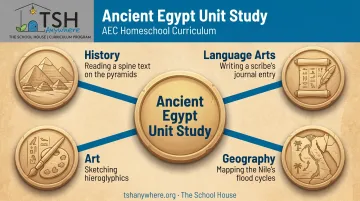
Everything connects back to one central story instead of feeling like four unrelated subjects.
Homeschoolers often choose this format because it is practical at home:
- You set the pace instead of following a textbook's chapter count
- One theme works across ages, with output matched to each child
- Curiosity can drive depth—if mummification hooks your child, spend an extra week there
One limit still applies: sequential skill subjects like phonics, spelling, and math usually need their own track. Unit studies fit content-based subjects best, not every subject.
Why History Unit Studies Work So Well in Homeschooling
Connected, contextual learning outperforms isolated fact memorization. A 2021 study of 2,371 third-graders across 46 schools found that students using project-based learning scored 8 percentage points higher on a science assessment than peers in traditional instruction, according to Edutopia's reporting on the research.
History unit studies apply that same active, connected mechanism.
One Theme, Every Grade Level
A single era lets one family teach multiple children simultaneously. Your fourth grader might narrate what she learned about the Oregon Trail while your seventh grader writes a research paper on the same topic. Same theme, different output, less duplicated planning.
Flexible Pacing Beats Burnout
There's no fixed daily chapter to rush through. If your kids are fascinated by knights and castles, stay there another two weeks. If a topic falls flat, move on. That elasticity reduces the burnout that comes with a rigid, one-size-fits-all schedule.
Hands-On Work Makes History Stick
Crafts, reenactments, primary source documents, and field trips turn abstract names and dates into something a child has touched, built, or acted out. A cardboard castle is more memorable than a paragraph about feudalism.
The same approach shows up in research-backed school design, not only at the kitchen table.
The School House, for instance, builds its American Emergent Curriculum around project-based learning and hands-on studio work rather than siloed subjects. That model grew from a decade of curriculum research and more than six years of classroom testing at its Long Island flagship. The philosophy matches what drives unit studies at home: kids learn best when subjects connect.
How to Build Your Own Homeschool History Unit Study
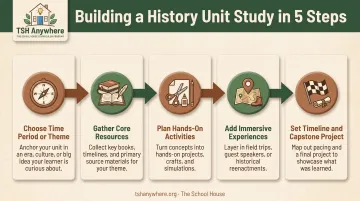
Building a unit study from scratch feels daunting the first time. Break it into five steps and the process stays clear and doable.
Step 1: Choose Your Time Period or Theme
Pick a topic based on:
- Your child's existing curiosity (did a museum trip spark interest in knights?)
- Chronological sequence, moving from ancient to modern across the school year
- State history requirements, if applicable
Step 2: Gather Core Resources
Curate a small, focused set rather than everything the library offers:
- One spine text — a solid overview book covering the whole era
- Historical fiction or age-appropriate literature set in the period
- Primary source documents (letters, speeches, photographs)
- A reference map or timeline your child can return to repeatedly
Step 3: Plan Hands-On Activities and Projects
Choose two or three project types, not ten. Options include:
- Crafts tied to the era (a model pyramid, a coat of arms)
- Cooking a recipe from the period
- Costume or "living history" days
- Lapbooking or notebooking pages to track learning
Step 4: Add Immersive Experiences
Layer in experiences beyond books:
- Field trips to museums or historical sites
- Documentaries or age-appropriate films
- Community reenactments, if available locally
Step 5: Set a Flexible Timeline and Capstone Project
There's no single correct length. HSLDA notes unit studies can run a season, a semester, or an entire year. Most families land on four to twelve weeks for one theme.
Close with a synthesis project so learning sticks. Strong capstone options include:
- A short presentation or oral report
- A diorama, model, or display board
- A family "museum night" where each child shows what they built and learned
Homeschool History Unit Study Ideas by Time Period
Pick a period, then mix one hands-on project with a primary source or map so kids tie facts to something they built or read.
Ancient Civilizations (Egypt, Greece, Rome)
- Build a pyramid model out of sugar cubes or clay
- Practice writing names in hieroglyphics
- Recreate an ancient Olympic event (the Games ran from 776 BC to at least AD 393), such as running, javelin, or wrestling
- Read mythology-based literature as a family read-aloud
The Middle Ages and Renaissance
- Construct a cardboard castle, comparing an early wooden motte-and-bailey design to a later stone keep
- Research a historical figure such as Joan of Arc
- Design a family coat of arms
- Study illuminated manuscripts and try calligraphy
Colonial America and the American Revolution
- Read founding documents together as a family
- Simulate colonial trade with a simple bartering game
- Stage a mini Revolutionary War reenactment
- Map key battle sites on a printable outline map
Westward Expansion and Pioneer Life
- Churn butter the old-fashioned way
- Build a covered wagon craft from a shoebox
- Map the roughly 2,000-mile Oregon Trail from Missouri toward the Pacific Northwest
- Write a pioneer-style diary entry from a child's perspective
Civil War, Civil Rights, and Modern America
- Map major Civil War battles or compare Union and Confederate resources
- Study primary speeches and historical photographs from the era
- Read biographies of civil rights leaders
- Build a timeline from Brown v. Board of Education (1954) and the Civil Rights Act (1964) into later reforms
Choosing the Best Curriculum and Resources for History Unit Studies
There's no single "best" curriculum for history. The real choice is between pre-made and DIY.
| Approach | Pros | Cons |
|---|---|---|
| Pre-made unit study kit | Less prep, structured pacing, everything included | Less flexible, can feel generic for your child's interests |
| DIY with library books | Fully customizable, often cheaper | Time-intensive to plan and source materials |
Whichever route you choose, a strong history unit study needs:
- Spine text — an overview book that anchors the chronology
- Primary sources — letters, speeches, and photographs from the era
- Literature — novels or biographies tied to the period
- Audiovisual supplements — documentaries or virtual museum tours
Before adding anything to your unit, preview it for:
- Reading level — is it too advanced or too simple for your child?
- Historical accuracy — does it hold up against other sources, or does it reflect one narrow point of view?
- Fit with family values — does the content match how you want to present sensitive history?
Making History Unit Studies Work Across Multiple Ages
Homeschoolers often choose unit studies for multi-age flexibility. HSLDA notes that a shared family topic can maximize both preparation and instruction time, with work adjusted by age and ability instead of duplicated across grade levels.
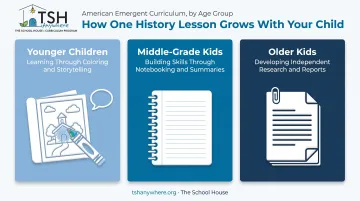
How to differentiate by age using one shared theme:
- Younger children: narrate what they heard or color a related picture
- Middle-grade kids: write a short summary or complete a notebooking page
- Older kids: research independently and write a full report
Two simple routines keep everyone working from the same theme:
- Rotate an "expert presenter" role so an older sibling teaches younger ones what they learned that week—it deepens the presenter's recall and pulls younger kids in
- Keep a shared family history timeline on a wall or poster board; after each unit, every child adds one event or image so the year becomes a visible record of what you covered together
Frequently Asked Questions
What are homeschool unit studies?
Unit studies are theme-based, interdisciplinary lessons that combine subjects like reading, art, and geography around one historical topic. Instead of separate subject blocks, everything connects to a central theme.
What are some good homeschool history unit study ideas?
Strong options include Ancient Egypt, the Middle Ages, the American Revolution, pioneer life on the Oregon Trail, and the Civil Rights Movement. Each era offers plenty of hands-on project ideas covered above.
What is the best homeschool curriculum for history?
There's no single "best" option. Combining a spine text with literature and primary sources, or using a well-reviewed unit study kit, generally works better than relying on one curriculum alone.
How long should a history unit study typically last?
Most families run a unit study for four to twelve weeks, though it can stretch to a full semester depending on depth, pace, and how many activities you include.
What age is best suited for history unit studies?
Unit studies work well from early elementary through middle school. Differentiated output (narration for younger kids, research reports for older ones) makes them adaptable for multiple ages at once.
How do I assess what my child has learned from a unit study?
Capstone projects, notebooking pages, and simple narration or presentations work well as informal assessments. They show what your child retained without a formal test.