Here's the relief: you don't need any of that. Kindergarten homeschooling works best when it's built around curiosity, books, hands-on play, and the everyday moments you're already having with your child. This guide breaks down exactly what to teach, which activities actually work, and how to build a routine that fits your family instead of a textbook's idea of one.
Key Takeaways
- Prioritize readiness over age: curiosity, focus, and letter/number interest matter more than a birthday
- Core subjects at this age center on phonemic awareness, hands-on math, and experiential science
- Formal table-time can stay under 20 minutes a day and still be effective
- Curriculum can be as simple as library books and one math manipulative set
- Avoiding burnout matters more in year one than covering every possible topic
Is Homeschool Kindergarten Right for Your Family? Signs of Readiness
There's no universal "right age" to start homeschool kindergarten, and the research backs that up. Kids don't hit reading and academic milestones on a fixed timeline — some show interest early, others take longer, and both are normal.
The American Academy of Pediatrics notes that while a few 4-year-olds show real enthusiasm for reading and recognizing familiar words, there's no need to push early reading. Enthusiasm matters far more than the age it begins. Instead of fixating on a number, look at behavior.
Signs your child may be ready for more structured learning:
- Can focus on a preferred task for 5-10 minutes at a time (excluding screen time)
- Asks frequent "why" and "how" questions
- Shows genuine interest in letters, numbers, or writing their name
- Can follow two-step directions ("get your shoes, then meet me at the door")
- Takes turns and answers simple questions about a story
The CDC's developmental milestones for age 5 list nearly identical benchmarks — attention span during stories or crafts, following game rules, and counting to 10 among them.
Signs your child needs more free-play time first:
- Can't sit for even a minute during a directed activity
- Resists structure consistently, not just on off days
- Shows little interest in letters or numbers yet
None of this is a red flag. It's a normal developmental stage, and pushing structured lessons before a child is ready usually backfires anyway.
What Should You Teach a 5-Year-Old? Core Kindergarten Skills & Subjects
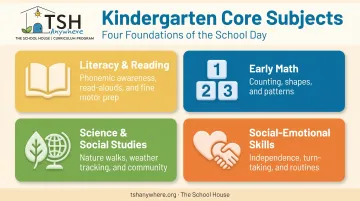
Every new homeschool parent asks some version of this: what actually belongs in a kindergarten day, and what can wait? Below is a subject-by-subject breakdown of the skills that matter most at five.
Literacy & Early Reading Foundations
Phonemic awareness and letter-sound recognition, not memorized sight words, are the real building blocks of reading. The National Reading Panel identified phonemic awareness and letter knowledge as the two strongest predictors of a child's reading progress in the first two years of school.
Phonemic awareness training alone doesn't guarantee reading success. It is foundational, not a complete program. At this age, daily read-alouds matter more than formal phonics drills.
Before handwriting instruction, focus on fine motor readiness:
- Tracing shapes and letters
- Cutting along lines with child-safe scissors
- Drawing and coloring freely
- Squeezing playdough or clay
Early Math Foundations
Core kindergarten math includes:
- Counting to 20 and beyond, with some kids reaching 100 by ones and tens
- Number recognition and writing numerals 0-20
- Basic 2D and 3D shape identification
- Simple pattern recognition (AB, AB, AB)
Manipulatives such as blocks, buttons, and counting bears teach these concepts more effectively than worksheets for most young learners. You don't need a curriculum box to embed math into the day:
- Measure ingredients together while baking
- Count stairs on the way up to bed
- Sort laundry by color or type
Science, Social Studies & the World Around Them
At five, science and social studies work best as experiences, not textbook units. Simple daily moments cover more ground than worksheets:
- Take a nature walk and notice seasonal changes
- Track the weather on a simple chart
- Talk about your family, neighborhood, and community helpers
That is social studies at this age. No separate curriculum is required.
Social-Emotional & Life Skills
Curiosity, confidence, and a genuine love of learning matter more right now than hitting academic benchmarks. The American Academy of Pediatrics (AAP) notes that developmentally appropriate play supports social-emotional growth, self-regulation, and executive function. Those skills outlast any single fact learned this year.
Independence skills worth building now:
- Following a simple daily routine
- Cleaning up after an activity, unprompted
- Taking turns during games
20+ Fun Kindergarten Homeschool Activities by Subject
Here's the practical answer to "what do I actually do with my kindergartner this week?" Pick activities based on whatever subject you're focused on — no need to do them in order.
Literacy & Reading Activities
- Letter scavenger hunt — hide foam or paper letters around a room and have your child find and name each one
- Sight-word bingo — homemade cards with common words, using dried beans as markers
- Alphabet sensory bin — rice or beans with hidden letter tiles to dig through
- Rhyming games — call out a word and take turns finding rhymes
- Book & a bite — read a story, then eat a themed snack (bear-shaped crackers after "Goldilocks," for example)
- Pretzel or playdough letters — form letters with sticks or dough you already have (no purchased materials)
Hands-On Math Activities
- Cereal sort — count and sort cereal by color into muffin tins
- Shape of the day — scavenger hunt around the house for one shape
- Pattern-block challenges — build patterns with blocks you already own
- Paper-plate clock — homemade clock for practicing telling time
- Cheerio necklace — string and count as you go for a snack math lesson
Science & Nature Exploration Activities
- Nature scavenger hunt — outdoor finds with a simple printed checklist
- Color-changing flowers — food coloring and water experiment
- Daily weather chart — stickers for sun, rain, and clouds
- Magnifying-glass study — leaf or bug observation in the backyard
Art, Fine Motor & Sensory Play Activities
- Playdough shape-cutting — kid-safe tools for fine-motor practice
- Shaving cream letters — write letters on a table or tray
- Paper-plate animals — crafts from recycling-bin scraps
- Three-crayon challenge — pick three colors, draw anything
Social Studies & Life Skills Activities
- State or country of the week — mini-project with a map and one fun fact
- Address and family names — practice home address and names out loud
- Simple cooking tasks — spreading peanut butter or pouring cereal
Creating a Simple Daily Routine for Kindergarten Homeschool
There's no required number of "school hours" for kindergarten homeschooling. A loose routine works better than a rigid schedule at this age.
A sample day might look like:
- Books together on the couch
- One short, focused table-time activity
- Outdoor time
- Free play
Keep formal table-time under 15-20 minutes. Follow your child's engagement level, not a clock. If they're locked in at minute 12, let them keep going; if they're done at minute 5, that's fine too.
Even on busy days, protect two daily anchors:
- Outdoor time: supports hands-on learning, gross motor skills, and overall well-being
- Read-aloud time: the AAP recommends interactive read-alouds as a daily habit through kindergarten and beyond, tied to stronger language skills at school entry
Everything else in the day can flex.
Choosing a Kindergarten Curriculum Approach That Fits Your Family
There isn't one "correct" model for homeschool kindergarten. Most families land on one of three approaches:
| Approach | What it looks like | Best for |
|---|---|---|
| Play-based/child-led | No fixed lessons; child's interests drive the day | Families comfortable with less structure |
| Workbook/textbook-based | School-at-home model with set lessons and grade levels | Parents who want a clear daily script |
| Hybrid unit studies | Themes tie subjects together (a week on "farms" covers reading, math, science) | Families wanting structure without rigidity |
Start small in year one. A library card, one math manipulative set, and a simple phonics list will carry you further than a full boxed curriculum most families never finish.
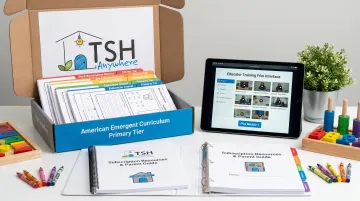
If you want more structure without building lesson plans from scratch, a ready-made curriculum can fill that gap. TSH Anywhere's American Emergent Curriculum (AEC) was developed over a decade of research and refined for more than six years in The School House's flagship classroom before opening to homeschool families nationwide.
The Primary tier covers Pre-K through kindergarten and bundles printables, 400+ educator training films, and live weekly support in one subscription: $125 a month or $1,200 a year per learner.
Whatever you choose, match cost to your budget and goals before you commit. Some packages run into the thousands a year; others cost little more than library visits.
Common Mistakes to Avoid in Homeschool Kindergarten
Trying to replicate a full school day. A six-hour homeschool day with back-to-back subjects isn't necessary for a five-year-old and often exhausts both parent and child faster than it teaches anything.
Comparing your child's pace to siblings or peers. Reading and math readiness can vary by years between individual kids, even within the same family. That gap is normal, even for kids the same age.
Over-scheduling or over-buying curriculum in year one. It's tempting to buy every recommended resource before you've even started. Instead:
- Begin with a handful of core materials
- Add only what you find yourself actually needing
- Wait at least one semester before expanding your curriculum shelf
Starting minimal leaves room to figure out what your child — and you — actually respond to.
Frequently Asked Questions
What are some good homeschool activities for kindergarten?
Low-prep favorites include letter scavenger hunts, cereal counting and sorting by color, and a magnifying-glass bug or leaf study in the backyard. All three use materials you likely already have at home.
What should I teach a 5-year-old in homeschool?
Focus on phonemic awareness and read-alouds, hands-on counting and shape recognition, experiential science and social studies, and social-emotional skills like independence and turn-taking. Academic drilling can wait.
How many hours a day should kindergarten homeschool take?
Most formal instruction fits into 20-60 minutes a day. The rest of the day can be filled with play, reading together, and real-life learning moments like cooking or errands.
Do I need to follow a set curriculum for kindergarten homeschool?
No — a formal curriculum is optional at this age. Books, conversation, and hands-on activities can teach the same core skills just as effectively as a boxed program.
How do I know if my child is ready for homeschool kindergarten?
Look for curiosity, the ability to focus on a task for 5-10 minutes, interest in letters or numbers, and the ability to follow two-step directions. If those aren't there yet, more free play is likely the better next step.
Is homeschool kindergarten legally required to follow state standards?
Requirements vary by state, covering everything from notification to curriculum approval. Check your specific state's homeschool laws before finalizing your plans, since rules in one state won't necessarily apply in another.