This guide reviews the top homeschool grammar curricula across grade levels, teaching styles, and budgets. We'll break down what makes each one work, who it fits best, and how much it costs.
Here's the catch: "best" and "easiest" aren't universal. A workbook that thrills one kid will bore another to tears. Your child's age, learning style, and your own comfort with grammar all shape the right answer.
Key Takeaways
- No single curriculum fits every family; match age, learning style, and independence level
- Story-based programs suit reluctant learners; workbooks suit kids who like structure
- Formal grammar works best between 4th and 7th grade, not in early elementary
- Strongest programs tie grammar rules to real reading and writing, not memorized definitions
Why Grammar Still Matters in Your Homeschool
Kids forget the difference between a gerund and a participle within weeks of the quiz. That's fine. The terminology was never the real goal.
What matters is what grammar does while students learn it:
- Strengthens reading comprehension
- Sharpens writing clarity
- Builds confidence to communicate without second-guessing every sentence
Those benefits outlast the vocabulary list.
Research backs one method in particular: applying grammar directly inside sentences, not memorizing isolated rules. The influential Writing Next research review found sentence combining (where students practice merging and revising sentences rather than diagramming them in isolation) carries an effect size of 0.50 on student writing, one of the stronger interventions studied.
That doesn't mean every "grammar-in-context" program automatically works better. A UK-based trial of a similar contextual approach found no measurable writing gains after a six-week whole-class rollout, largely because teachers skipped key discussion steps. The takeaway: context helps, but only when a program actually requires students to apply rules in real sentences, not just read about them.
Curriculum grounded in educational science tends to beat drill-and-kill worksheets over the long term. The School House's American Emergent Curriculum was built on that idea: language instruction woven into connected lessons rather than standalone drills, shaped by a decade of curriculum research and years of testing at its flagship school.
When to Start Formal Grammar Instruction
Homeschool circles have argued about grammar timing for decades, and the debate hasn't really settled.
Charlotte Mason and her modern followers push formal grammar later. AmblesideOnline, the popular Mason-based curriculum guide, doesn't introduce formal grammar until Year 4 (roughly 4th grade), per its grammar guidance.
Ruth Beechick's approach is similar: young kids absorb language through copying, dictation, and read-alouds, with formal rule-study coming later.
Other camps push earlier exposure, arguing kids can handle simple parts-of-speech concepts as young as first or second grade.
The developmental case for waiting a bit:
A 2022 study of children ages 5 to 7 found metalinguistic skills (the ability to think about language, not just use it) grow steadily in this window. Overall metalinguistic ability correlated strongly with grammatical comprehension (r = 0.54). That trajectory suggests most kids aren't primed for abstract grammar until upper elementary.
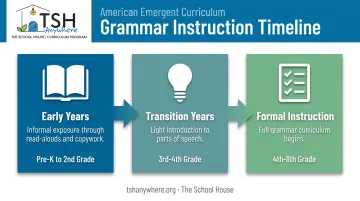
A practical progression looks like this:
- Early years (Pre-K to 2nd grade): Informal exposure through read-alouds, conversation, and copywork. No worksheets required.
- Transition years (3rd to 4th grade): Light introduction to parts of speech and sentence structure.
- Formal instruction (about 4th to 8th grade): Full grammar curriculum once abstract reasoning is in place. Exact timing still varies by child.
Top Homeschool Grammar Curricula Reviewed
These programs represent the most commonly used homeschool grammar options, spanning story-based, workbook-style, and mastery approaches.
Easy Grammar Systems
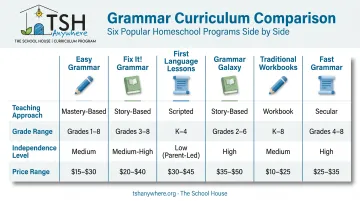
Easy Grammar's signature move is teaching prepositions first. Once kids can spot and cross out prepositional phrases, identifying subjects and verbs gets dramatically easier. The series spans grades 1-12 through Easy Grammar, Easy Grammar Plus, Ultimate Series, and Daily GRAMS for review.
Pros:
- Short, independent lessons with minimal parent involvement
- Built-in review keeps concepts from fading
- No sentence diagramming required
- Flexible placement tests help you skip what your child already knows
Best fit: Students who want mastery-based instruction they can mostly complete solo. Teacher editions run $36.95 to $41.95, with student workbooks around $16.95 to $17.95.
Fix It! Grammar (IEW)
Instead of isolated sentences on a worksheet, Fix It! Grammar hands students one sentence per day from an ongoing story to find and correct. Six sequential levels cover grades 3-12, mastering grammar through repeated editing rather than repeated drilling.
Pros:
- Grammar taught in context, not memorized in a vacuum
- Fosters independence once kids learn the editing routine
- Light vocabulary and writing integration built in
The drawback: no built-in tests, so tracking mastery takes more parent judgment.
Best fit: kids who dislike dry worksheets and respond to narrative. Teacher/student combos run $29, with student books alone around $19.
First Language Lessons (The Well-Trained Mind)
This fully scripted, classical program covers parts of speech, sentence diagramming, memorization, and dictation across four levels for grades K-4. Parents read directly from the script — no grammar expertise required.
Pros:
- Zero prep, since the teacher's guide does the talking
- Strong repetition builds lasting retention
- Ideal for parents who never quite mastered grammar themselves
Best fit: younger students and classical or Charlotte Mason-style homeschoolers wanting a gentle, thorough foundation. Level 1 runs $11.86 to $16.11; Level 3's guide and workbook together run roughly $40.
Grammar Galaxy
Grammar Galaxy wraps grammar, spelling, vocabulary, and comprehension into a single story-driven adventure. Kids follow a narrative across seven levels (Nebula through Supernova) while completing short mission-based activities tied to each chapter.
Pros:
- High engagement: many kids ask to keep reading
- Community support and monthly extension activities add variety
- Unit tests allow two attempts, reducing test anxiety
Best fit: younger or reluctant learners who need a story hook to stay motivated. The Nebula kit (text plus Mission Manual) runs $50 to $70.
The Good and the Beautiful / Traditional Workbook Options
For families who want straightforward, no-frills instruction, three traditional workbook programs are staples in the homeschool market:
| Program | Approach | Best for |
|---|---|---|
| The Good and the Beautiful | Integrated language arts with grammar woven into literature and writing | Families wanting one coordinated package |
| Abeka | Traditional work-text with diagramming and composition | Structured, textbook-style learners |
| Rod & Staff | Traditional grammar/composition sequence with heavy review | Budget-conscious, faith-based households |
Pros across all three: easy to implement, widely used and trusted in homeschool communities, with options at several price points.
Printed Good and the Beautiful sets range from $48.97 (Preschool) to $122.92 (High School 1). Abeka's Grade 8 grammar text runs $35.05, plus separate quiz and key books.
Best fit: families who want simple, structured, low-prep grammar practice with daily worksheet consistency.
Fast Grammar (Secular, High School)
Fast Grammar is a supplemental, secular program built for independent teens. Each course runs 32 weekly "operations," with four short workbook missions apiece: real-world editing practice rather than dense grammar theory.
Pros:
- Bite-sized daily practice that won't eat into literature or writing time
- No religious content
- Designed for teens to work through solo
Best fit: secular homeschoolers and high schoolers needing a light grammar refresher alongside other coursework. Level 1 runs $25 to $35, with a digital bundle of both levels around $45.
How to Choose the Right Grammar Curriculum for Your Family
With seven solid options reviewed above, narrow your choice with a few practical filters.
Start with these filters:
- Age and readiness — Match the program to developmental stage; hold off on formal grammar before 4th grade
- Learning style — Story-based (Fix It!, Grammar Galaxy), traditional workbook (Abeka, Rod & Staff), or mastery-based direct instruction (Easy Grammar)
- Independence level — Fix It! and Easy Grammar Plus support solo work; First Language Lessons needs a parent at the table every lesson
- Worldview — Secular (Easy Grammar, Fix It!, Fast Grammar) vs. faith-based (Abeka, Rod & Staff, The Good and the Beautiful)
- Full package cost — Price the complete set (teacher guide, student book, tests), not the cheapest single item
That last point trips people up constantly. A $19 student workbook looks cheap until you realize the teacher guide is sold separately for another $25.
Past logistics, favor programs that connect rules to real sentences instead of isolated memorization. Kids retain language skills better when grammar sits inside meaningful reading and writing — the same context-first approach used in connected lessons at The School House. Let that principle guide your final pick.
Frequently Asked Questions
What is the best grammar curriculum for homeschool?
There's no single universal best. Easy Grammar and Fix It! Grammar rank highest for most families, but the right pick depends on your child's age, learning style, and how independently they work.
What is the easiest grammar curriculum available?
Easy Grammar and Grammar Galaxy are frequently cited as easiest to implement, thanks to short lessons, minimal prep, and built-in review cycles.
What grade should homeschoolers start formal grammar instruction?
Most educators recommend starting between 4th and 7th grade, once kids can handle abstract reasoning, rather than pushing formal rules in early elementary.
Can grammar be taught independently, or does it need direct instruction?
Fix It! Grammar and Easy Grammar Plus work well for independent study. Younger kids or first-time grammar learners generally do better with parent-led, scripted programs like First Language Lessons.
Is Fix It! Grammar or Easy Grammar better for middle school?
Fix It! suits kids who enjoy story-based learning and light editing work. Easy Grammar suits kids who prefer direct, structured drills without a narrative wrapper.
How much time should homeschool grammar lessons take each day?
Most effective programs keep daily lessons short — Easy Grammar's Daily GRAMS runs 5-10 minutes, and Fix It! rarely exceeds 15 minutes. Consistency matters more than length.